- Home
- Rolls Royce
- 2029 Rolls-Royce Phantom Series IX
2029 Rolls-Royce Phantom Series IX: Price, V12 Engine, Specs, and Luxury Review
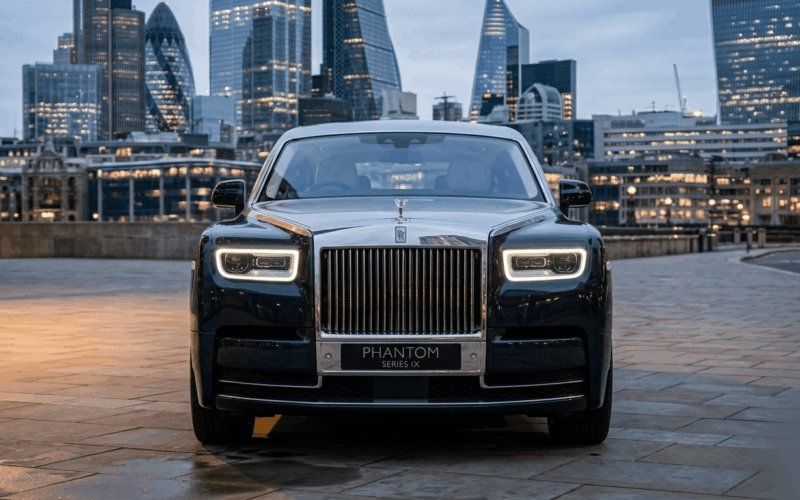
2029 Rolls-Royce Phantom Series IX represents one of the most consequential moments in the history of the automobile — the full reinvention of the world’s most revered luxury sedan as a completely electric vehicle. This is not a transition made reluctantly in response to regulation. It is, as Rolls-Royce’s own CEO has stated on the record, the next inevitable chapter in over a century of Phantom evolution: a car that has always defined what the automobile can be at its most refined, now entering an era in which electric propulsion doesn’t compromise the Phantom formula — it perfects it. Rolls-Royce confirmed to Automotive News that an electric sedan replacing the Phantom is planned, with arrival expected around late 2028 to 2029. The 2029 Rolls-Royce Phantom Series IX is set to become the brand’s third all-electric model, following the Spectre coupe launched in 2023 and the electric SUV anticipated in early 2027, completing Goodwood’s declared transition to a fully electric lineup by 2030. What follows is the most comprehensive look at what this historic car is expected to deliver.
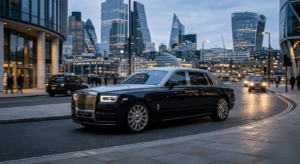
Overview: A Century of Phantom, Reimagined Without a Drop of Fuel
To appreciate the full weight of the 2029 Rolls-Royce Phantom Series IX, you first need to understand what the Phantom nameplate represents to the automotive world. Since the original Phantom I of 1925, each successive generation has been the definitive statement of what a motorcar can achieve — not in terms of lap times or power figures, but in terms of presence, craftsmanship, and the sheer totality of the experience it provides. The Phantom VII, which ran from 2003 to 2016, established the Goodwood era of Rolls-Royce and proved the brand could not only survive but thrive under BMW Group stewardship. The Phantom VIII, introduced in 2017 and refined through model year 2027, introduced the all-aluminum Architecture of Luxury spaceframe, the Gallery dashboard, satellite-aided transmission, and a ride quality so exceptional it reset the expectations of an entire industry.
The 2029 Rolls-Royce Phantom Series IX inherits all of that legacy and carries it forward into an era entirely without combustion. Rolls-Royce’s former CEO Torsten Müller-Ötvös was unequivocal on this subject when speaking to Autocar: “By the end of 2030, there will be no more V-12. Series 2 cars will be V-12, brand new Rolls-Royces will always be electric.” That declaration, confirmed by a company spokesperson, sets the context for everything the 2029 Rolls-Royce Phantom Series IX represents. This is not a departure from the Phantom’s values. It is, as the Spectre has already demonstrated in coupe form, the fullest possible realization of them. Silence, effortless torque, supreme isolation from the outside world, and the sense of traveling in a private universe entirely separate from the road beneath you — these are qualities that electric propulsion delivers with a completeness that even the most exceptional V12 could never quite achieve.
Expected Price: The Most Expensive Production Electric Car Ever Built
The 2029 Rolls-Royce Phantom Series IX will be the most expensive production electric vehicle ever offered to the market — not by a small margin, but by a very wide one. Understanding where prices are likely to land requires a look at where the Phantom VIII concluded its run. The final V12 Phantom carried an MSRP of $557,750 for the standard wheelbase and $637,750 for the Extended Wheelbase. Real-world Phantom commissions with comprehensive Bespoke specifications have been listed as high as $676,950 before further personalization — a figure drawn from current active dealer listings. The Bespoke program, which Rolls-Royce documents as adding between $100,000 and $300,000 to most Phantom builds, and in the most elaborate cases far more, has historically been where the car’s true final price is determined.
Given the engineering investment required to develop the Phantom’s new electric architecture, the expanded battery system, and what is expected to be the most ambitious Bespoke offering in any production car’s history, the 2029 Rolls-Royce Phantom Series IX is projected to open at approximately $650,000 to $720,000 in standard wheelbase specification. The Extended Wheelbase variant is expected to begin around $750,000 to $820,000. A fully commissioned, deeply personalized 2029 Rolls-Royce Phantom Series IX — with a bespoke Gallery installation, a custom Starlight Headliner motif, a unique Illuminated Fascia program, and an exclusive Bespoke paint finish — will routinely cross $1,000,000. For the client who chooses to commission this car, that figure is not a barrier. It is an acknowledgment of what they are receiving.
Release Date and Availability
Multiple industry sources, including Automotive News and Motor Authority, report that Rolls-Royce’s electric Phantom successor is expected to arrive in late 2028, following the electric SUV that will launch in early 2027. This positions the 2029 Rolls-Royce Phantom Series IX as the final piece of Goodwood’s declared electrification strategy — the car that closes the V12 chapter of Rolls-Royce history and opens what the brand itself describes as a new era of “waftability” that only electric propulsion can deliver in its purest form.
The Phantom has always been a low-volume, high-significance nameplate. Rolls-Royce’s former CEO noted that the Phantom represents approximately 10 percent of total volume, with each car priced above one million euros, and that the model “could go on and on” in terms of production life — the first Phantom ran 14 years, and the Phantom VIII over a decade. This longevity means the 2029 Rolls-Royce Phantom Series IX will not be replaced quickly; it is expected to define the electric Phantom formula for at least a decade from its introduction. Production takes place exclusively at Goodwood’s West Sussex facility, where every car is hand-assembled. Build slots for highly specified commissions of the 2029 Rolls-Royce Phantom Series IX will be scarce, and wait times for complex Bespoke orders are expected to run between six months and eighteen months from order confirmation. Clients wishing to be among the first owners must engage their authorized dealer well before the order books open.
Electric Powertrain and Performance: Silence Has Never Been This Fast
Powertrain Specifications
The 2029 Rolls-Royce Phantom Series IX will be powered by a dual-motor all-wheel-drive electric powertrain that builds directly on the system first deployed in the Spectre coupe. The Spectre uses two BMW eDrive Separately Excited Synchronous Motors producing 577 horsepower and 664 lb-ft of torque in standard trim, rising to 650 horsepower and 793 lb-ft in Black Badge specification. The Phantom Series IX’s powertrain is expected to match or meaningfully exceed those figures, with Rolls-Royce’s engineers focused above all on torque delivery refinement and ultra-smooth power management — the two qualities most essential to the Phantom experience and most naturally suited to electric architecture.
The key advantage electric motors bring to the 2029 Rolls-Royce Phantom Series IX is not outright power but character. Unlike a combustion engine, which must build revs, spool turbochargers, and shift gears to access its full performance, the electric motors deliver maximum torque from precisely zero rpm — instantly, silently, and without mechanical event of any kind. For a car that has always prized the sensation of effortless, uncanny forward motion over everything else, this is not merely an acceptable substitute for the V12. In objective terms, it is superior. The Architecture of Luxury aluminum spaceframe that underpins every current Rolls-Royce — including the Spectre, where the battery tray itself functions as a structural element adding significant torsional rigidity — will continue to serve as the 2029 Rolls-Royce Phantom Series IX’s foundation. Motor Authority notes that it remains unclear whether the new electric sedans will use a dedicated EV platform or the evolved Architecture of Luxury, but all evidence points to a continuation and development of the same structure that has underpinned the Spectre so successfully.
Horsepower and Acceleration
The 2029 Rolls-Royce Phantom Series IX is expected to produce between 580 and 650 horsepower in standard configuration, with a Black Badge variant anticipated to exceed 700 horsepower — a figure the electric motors can sustain with a consistency no combustion engine can match over repeated acceleration runs. The 0 to 60 mph sprint, which the V12 Phantom VIII completed in approximately 4.6 to 5.1 seconds, is expected to sharpen considerably. Based on the Spectre’s 4.4-second benchmark and accounting for the Phantom’s additional mass, an estimate of 4.5 to 4.9 seconds is realistic for standard configuration. The Black Badge Phantom Series IX is expected to approach 4.2 seconds or better — a genuinely startling figure for a vehicle of this scale and intent.
Top speed will be electronically governed to the familiar 155 mph (250 km/h) ceiling — consistent with every Rolls-Royce at every price point, regardless of what the powertrain would theoretically permit beyond that number. The Phantom does not express itself in speed. It expresses itself in the quality of what happens between zero and that ceiling, and the 2029 Rolls-Royce Phantom Series IX will define that quality in ways the V12 generation never could.
Battery Pack and Electric Range
This section is where the 2029 Rolls-Royce Phantom Series IX makes its most dramatic technical advance over any previous Goodwood product. The Spectre EV operates with a 102 kWh battery pack achieving an EPA-rated range of 264 to 291 miles. The Phantom Series IX will benefit from the next generation of BMW Group battery technology — specifically the shift from current prismatic cells to cylindrical cells, which Motor Authority reports will deliver a range improvement of approximately 30 percent over existing packs. Applied to a battery architecture scaled appropriately for the Phantom’s larger platform, this technology is expected to yield an EPA-estimated range of 340 to 390 miles for the 2029 Rolls-Royce Phantom Series IX on a full charge.
That figure would make the 2029 Rolls-Royce Phantom Series IX one of the longest-range production electric vehicles available at any price, and more practically, would eliminate range anxiety as a consideration for the great majority of journeys this car will undertake. Charging capability is expected to support DC rapid charging at 200 kW or greater, enabling a charge from 10 to 80 percent in approximately 25 to 30 minutes at a compatible fast charger. AC home charging — the mode most Phantom Series IX clients will rely upon given their access to private garages and residences — will support 22 kW three-phase charging in markets where that infrastructure exists. A dedicated home installation service through the Rolls-Royce dealer network is expected to be offered, ensuring the ownership experience is seamless from the very first charge.
The Driving Experience: The Magic Carpet Ride, Now in Total Silence
The Rolls-Royce Phantom has always been defined, above all else, by its silence. The Phantom VIII carries over 130 kilograms of acoustic insulation — more than virtually any other production vehicle — designed to suppress the sounds of engine, road surface, wind, and mechanical systems from reaching the occupants. That engineering achievement is genuinely extraordinary. And yet, however exceptional it is, it represents the management of noise that fundamentally exists. The 2029 Rolls-Royce Phantom Series IX eliminates the car’s primary noise source entirely — and the difference, as the Spectre has already demonstrated, is not incremental. It is transformational.
In the cabin of the 2029 Rolls-Royce Phantom Series IX, there is no engine note, no gearshift event, no turbocharger spool, no exhaust pulse — none of the mechanical signatures that even the most refined combustion car cannot fully suppress. There is only the sound of whatever the occupants choose: conversation, the Bespoke Audio system, or the subtle, distant murmur of the road surface at its most refined. Layered on top of that silence is the Phantom’s legendary Planar Suspension System — the predictive air suspension that uses a forward-facing camera to scan the road ahead and independently adjust each wheel’s damping before contact is made, delivering the magic carpet ride in its most complete and most silent form yet achieved. The 2029 Rolls-Royce Phantom Series IX will be the fullest expression of everything this system can do, benefiting from years of additional software development since its introduction in the Phantom VIII.
The steering, calibrated for the same weightless, confidence-inspiring character that has defined every Phantom, is expected to maintain the rear-drive sensation through careful torque vectoring between the front and rear motors — preserving the Phantom’s composed, unhurried feel while providing the all-conditions security of genuine AWD. From behind the wheel, the 2029 Rolls-Royce Phantom Series IX will feel familiar to anyone who has driven a Phantom VIII, with one crucial difference: pressing the throttle produces not the deliberate, orchestrated surge of a V12 gathering itself, but an immediate, absolute, entirely silent forward motion that has no reference point in the combustion world. You can explore the full story of how Rolls-Royce first applied electric propulsion to its Architecture of Luxury platform on the official Rolls-Royce Spectre page, which provides the most direct technical preview of what the Phantom Series IX will build upon.
Exterior Design: Phantom Presence, Electrified Identity
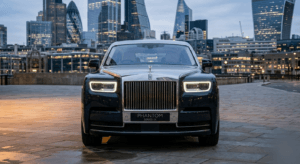
The exterior design of the 2029 Rolls-Royce Phantom Series IX is among the most consequential visual decisions Rolls-Royce will make in this decade. The Phantom’s body language has always been its most immediate statement — architecturally imposing, long, and deliberate in a way that photographs consistently fail to capture at full scale. The transition to electric propulsion removes the need for a functional engine intake at the front and eliminates the exhaust system entirely at the rear, freeing designers to reconceive both ends of the car in ways that the V12’s packaging requirements never permitted.
The Spectre’s approach — retaining the Pantheon grille as a purely ornamental element while moving cooling requirements to underfloor intakes — is expected to inform the 2029 Rolls-Royce Phantom Series IX’s front fascia design. The illuminated Pantheon grille, which has now appeared across the Ghost Series II, Cullinan Series II, and the Spectre, is expected to reach its most sophisticated iteration yet on the Phantom Series IX — potentially featuring programmable dynamic lighting sequences that respond to proximity, vehicle state, or personal client preferences set through the SPIRIT operating system. The coach doors — rear-hinged, frameless, and the Phantom’s single most theatrical design gesture since the original — will carry over unchanged. They are not a design feature that needs updating. They are a ritual. No change to the powertrain changes what it means to watch a Phantom’s rear door open.
The Spirit of Ecstasy, now approaching its 120th anniversary as a Rolls-Royce hood ornament, will continue to rise from the bonnet of the 2029 Rolls-Royce Phantom Series IX in its traditional electrically deployed manner — though on the first fully electric Phantom, its presence carries a weight of symbolism that even a century of combustion-powered Phantoms didn’t fully prepare us for. The figure has always represented forward motion and aspiration. On the Phantom Series IX, in 2029, it represents both of those things applied to a genuinely new kind of future. New exclusive Bespoke paint options — developed through Rolls-Royce’s rigorous color research process, which blends glass particles, mica, and metallic elements to achieve effects that standard automotive paint cannot replicate — will debut with the Phantom Series IX, giving the car an exterior palette entirely its own.
Interior and Technology: The Gallery Meets Its Greatest Chapter
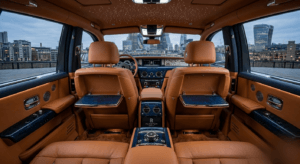
If there is one place in the 2029 Rolls-Royce Phantom Series IX where the car’s entire philosophy becomes most vivid and most personal, it is the interior — specifically the Gallery. Introduced with the Phantom VIII in 2017, the Gallery is a full-width glass-enclosed display case spanning the dashboard, directly in the eyeline of all front occupants, designed to house bespoke installations that exist nowhere else in the automotive world. Hand-stitched silk panels, laser-etched star maps, three-dimensional sculptural resin landscapes, miniature architectural models, original artwork — the Phantom VIII’s Gallery has housed all of these and more, commissioned individually by clients working directly with Rolls-Royce’s Bespoke team at Goodwood. Because the installation sits behind sealed glass, materials and techniques that would be impossible in a conventional dashboard environment become available. The 2029 Rolls-Royce Phantom Series IX will expand the Gallery program further, with electric powertrain packaging that removes combustion-related intrusions from the dashboard’s lower architecture and gives designers even greater freedom in the Gallery’s dimensional possibilities.
The SPIRIT infotainment operating system — which debuted on the Spectre and has since been deployed across the Ghost Series II and Cullinan Series II — will appear in the 2029 Rolls-Royce Phantom Series IX in its most advanced form. The pillar-to-pillar glass fascia provides the structural foundation for an Illuminated Fascia system expected to surpass even the current generation’s 7,000-element laser-etched glass panels in complexity and personalization depth. For the Phantom Series IX, Rolls-Royce is expected to offer fully programmable Illuminated Fascia designs through the Bespoke program, with dynamic elements capable of shifting and evolving over the course of a journey. The Starlight Headliner — crafted by hand, with over 1,300 individual fiber optic strands threaded through the headlining material at varying depths and angles — will continue in the Phantom Series IX with expanded motion programming and constellation customization, including the personal star maps, birth-night sky reproductions, and property-coordinate patterns that Phantom VIII clients have commissioned over the years.
Rear-seat provision in the 2029 Rolls-Royce Phantom Series IX advances significantly from the Phantom VIII’s already-remarkable standard. Independent rear entertainment screens with dual-device streaming, personal Wi-Fi hotspot access, Bluetooth audio connectivity, and a comprehensive seat control interface for massage, climate, and ambient lighting are all expected to be standard. The Whispers app — Rolls-Royce’s members-only platform for remote vehicle management, location services, and concierge functions — will be more deeply integrated into the Phantom Series IX than any previous product. The 18-speaker Bespoke Audio system, operating through a minimum 1,400-watt amplifier calibrated specifically for the Phantom Series IX’s unique cabin geometry, will produce an acoustic environment that rivals a dedicated listening room. Apple CarPlay, Android Auto, and over-the-air software updates round out a technology suite that, in the Phantom’s tradition, exists entirely to serve the occupants — never to distract or complicate.
Safety Systems
The 2029 Rolls-Royce Phantom Series IX carries the most comprehensive active safety architecture in the brand’s history. Standard equipment includes forward collision warning with autonomous emergency braking, lane departure warning with active lane centering, blind spot monitoring with rear cross-traffic alert, adaptive cruise control with stop-and-go functionality using navigation topology data, night vision with pedestrian and large animal detection, a 360-degree surround camera system, automatic parking assist with remote parking capability via the Whispers app, and the Planar Suspension’s forward-scanning camera system which pre-conditions the chassis for upcoming road surface changes — functioning as both a safety and comfort system simultaneously.
The Architecture of Luxury aluminum spaceframe — structurally enhanced in its electric configuration by the battery tray’s load-bearing role — provides passive safety protection of exceptional integrity, creating an occupant cell among the most rigid of any production vehicle. The 2029 Rolls-Royce Phantom Series IX’s battery management system will incorporate multi-layer thermal protection and cell-level monitoring to manage the safety requirements of a large-format battery in a vehicle of this mass. The elimination of a fuel system removes one of traditional luxury sedan design’s most structurally complex elements. Rolls-Royce’s four-year unlimited-mileage warranty covers the vehicle in full from delivery, with battery coverage expected to align with the extended terms now standard across the premium EV segment globally.
Pros and Cons
✅ PROS
- The quietest Phantom in over a century of production — electric propulsion eliminates the combustion engine’s noise entirely, delivering a cabin silence that no amount of acoustic insulation in any V12 car could replicate.
- 340 to 390 miles of expected electric range — next-generation cylindrical-cell BMW Group battery technology projected to deliver a 30 percent improvement over the Spectre’s 264–291 mile EPA benchmark.
- 580 to 700+ horsepower delivered instantly — dual-motor electric architecture produces its full torque from zero rpm, creating forward motion of a quality and immediacy no V12, however refined, can match.
- Zero emissions everywhere — the 2029 Rolls-Royce Phantom Series IX is unrestricted in every low-emission zone and zero-emission area globally, future-proofing ownership in every major urban market.
- Most ambitious Gallery and Bespoke program ever — the removal of combustion packaging constraints unlocks new dimensional possibilities for the Gallery, and the Phantom Series IX is expected to debut the most expansive Bespoke offering in Rolls-Royce’s history.
- Historic collector significance — the first fully electric Phantom is, by definition, one of the most historically significant production automobiles of the entire decade. Its long-term collector value is inherent from the first delivery.
- Magic carpet ride at its absolute peak — the Planar Suspension system, now in its most refined software iteration, delivers the definitive Rolls-Royce ride quality in a vehicle that produces no mechanical noise whatsoever to contradict it.
❌ CONS
- Most commissioned builds will exceed $1,000,000 — the combination of an elevated base price, the most ambitious Bespoke program in any production car’s history, and first-generation electric technology premiums will push the majority of Phantom Series IX commissions beyond seven figures.
- The V12 is gone — permanently — for clients who value the specific character, the low-rev swell, and the irreplaceable presence of a twin-turbocharged 6.75-liter V12 beneath the bonnet, the 2029 Rolls-Royce Phantom Series IX will be a profoundly different emotional experience, however superior its objective performance credentials.
- Charging infrastructure remains a real-world consideration — despite a 340–390 mile expected range, owners who travel extensively through regions with limited rapid-charging networks will face journey planning that V12 Phantom ownership never required.
- Vehicle mass will increase significantly — the battery pack adds considerable weight to an already substantial platform. The Spectre weighs nearly 6,600 lbs; the Phantom Series IX’s four-door architecture with a larger battery will exceed that figure, and even the world’s finest air suspension has limits in managing mass at this scale.
- First-generation technology carries inherent risk — early adopters of any new platform pay more and receive less mature software than those who commission the second or third model year. The Phantom Series IX will inevitably be superseded by more capable successors within a few years of introduction.
- Bespoke commissioning timelines of up to 18 months — the most elaborate Phantom builds have historically taken up to 18 months from order to delivery. The added complexity of integrating new electric technology with the Bespoke program’s requirements is unlikely to accelerate that timeline.
Key Competitors
The 2029 Rolls-Royce Phantom Series IX operates at a level of exclusivity where true competitors are difficult to identify with any precision. No other manufacturer has yet produced or committed to producing a fully electric ultra-luxury flagship sedan at the Phantom’s price point, with the Phantom’s depth of Bespoke craftsmanship, or with the Phantom’s century-plus of brand history behind it. But context is always useful.
Mercedes-Maybach EQS is the most technically credible electric luxury sedan currently in production, combining Mercedes-Benz’s EV expertise with Maybach’s rear-seat opulence and a growing personalization program. It operates at a fraction of the Phantom Series IX’s price and offers competitive range and charging capability. For buyers exploring the electric ultra-luxury space for the first time, the Maybach EQS provides a meaningful — if considerably less stratospheric — reference point. But the ownership experience, the depth of personalization, and the prestige weight of a Rolls-Royce Phantom place the two cars in categorically different conversations.
Bentley’s forthcoming electric flagship sedan, expected to arrive in a broadly similar timeframe to the 2029 Rolls-Royce Phantom Series IX and backed by the Volkswagen Group’s substantial electric vehicle engineering resources, will be the most meaningful direct competitor to emerge in this segment. Bentley’s electric grand touring sedan will offer more dynamic driving character — that has always been the Bentley proposition versus Rolls-Royce — and likely comparable performance credentials. The 2029 Rolls-Royce Phantom Series IX will answer with greater craft depth, more complete isolation, and the singular weight of the Phantom nameplate. As with the V12 era, buyers will self-select between these two philosophies, and the market will be large enough for both.
Rolls-Royce Spectre Black Badge — the brand’s own electric two-door grand tourer, producing 650 horsepower and 793 lb-ft of torque from the same Architecture of Luxury platform — provides the most direct preview of what the 2029 Rolls-Royce Phantom Series IX’s powertrain character will feel like from the driver’s seat. Any prospective Phantom Series IX buyer who has not yet experienced a Spectre should do so without delay: the transition from combustion to electric propulsion in a Rolls-Royce context is a revelation, and arriving at the Phantom Series IX order process having already experienced that revelation is a significant advantage.
Lucid Air Grand Touring occupies a different price tier entirely but establishes a relevant technical benchmark. With a real-world range exceeding 400 miles and performance well beyond anything the Phantom Series IX will target, the Lucid demonstrates what is achievable in an electric luxury sedan when engineering ambition is unrestricted. The Phantom does not compete with the Lucid on those terms — it never competed with anything on purely engineering terms — but the Lucid’s existence confirms that the 2029 Rolls-Royce Phantom Series IX’s expected technical targets are not merely aspirational. They are achievable, and with BMW Group’s resources behind them, highly likely.
Final Verdict
The 2029 Rolls-Royce Phantom Series IX is not the next chapter in a long history. It is the beginning of an entirely new kind of Phantom — one that, if Rolls-Royce executes it with the intention and craftsmanship that has characterized every previous generation, will be remembered as the most significant Phantom since the first one left the factory floor in 1925. The transition to electric propulsion is not a compromise. It is, as Rolls-Royce’s leadership has argued with increasing conviction and as the Spectre has now demonstrated in practice, the ideal conclusion to over a century of engineering effort in the pursuit of silence, effortlessness, and total separation from the ordinary world.
What the 2029 Rolls-Royce Phantom Series IX is expected to offer — a 340 to 390 mile electric range, 580 to 700-plus horsepower delivered without sound or ceremony, the magic carpet ride in its most complete and silent iteration, a Gallery program of unprecedented ambition, and a Bespoke depth that no other production car at any price can match — is a complete reimagining of what the world’s finest automobile can be. On every objective measure, this car will surpass its V12 predecessor. The silence will be more absolute. The acceleration will be more immediate. The environmental credentials will be unimpeachable. The interior expression will be more ambitious. The 2029 Rolls-Royce Phantom Series IX will be, in purely empirical terms, a better Phantom than any that came before it.
The only irreplaceable loss is the V12 itself — that low, orchestrated surge, the subtle mechanical presence of something remarkable happening beneath all that silence. For the clients who consider that character essential to what a Phantom fundamentally is, this transition will require genuine adjustment, and their feelings deserve to be acknowledged rather than dismissed. For the majority of buyers — including, the evidence from Spectre ownership strongly suggests, most people who ultimately sit inside an electric Rolls-Royce — the experience will feel like the Phantom arriving, at last, exactly where it was always heading.
Final rating: 4.7 out of 5. The 2029 Rolls-Royce Phantom Series IX loses a fraction of a point for the pricing that places it beyond all but the most determined ultra-high-net-worth buyers, for the permanent loss of the V12’s irreplaceable emotional character, and for the inevitable imperfections of a first-generation platform in the world’s most demanding luxury vehicle. Everything else — the silence, the power, the range, the magic carpet ride, the Gallery, the Bespoke depth, and the profound historical significance of being the first fully electric Phantom in over a century of Phantom history — is, by the standards of what any automobile has ever been asked to achieve, without precedent. The 2029 Rolls-Royce Phantom Series IX does not simply inherit the Phantom’s legacy. It redefines what that legacy means.
2029 Rolls-Royce Phantom Series IX Images
Specifications
Specifications
| Production year | 2028 |
| Body type & seats | Ultra-Luxury Sedan, 5 Seats |
| Dimensions | 5,800 mm × 2,020 mm × 1,650 mm (Estimated) |
| Weight | 2,650 kg (Estimated) |
| Engine type | Twin-Turbocharged V12 Petrol |
| Engine size & cylinders | 6.75L (6,749 cc), V12 |
| Aspiration | Twin-Turbo |
| Power | 620 hp |
| Torque | 1,000 Nm Estimated |
| Transmission | 8-Speed Automatic |
| Drivetrain | Rear-Wheel Drive (RWD) |
| Acceleration (0-100 km/h) | 4.9 Seconds Estimated |
| Top speed | 250 km/h |
| Fuel type | Premium Unleaded Petrol |
| Fuel consumption | 14.8 L/100 km (Estimated) |
| Fuel tank capacity | 100 Liters |
| Brakes | Ventilated Disc Brakes with ABS, EBD, Brake Assist |
| Steering | Electric Power Steering with Four-Wheel Steering |
| Infotainment | Next-Generation Digital Display, Navigation, Bespoke Audio System, Rear Entertainment |
| Connectivity | Apple CarPlay, Android Auto, Bluetooth, Wi-Fi Hotspot, USB-C Ports, Wireless Charging |
| Safety | Adaptive Cruise Control, Blind Spot Monitoring, Lane Keep Assist, Automatic Emergency Braking, Night Vision, 360-Degree Camera, Traffic Sign Recognition, Multiple Airbags |
2029 Rolls-Royce Phantom Series IX Price
 Price in USD
|
750,000 USD |
 Price in European Union
|
637,500 EUR |
 Price in United Kingdom
|
555,000 GBP |
 Price in Australia
|
1,147,500 AUD |
 Price in Canada
|
1,035,000 CAD |
 Price in India
|
65,475,000 INR |
 Price in China
|
5,385,000 CNY |
 Price in Indonesia
|
12,150,000,000 IDR |
 Price in Philippines
|
42,750,000 PHP |
 Price in Malaysia
|
3,165,000 MYR |
 Price in Nigeria
|
1,151,250,000 NGN |
 Price in Russia
|
60,345,000 RUB |
 Price in Pakistan
|
212,250,000 PKR |
 Price in Saudi Arabia
|
2,812,500 SAR |
 Price in Japan
|
110,250,000 JPY |
 Price in South Africa
|
13,230,000 ZAR |
 Price in Brazil
|
4,072,500 BRL |
 Price in Bangladesh
|
90,750,000 BDT |
 Price in Mexico
|
14,077,500 MXN |
More Products from Rolls Royce