- Home
- Rolls Royce
- 2028 Rolls-Royce Phantom Black Badge
2028 Rolls-Royce Phantom Black Badge: Price, Performance, Specs, and Features
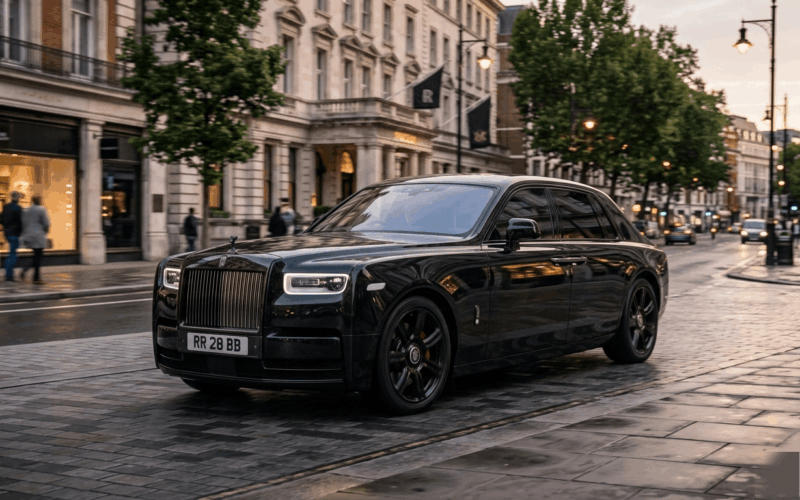
2028 Rolls-Royce Phantom Black Badge is not simply a car. It is a declaration — a rolling statement from a manufacturer that has spent over a century perfecting the art of the automobile, now filtered through the most subversive and deliberately rebellious identity in the Goodwood lineup. The 2028 Rolls-Royce Phantom Black Badge takes the already-extraordinary Phantom VIII platform and pushes it into darker, more aggressive territory, while somehow managing to retain every molecule of the grace and presence that has made the Phantom the undisputed benchmark for ultra-luxury motoring since its introduction in 2003. This is the car for the person who finds the standard Phantom slightly too polished, too deferential — and who wants something with a little more shadow in its soul.
Overview: The World’s Finest Car, Dressed in Darkness
To understand what makes the 2028 Rolls-Royce Phantom Black Badge so compelling, you first have to understand the standard Phantom itself. The Phantom VIII — the current generation that has been continuously refined since its launch in 2017 — represents the absolute pinnacle of what any automobile manufacturer has ever produced. It is the car that other luxury brands measure themselves against and invariably fall short of. The space-frame aluminum architecture, the satellite-aided eight-speed transmission, the acoustically engineered cabin that registers near-zero noise at motorway speeds, the Gallery dashboard that functions as a literal glass-enclosed display case — these are not engineering achievements confined to the Rolls-Royce world. They set a standard the entire industry aspires to.
The Black Badge program, introduced by Rolls-Royce in 2016, takes that foundation and redefines it for a different kind of client. Where the standard Phantom speaks quietly with immense authority, the 2028 Rolls-Royce Phantom Black Badge speaks with a lower, more deliberate register. More power, darker aesthetics, more assertive presence — not louder, exactly, but considerably less willing to remain in the background. Rolls-Royce describes Black Badge as the brand’s “alter ego,” and that description has never felt more apt than it does with the Phantom wearing it.
Expected Price: The Cost of Ultimate Darkness
The 2028 Rolls-Royce Phantom Black Badge will not carry a window sticker in any conventional sense of the term. Pricing for Rolls-Royce vehicles is always a starting point, not a destination, and the Phantom’s Bespoke program means no two cars are priced identically. That said, the numbers are instructive.
The standard 2027 Rolls-Royce Phantom carries an MSRP of $557,750, with the Extended Wheelbase beginning at $637,750. The Black Badge designation historically adds a meaningful premium above those figures — typically in the range of $40,000 to $70,000 over the equivalent standard model — placing the 2028 Rolls-Royce Phantom Black Badge at an estimated starting price of approximately $595,000 to $630,000 before any Bespoke customization. And with the Phantom, Bespoke is never truly optional. Most clients commission interiors, paint finishes, Gallery installations, and Starlight Headliner configurations that can add anywhere from $50,000 to several hundred thousand dollars on top of the base figure. A fully realized, thoroughly bespoke 2028 Rolls-Royce Phantom Black Badge will comfortably exceed $800,000 — and will be worth every penny to the person who orders it.
Release Date and Availability
The Phantom VIII platform has proven extraordinarily durable — it has been in continuous production since 2017 with regular refinements, and the 2028 model year represents the continued evolution of one of the most successful luxury flagships in recent automotive history. The 2028 Rolls-Royce Phantom Black Badge will follow the same annual production cadence as previous Black Badge Phantom models, with order books typically opening in mid-2027 for 2028 model year deliveries.
It’s worth noting that Rolls-Royce has signaled the Phantom’s eventual transition toward a fully electric successor, which makes the current generation’s remaining V12-powered years especially significant. For buyers who value the internal combustion experience — the low-rev, effortless surge of a twin-turbocharged 6.75-liter V12 — the 2028 Rolls-Royce Phantom Black Badge may represent one of the last opportunities to commission a Phantom with that engine in it. That reality is not lost on Rolls-Royce’s clientele, and it’s adding a layer of urgency to commissions that didn’t exist a few years ago.
Engine and Performance: The V12 Gets Darker and More Powerful
Powertrain Specifications
Every Rolls-Royce Phantom is powered by a bespoke twin-turbocharged 6.75-liter V12 engine — the same architecture that has been at the heart of the Goodwood marque for generations, though continuously developed and refined in its current form. In standard Phantom specification, this engine delivers 563 horsepower and 664 lb-ft of torque. The numbers alone barely hint at the character of the unit. This is an engine that makes its power in an almost orchestrated manner — smooth, building, and overwhelming in a way that never feels sudden or aggressive despite the forces involved.
The 2028 Rolls-Royce Phantom Black Badge upgrades that output meaningfully. Rolls-Royce’s engineers recalibrate the engine management system and remap the V12 to extract additional performance while preserving the characteristic delivery. The result is an increase in both power and torque — with Black Badge Phantom models historically tuned for greater urgency in response to throttle inputs and a more eager character through the rev range. The transmission also receives a recalibration, enabling faster gear changes and keeping the engine in its powerband more aggressively when the driver demands it. The standard Phantom uses rear-wheel drive, and the Black Badge retains that architecture — a choice that contributes significantly to the car’s composed, unhurried sense of motion even when covering ground at speed.
Horsepower and Acceleration
The 2028 Rolls-Royce Phantom Black Badge is not a car you purchase for straight-line performance metrics, and yet its numbers are genuinely impressive. The standard Phantom VIII dispatches 0 to 60 mph in approximately 4.6 to 5.1 seconds depending on conditions — extraordinary for a car weighing nearly 6,000 pounds. The Black Badge tuning, with its more aggressive engine mapping and faster transmission behavior, sharpens that figure meaningfully, with real-world acceleration feel that consistently surprises drivers who approach the Phantom expecting a vehicle with the sporting character of a living room sofa.
Top speed is electronically limited to 155 mph (250 km/h) — a figure that feels simultaneously conservative and unnecessary. The V12 in the 2028 Rolls-Royce Phantom Black Badge is perfectly willing to continue beyond that number; Rolls-Royce simply doesn’t believe its clients need to find out for themselves. The decision is both practical and characteristically British in its understatement.
Fuel Consumption
The Phantom’s V12 engine is not designed with economy as a primary objective, and the numbers reflect that honestly. The standard Phantom VIII is rated at approximately 11 mpg city / 19 mpg highway, with a combined figure hovering around 13–14 mpg. The Black Badge’s more aggressive tuning may reduce city economy marginally, though highway figures remain largely comparable. For the owner of a 2028 Rolls-Royce Phantom Black Badge, fuel costs are not a factor in the purchase decision — but the figures are worth noting for any buyer operating in markets with stringent emissions regulations or congestion charges.
Battery and Electrification
The 2028 Rolls-Royce Phantom Black Badge is a pure internal combustion vehicle. There is no hybrid system, no battery pack, and no plug-in option for this generation of the Phantom. The V12 is the only powertrain available, and Rolls-Royce has been transparent about the fact that a future all-electric Phantom successor is in development. The current ICE Phantom — including the 2028 Rolls-Royce Phantom Black Badge — represents the final expression of a V12-powered Goodwood flagship, a distinction that carries enormous historical and emotional weight for collectors and enthusiasts alike.
The Driving Experience: Effortless, Imperial, and Unexpectedly Engaging
There is a widely held misconception that the Rolls-Royce Phantom is a car for being driven, not driving. That the person behind the wheel is somehow incidental to the experience. That misunderstanding evaporates approximately thirty seconds into your first drive in a Phantom Black Badge.
The 2028 Rolls-Royce Phantom Black Badge sits on the same space-frame aluminum spaceframe architecture as the standard Phantom, with an air suspension system that uses a forward-facing camera to read the road surface ahead and pre-emptively adjust damping for each wheel independently before the tire makes contact. The effect is the Phantom’s legendary “magic carpet ride” — a sensation so complete and so unlike anything else in the automotive world that first-time Phantom drivers often describe it as genuinely disorienting. The car seems to float rather than drive, to hover over road imperfections rather than absorb them.
The Black Badge configuration layers additional engagement onto that platform. The steering is calibrated to feel marginally more responsive, the throttle mapping more immediate, and the character of the V12 more present and communicative. None of this comes at the expense of the Phantom’s fundamental grace — the magic carpet remains entirely intact — but the 2028 Rolls-Royce Phantom Black Badge has an energy about it that the standard car, deliberately, does not. You can read more about the Phantom’s engineering and the full scope of the Black Badge program on the official Rolls-Royce Motor Cars website.
Exterior Design: Every Chrome Surface Turned to Shadow
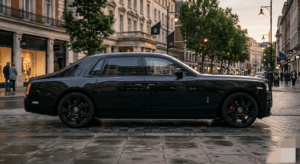
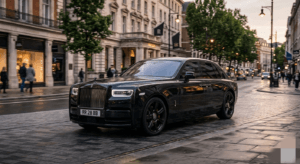
The visual transformation of the 2028 Rolls-Royce Phantom Black Badge begins with an obsessive attention to surface treatment. Where the standard Phantom deploys chrome generously — on the Pantheon grille, the Spirit of Ecstasy hood ornament, the window surrounds, the door handles — the Black Badge replaces all of it with darkened finishes produced through a process so precise it measures in single micrometers. The Spirit of Ecstasy and the Pantheon grille are not painted black; they are darkened through a proprietary chemical process that preserves the sharpness of every detail while eliminating all reflectivity. The final coat thickness is, remarkably, just one micrometer — approximately one hundredth of the width of a human hair.
The 2028 Rolls-Royce Phantom Black Badge also features the marque’s signature Black Badge wheel options — including three-dimensional milled stainless steel designs with dark angular facets and the dramatic disc wheel that recalls the golden era of Rolls-Royce racing history. Both options are available in fully or partially polished configurations, giving clients the ability to fine-tune the balance between darkness and light on the car’s exterior. The result is a Phantom that reads as simultaneously more menacing and more refined than the standard car — not louder, but distinctly more intentional.
Exterior color options for the 2028 Rolls-Royce Phantom Black Badge draw from the full Rolls-Royce palette — more than 44,000 paint color possibilities through the Bespoke program — though Black Badge clients tend toward deep jewel tones, midnight blues, and the marque’s signature shadow finishes that amplify the model’s inherently dramatic presence. The coach doors, that most recognizable of Phantom signatures, remain rear-hinged and frameless, opening to reveal the interior in a single, theatrical gesture that never loses its impact regardless of how many times you’ve seen it.
Interior and Technology: The Gallery, the Stars, and the Silence
If the exterior of the 2028 Rolls-Royce Phantom Black Badge is a statement, the interior is the argument. No other car in production — at any price — offers the Phantom’s combination of craftsmanship, personalization depth, and sheer sensory impact. And in Black Badge specification, every element of that interior takes on additional character.
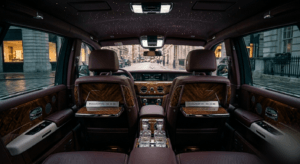
The Phantom’s signature Gallery — a glass-enclosed display case spanning the full width of the dashboard, positioned directly in the occupants’ line of sight — is the most structurally unique interior feature in the automotive world. In the 2028 Rolls-Royce Phantom Black Badge, the Gallery becomes a canvas for some of the most extraordinary bespoke commissions Rolls-Royce has ever produced: hand-stitched silk panels, laser-etched star maps, three-dimensional sculptural installations, translucent resin landscapes. The Gallery’s glass case means the installation is protected from the environment entirely, allowing materials and techniques that would be impossible in a conventional dashboard setting.
Above the occupants, the Starlight Headliner — created by Rolls-Royce craftspeople who hand-thread individual fiber optic strands through the headlining material at varying depths and angles to produce light that escapes in multiple directions and at different intensities — creates the illusion of a private sky. In Black Badge specification, the headliner’s constellation is uniquely configured for each client, with shooting star sequences and brightness adjustable to suit the mood of the journey. The 2028 Rolls-Royce Phantom Black Badge can accommodate headliner configurations of over 1,000 individual fiber optic points in elaborate custom patterns — sky maps of meaningful dates, constellation arrangements based on the owner’s birthplace, or purely abstract designs developed in collaboration with Rolls-Royce’s Bespoke team.
Technology, in the Phantom’s world, is always subordinate to craft. The satellite-aided transmission uses GPS data to anticipate gear changes based on upcoming road topology — selecting the optimal ratio before a corner begins, not in response to it. The dashboard fascia in Black Badge configuration is illuminated with over 850 individual light points that extend the starlight constellation from the headliner down into the dashboard itself, creating a visual continuity between ceiling and fascia that feels more art installation than automotive interior. Apple CarPlay, adaptive cruise control, lane departure warning, a bespoke Rolls-Royce audio system developed specifically for the Phantom’s acoustic profile, and the marque’s night vision system are all standard. In the 2028 Rolls-Royce Phantom Black Badge, technology serves the experience — it is never allowed to define it.
Safety Systems
The 2028 Rolls-Royce Phantom Black Badge carries the full safety suite that Rolls-Royce has developed for the Phantom VIII platform. This includes a forward collision warning system, lane departure warning, blind spot monitoring with rear cross-traffic alert, night vision with pedestrian detection, and a reversing camera system with 360-degree parking assistance. The air suspension’s forward-scanning camera system also contributes meaningfully to active safety, preparing the chassis for road surface changes before they occur — which improves stability in unexpected situations as well as comfort.
The Phantom’s structural architecture — an all-aluminum space-frame that is among the most rigid in any passenger car — provides the passive safety foundation for all of this. The cabin’s extraordinary acoustic insulation, which includes over 130 kilograms of sound-deadening material, means that the occupants are sealed from the outside world in a way that also contributes to a sense of security few other vehicles can match. Rolls-Royce’s four-year unlimited-mileage warranty covers the vehicle in full.
Pros and Cons
✅ PROS
- The ultimate expression of the world’s finest car — no other vehicle combines the Phantom’s engineering excellence with Black Badge’s assertive character.
- Darkened aesthetics are genuinely striking — the one-micrometer black treatment of all chrome elements gives the Phantom a presence that the standard car, deliberately, avoids.
- More urgent V12 performance — the Black Badge engine recalibration delivers noticeably sharper throttle response and faster gear changes without compromising the iconic delivery character.
- The Gallery interior system — no other automotive interior in the world offers this level of genuine craftsmanship or this degree of personal expression.
- Last of the V12 Phantoms — with an electric successor on the horizon, the 2028 Rolls-Royce Phantom Black Badge carries increasing collector significance.
- Magic carpet ride fully intact — despite Black Badge’s more dynamic calibration, the Phantom’s legendary floating sensation is preserved completely.
- Unlimited Bespoke personalization — over 44,000 color options and a Bespoke program with effectively no design limits mean this car is truly one of one.
❌ CONS
- Price is prohibitive — a fully specced 2028 Rolls-Royce Phantom Black Badge can exceed $800,000, placing it beyond even most high-net-worth buyers without careful planning.
- Rear-wheel drive only — unlike the Ghost, the Phantom does not offer AWD, which will matter to buyers in northern climates or those seeking maximum all-weather confidence.
- No electrification — the pure ICE powertrain will limit ownership appeal in markets with zero-emission zones or escalating emissions taxation.
- Size creates practical limitations — at nearly 20 feet long, the Phantom is simply too large for many urban environments, tight parking structures, and narrow European roads.
- Long lead times — bespoke commissions routinely require six to twelve months from order placement to delivery, which is not a concern for every buyer but is worth knowing.
- Running costs are significant — beyond the purchase price, insurance, maintenance, and specialist service costs place the Phantom firmly in the realm of serious ongoing financial commitment.
Key Competitors
The 2028 Rolls-Royce Phantom Black Badge occupies competitive space so rarefied that the word “competitor” barely applies. There is no other car in production that can genuinely claim to rival the Phantom on its own terms. But context is useful.
Bentley Mulsanne was the most natural Phantom rival for decades, but Bentley discontinued the Mulsanne in 2020, leaving the Phantom without its most credible adversary. The Bentley Flying Spur, while a magnificent car in its own right, operates in a different segment — more driver-focused, more athletic, less imperial in its intentions. A Flying Spur Black Edition competes in spirit but not in scale or prestige hierarchy.
Mercedes-Maybach S-Class Haute Voiture represents the most serious factory-built alternative to the Phantom’s proposition, offering Maybach’s signature rear-compartment luxury and a growing bespoke program in a car that starts at a fraction of the Phantom’s price. For buyers who want Phantom-adjacent luxury without the Phantom’s investment, the Maybach is a compelling argument — though those who have experienced both tend to describe the gap between them as wider than the price difference suggests.
Rolls-Royce Phantom Extended Wheelbase — the standard car, without the Black Badge treatment — is itself a meaningful consideration. For buyers who want maximum rear-seat grandeur without the darker aesthetic character of Black Badge, the Phantom EWB offers an additional 220mm of rear passenger space and an even more palatial sense of occasion. The 2028 Rolls-Royce Phantom Black Badge and the Phantom EWB serve genuinely different purposes, even for the same buyer.
Rolls-Royce Phantom Bespoke Private Collection models — one-off commissions produced by Rolls-Royce’s own Bespoke team — represent perhaps the most direct philosophical competition to the Black Badge, offering radical individuality without the sportier Black Badge character. For collectors more interested in artistry than performance character, the standard Phantom with a deep Bespoke commission occasionally produces results that rival the Black Badge’s drama without the darkness.
Final Verdict
The 2028 Rolls-Royce Phantom Black Badge is one of the most singular automotive objects on earth. It is not the fastest car at any price. It is not the most technologically advanced. It does not lap a circuit particularly quickly, and it was never asked to. What it is, with a completeness and confidence that no other manufacturer comes close to matching, is the most extraordinary expression of personal luxury and craftsmanship that the automobile as an art form has ever produced — now wrapped in a darker, more deliberately provocative character that makes it feel contemporary in a way that previous generations of the Phantom did not always manage.
The V12 is sublime. The ride quality is genuinely unlike anything else in production. The interior, in Black Badge specification with a well-considered Bespoke commission, transcends the automotive category entirely — it becomes closer to architecture or furniture design than to anything you’d expect to find inside a vehicle. Sitting in the rear of a well-specced 2028 Rolls-Royce Phantom Black Badge, with the Starlight Headliner above and the darkened Gallery ahead, while the V12 moves two and a half tons of aluminum and leather with the effort of a sigh — that is an experience with no equivalent anywhere in the automotive world.
The case against the 2028 Rolls-Royce Phantom Black Badge is simple: the price is extraordinary, the running costs are substantial, and the rear-wheel-drive-only powertrain limits all-weather usability in a way the Ghost doesn’t. For buyers in snowy climates or congestion-charge zones, those are real considerations.
The case for it is also simple, and considerably more powerful: there is nothing else like it. There has never been anything like it. And with the V12 Phantom’s days numbered, the 2028 Rolls-Royce Phantom Black Badge may be among the last of its kind to ever be made. That alone — independent of everything else it represents — makes it one of the most important automobiles you can commission right now.
Final rating: 4.6 out of 5. Points are withheld for the rear-wheel-drive limitation, the absence of any electrification option for emissions-sensitive markets, and a price that even by the standards of extreme luxury requires a moment of careful reflection. Everything else about the 2028 Rolls-Royce Phantom Black Badge is, without reservation, the finest of its kind.
2028 Rolls-Royce Phantom Black Badge Images
Specifications
Specifications
| Production year | 2028 |
| Body type & seats | Ultra-Luxury Sedan, 5 Seats |
| Dimensions | 5,762 mm × 2,018 mm × 1,646 mm |
| Weight | 2,700 kg |
| Engine type | Twin-Turbocharged V12 Petrol |
| Engine size & cylinders | 6.75L (6,749 cc), V12 |
| Aspiration | Twin-Turbo |
| Power | 600 hp |
| Torque | 950 Nm |
| Transmission | 8-Speed Automatic |
| Drivetrain | Rear-Wheel Drive (RWD) |
| Acceleration (0-100 km/h) | 5.0 Seconds Estimated |
| Top speed | 250 km/h |
| Fuel type | Premium Unleaded Petrol |
| Fuel consumption | 15.5 L/100 km |
| Fuel tank capacity | 100 Liters |
| Brakes | Ventilated Disc Brakes with ABS, EBD, Brake Assist |
| Steering | Electric Power Steering with Four-Wheel Steering |
| Infotainment | Digital Instrument Cluster, Navigation System, Bespoke Audio System, Rear Entertainment Screens |
| Connectivity | Apple CarPlay, Bluetooth, Wi-Fi Hotspot, USB-C Ports, Wireless Charging, Voice Control |
| Safety | Adaptive Cruise Control, Blind Spot Monitoring, Lane Departure Warning, Automatic Emergency Braking, Night Vision, 360-Degree Camera, Traffic Sign Recognition, Parking Assist, Multiple Airbags |
2028 Rolls-Royce Phantom Black Badge Price
 Price in USD
|
650,000 USD |
 Price in European Union
|
552,500 EUR |
 Price in United Kingdom
|
481,000 GBP |
 Price in Australia
|
994,500 AUD |
 Price in Canada
|
897,000 CAD |
 Price in India
|
56,745,000 INR |
 Price in China
|
4,667,000 CNY |
 Price in Indonesia
|
10,530,000,000 IDR |
 Price in Philippines
|
37,050,000 PHP |
 Price in Malaysia
|
2,743,000 MYR |
 Price in Nigeria
|
997,750,000 NGN |
 Price in Russia
|
52,299,000 RUB |
 Price in Pakistan
|
183,950,000 PKR |
 Price in Saudi Arabia
|
2,437,500 SAR |
 Price in Japan
|
95,550,000 JPY |
 Price in South Africa
|
11,466,000 ZAR |
 Price in Brazil
|
3,529,500 BRL |
 Price in Bangladesh
|
78,650,000 BDT |
 Price in Mexico
|
12,200,500 MXN |
More Products from Rolls Royce