2028 Nissan Magnite Review: Nissan’s Value SUV Sticks to Its Winning Formula
Few SUVs have done more for a single brand’s fortunes than the Magnite has done for Nissan in India. Since its 2020 launch, it has been the company’s best-selling model by a wide margin and its main export product to more than 65 markets. This 2028 Nissan Magnite Review covers the current facelifted DD0-generation Magnite, which we expect to carry into the new model year with only minor running changes, since Nissan has confirmed no full next-generation redesign at the time of writing.
A quick note on method. This 2028 Nissan Magnite Review is based on the latest confirmed India-market facelift specifications and pricing, the most recent proper update the Magnite has received since launch. Mechanicals carried over unchanged from the pre-facelift car, so the figures below should remain accurate for the 2028 model year barring a surprise announcement from Nissan.
2028 Nissan Magnite Review: Pros and Cons
✅ What We Like
-
- Genuinely sharp pricing that undercuts almost every rival in its class
-
- Six airbags standard across the entire range, unusual at this price point
-
- Peppy 1.0-litre turbo-petrol engine with a genuinely usable 160 Nm
-
- Spacious cabin that comfortably seats two tall adults in the second row
-
- A long, sensibly structured six-grade line-up covering budget to well-equipped buyers
-
- Wireless Apple CarPlay and Android Auto standard from a mid-range grade up
❌ What We Don’t
-
- No advanced driver-assistance systems such as adaptive cruise or lane keeping
-
- Naturally aspirated engine feels genuinely underpowered above city speeds
-
- Rear seat space is tight for three adults across
-
- AMT gearbox shifts feel noticeably laggy compared with rival automatics
-
- Exterior design changes are minor, so it still looks close to the 2020 original
-
- 4-star Global NCAP rating trails some newer rivals
2028 Nissan Magnite Price and Estimated Cost of Ownership
The Magnite range spans six grades: Visia, Visia+, Acenta, N-Connecta, Tekna and Tekna+. Entry pricing for the naturally aspirated petrol manual starts at ₹5.99 lakh, climbing to ₹6.49 lakh for the Visia+. The AMT automatic option on the naturally aspirated engine ranges from ₹7.14 lakh on the Acenta to ₹9.60 lakh on the Tekna+. Buyers who want the turbo-petrol engine pay from ₹9.19 lakh for the manual N-Connecta up to ₹9.99 lakh for the Tekna manual, while the CVT automatic turbo tops the range at ₹11.50 lakh on the fully loaded Tekna+.
This 2028 Nissan Magnite Review sees the pricing structure as one of the car’s biggest strengths. Nissan has kept entry pricing unchanged from the pre-facelift model despite adding equipment, and the Magnite continues to undercut most rivals in the sub-four-metre SUV segment while still offering six airbags as standard. Running costs should stay low thanks to the simple three-cylinder petrol engines, straightforward mechanicals and a wide, well-established dealer network built up since the car’s 2020 launch.
Performance: Two Familiar Engines, One Clear Pick
The Magnite carries over its two three-cylinder petrol engines unchanged through the facelift. The base unit is a 1.0-litre naturally aspirated petrol producing 72 hp and 96 Nm of torque, paired with either a five-speed manual or a five-speed AMT automated manual gearbox. It is adequate for city driving but noticeably strained once you head onto the highway or load the car with passengers and luggage.
The more interesting engine, and the one this 2028 Nissan Magnite Review would steer most buyers toward, is the 1.0-litre turbo-petrol unit making 100 hp and 160 Nm. It is available with a five-speed manual or a third-generation X-Tronic CVT automatic, the latter bringing a wider gear ratio spread that Nissan says improves both fuel economy and responsiveness in stop-start traffic. Claimed fuel efficiency sits at around 20 km per litre for the manual variants and roughly 17.4 km per litre for the turbo-CVT combination, both class-competitive figures.
Ground clearance of 205 mm gives the Magnite a reasonably confident stance over speed bumps and broken road surfaces, a genuine consideration for buyers in markets with inconsistent road quality. This being a front-wheel-drive-only subcompact SUV, there is no all-wheel-drive option and none is expected, keeping the car firmly positioned as a city and highway runabout rather than anything with off-road ambition.
Battery, Driving Range and Charging Time
This 2028 Nissan Magnite Review covers a conventional petrol SUV, not an electric or hybrid one. Nissan has not announced a battery-electric or hybrid version of the Magnite, so there is no traction battery, no charging port and no charging time to report. The only battery fitted is the standard 12-volt unit used for the electronics and starter motor.
Driving range instead comes down to fuel efficiency and tank size. With Nissan’s claimed efficiency figures of roughly 20 km per litre for the manual variants and 17.4 km per litre for the turbo-CVT, and a fuel tank in the region of 40 litres, most Magnite variants should be capable of well over 600 km on a full tank in mixed driving, dropping somewhat in heavy city traffic or with the air conditioning working hard.
Exterior Styling
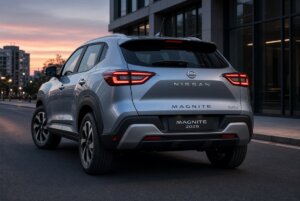
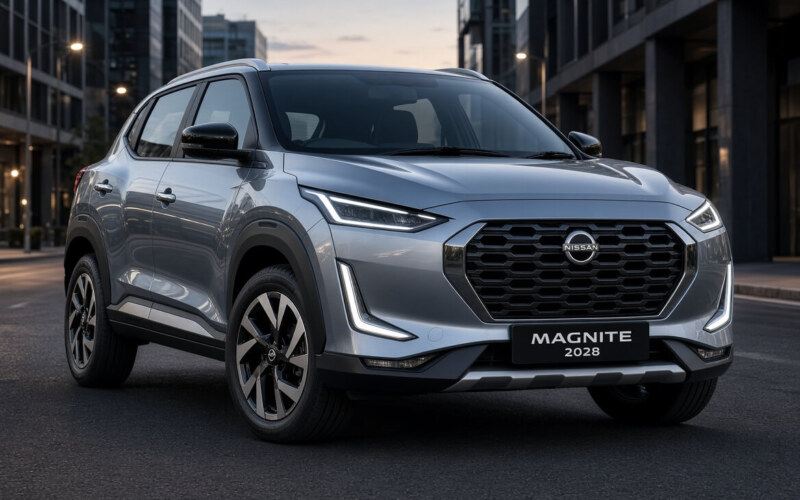
Styling changes with this facelift are deliberately restrained. The front end gets a wider hexagonal grille finished with chrome and gloss black accents, new LED headlamps with boomerang-shaped daytime running lights, and a revised front skid plate. New six-spoke dual-tone alloy wheels are fitted, and the tail lamps carry updated internal detailing with a blacked-out effect, though the overall silhouette remains close to the original 2020 car.
This 2028 Nissan Magnite Review sees the conservative approach as a reasonable trade-off. The Magnite’s boxy, upright SUV stance was always one of its strongest selling points against smaller, more car-like rivals, and Nissan has chosen to refine rather than replace it. Buyers wanting a bolder, more distinctive look may find rivals such as the Tata Nexon or Mahindra XUV 3XO more visually striking, but the Magnite’s proportions remain honest and practical.
Cabin Interior and Comfort
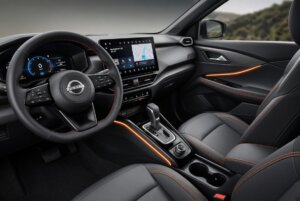
Inside, the facelifted Magnite introduces a new black-and-orange theme in place of the previous all-black cabin, along with updated seat upholstery and a redesigned steering wheel. Higher grades add a single-pane electric sunroof, ventilated front seats, four-colour ambient lighting and a height-adjustable driver’s seat, features that are genuinely uncommon at this price point.
Space remains one of the Magnite’s core strengths. This 2028 Nissan Magnite Review found rear legroom comfortably accommodates two tall adults sitting behind similarly tall front occupants, though a third adult across the rear bench is a tighter squeeze, as is typical in this segment. Boot space is respectable for a sub-four-metre SUV, and the overall cabin feels durable and well screwed together rather than outright plush.
Infotainment and Connected Technology
The facelift carries over an 8-inch touchscreen infotainment system on most grades, with wireless Apple CarPlay and Android Auto, a JBL sound system, and a wireless phone charging pad. A 7-inch digital driver display is fitted on higher trims. A new key fob adds remote engine start from up to 60 metres away, alongside automatic headlights and an auto-dimming interior rear-view mirror, both new additions with this update.
This 2028 Nissan Magnite Review considers the infotainment setup solid rather than class-leading. The screen resolution and menu responsiveness are adequate, and smartphone mirroring works reliably, but buyers expecting the larger, sharper displays now common on newer rivals may find the Magnite’s system starting to look dated, particularly on the lower Visia and Visia+ grades where equipment is more basic.
Safety Technologies
Safety is genuinely a standout for a car in this price bracket. Six airbags are standard across every single grade, not just the top of the range, a point this 2028
Nissan Magnite Review considers one of the Magnite’s strongest arguments over cheaper rivals. Electronic stability control, ABS with electronic brakeforce distribution, hill hold control, a 360-degree camera, Tyre Pressure Monitoring System and ISOFIX child seat anchorages are all included.
What the Magnite does not offer is any form of advanced driver-assistance system, such as adaptive cruise control, automatic emergency braking or lane keeping assistance, features increasingly common on newer rivals in this segment. The Magnite currently carries a 4-star Global NCAP rating, solid for its class but a notch below the 5-star ratings some newer competitors have achieved.
2028 Nissan Magnite Review: Practicality and Ownership
Practicality is where the Magnite has always made its strongest case. A genuinely usable second row, a reasonable boot, 205 mm of ground clearance and low running costs make it a sensible first SUV for young families or buyers upgrading from a hatchback. According to
Nissan India’s official announcement, the Magnite is manufactured at the Renault-Nissan Alliance plant in Chennai and exported to more than 65 markets, underlining how central the model is to Nissan’s global small-SUV strategy.
Ownership costs remain low thanks to simple, well-proven engines and an extensive dealer footprint built up over several years. The trade-off, as this 2028 Nissan Magnite Review has noted throughout, is a car that competes on value and space rather than outright driver-assistance technology or design flair.
Frequently Asked Questions
Which Nissan Magnite engine should I choose?
The 1.0-litre turbo-petrol engine, with 100 hp and 160 Nm, offers noticeably better real-world performance than the naturally aspirated engine and is worth the extra cost for most buyers.
Does the 2028 Nissan Magnite have a hybrid or electric option?
No. It remains petrol-only, and Nissan has not announced a hybrid or electric version of the Magnite.
Is this 2028 Nissan Magnite Review based on a confirmed new generation?
No. Nissan has not confirmed a next-generation Magnite at the time of writing. This review is based on the latest confirmed facelift specifications, expected to largely carry over into the 2028 model year.
2028 Nissan Magnite Review: Final Verdict and Is It Worth Buying?
The 2028 Nissan Magnite remains one of the smartest value propositions in its segment. Sharp pricing, class-leading standard airbag count, a genuinely spacious cabin and a punchy turbo-petrol engine option combine into a package that is hard to beat purely on substance for the money. It is not the flashiest SUV in its class, but it does not need to be to make its case.
Its shortcomings are consistent with its budget positioning. The lack of any driver-assistance technology, a laggy AMT gearbox and conservative styling changes mean buyers chasing the latest tech or the boldest design should look elsewhere. The naturally aspirated engine, in particular, is best reserved for buyers who stick mostly to city driving.
For value-focused buyers who want genuine SUV space and strong standard safety equipment without stretching their budget, the Magnite still makes a compelling case. That is where this 2028
Nissan Magnite Review lands for now, and we will update it in full should Nissan confirm a next-generation model.

 Price in USD
 Price in European Union
 Price in United Kingdom
 Price in Australia
 Price in Canada
 Price in India
 Price in China
 Price in Indonesia
 Price in Philippines
 Price in Malaysia
 Price in Nigeria
 Price in Russia
 Price in Pakistan
 Price in Saudi Arabia
 Price in Japan
 Price in South Africa
 Price in Brazil
 Price in Bangladesh
 Price in Mexico