- Home
- Volkswagen
- 2027 Volkswagen Touran Review
2027 Volkswagen Touran Review: Price, Specs, Interior & Release Date
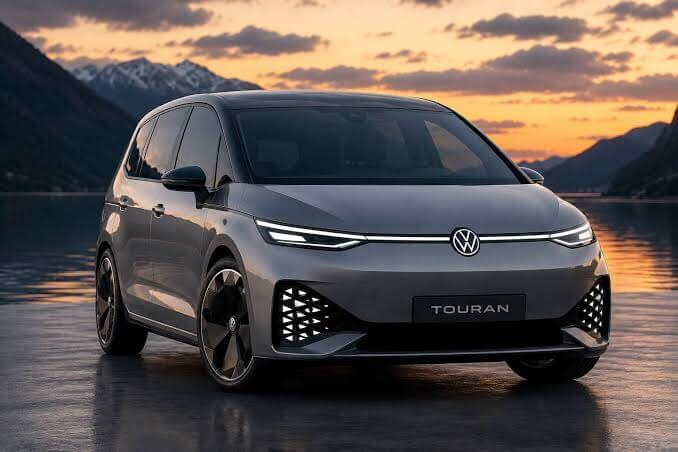
2027 Volkswagen Touran Review: The Last Great Compact Minivan, and What Comes After It
If you searched for a 2027 Volkswagen Touran, here is the honest starting point: there isn’t one. Volkswagen built the final Touran at its Wolfsburg plant on 29 April 2026, ending a 23-year run and roughly 2.3 million cars. This 2027 Volkswagen Touran Review therefore does something different from our usual new-car reviews. It assesses the final Touran that is still available as leftover stock and on the used market, explains what happened to it, looks at the rumoured electric successor and points you to the best alternatives. If you are weighing a seven-seat family car, this 2027 Volkswagen Touran Review will tell you whether the last Touran is still worth buying.
A quick note on method. This 2027 Volkswagen Touran Review is based on Volkswagen’s final specifications, published reporting on the production end and independent road tests of the second-generation car. Nothing here describes a confirmed 2027 model, and anything about a future electric Touran is clearly labelled as unconfirmed.
📌 2027 Volkswagen Touran Review: Key Takeaways
-
- Status: discontinued in April 2026, with no direct successor currently planned.
-
- Last price: from roughly €40,400 to €42,000 new in Germany, or around €37,000 to €38,000 for late-built used examples.
-
- Engines: 1.5 TSI petrol with 150 PS, or 2.0 TDI diesel with 122 or 150 PS.
-
- Space: up to seven seats and as much as 1,980 litres of cargo room.
-
- Biggest risk: an ageing electronic architecture that could not meet the 2026 safety rules.
What Happened to the Touran?
The second-generation Touran began production in May 2015 and became the oldest model in Volkswagen’s European line-up. Annual output had slipped to around 20,000 cars, even though Germany still registered more than 14,000 in 2025, compared with over 52,000 at its peak. Volkswagen says the car could not meet the UN’s General Safety Regulation II, Stage C without expensive changes, and the company saw no business case for a new generation.
The Touran’s assembly line now builds the Tiguan and the seven-seat Tayron. The closest Volkswagen in size is the Tiguan, while seven seats are offered only in the larger Tayron. As of late September 2026, Volkswagen’s UK website says new Tourans can no longer be ordered and only used cars remain, while some German dealers still list new stock with discounts of up to €2,200.
The Touran never made anyone’s heart race, but it quietly did the job of a family car better than most SUVs.
2027 Volkswagen Touran Review: Pros and Cons
✅ Pros
-
- Huge, flexible cabin with up to seven seats
-
- Up to 1,980 litres of cargo space with seats folded
-
- Golf-based chassis that rides and handles with polish
-
- Frugal engines, from 5.2 to 6.4 L/100 km combined
-
- Towing capacity of up to 1,800 kg
-
- Conventional rear doors and a sophisticated multi-link rear suspension
❌ Cons
-
- Discontinued, with no successor confirmed
-
- No hybrid, plug-in or electric version
-
- Ageing electronics and infotainment
-
- Third row is tiny, with just 4.8 cu ft behind it
-
- Front-wheel drive only
-
- New cars cost more than €40,000, close to Tiguan money
2027 Volkswagen Touran Price and Estimated Cost of Ownership
Volkswagen no longer publishes a conventional base price in Germany, where remaining Tourans are sold as stock cars. The last published listings showed the car starting around €40,445 to €41,995, with dealers offering price advantages of up to €2,200 on stock units. Used pricing varies widely: a 2019 Touran has a median asking price of around €21,700, while examples built in 2026 are listed at a median of about €37,800, a premium that reflects their rarity and low mileage.
This 2027 Volkswagen Touran Review sees the value story as nuanced. A new Touran is not cheap, and it costs about as much as a more modern Tiguan, but a lightly used example can be a smart buy for a family that wants a proper people carrier. Running costs should be modest thanks to frugal engines and a mechanically proven Golf-derived drivetrain. The main long-term unknown is resale value and parts support for a car that Volkswagen has retired, though a production run of 2.3 million cars suggests spares will stay widely available.
2027 Volkswagen Touran Review: Performance
Since 2024 the Touran has been offered with just three powertrains. The 1.5 TSI petrol produces 150 PS and 250 Nm of torque and comes with a six-speed manual or a seven-speed DSG dual-clutch automatic. The 2.0 TDI diesel is offered with either 122 PS or 150 PS, again with manual or DSG options, and the strongest version suits towing and long motorway trips best. All Tourans are front-wheel drive.
Performance is adequate rather than exciting. Published figures put 0-100 km/h at between roughly 8.9 and 10.8 seconds depending on engine and gearbox, with the 1.5 TSI managing around 9.3 seconds, and top speeds reach about 209 km/h. This 2027 Volkswagen Touran Review values the car for its calm, composed manners instead: the Golf-based chassis delivers a comfortable ride and secure handling, and the multi-link rear suspension gives it a more sophisticated feel than most small MPVs. Towing capacity reaches up to 1,800 kg.
Battery, Driving Range and Charging Time
This 2027 Volkswagen Touran Review has to be clear: the Touran that was actually built has no hybrid or electric system. It runs on petrol or diesel only, with a conventional 12-volt battery for the electronics and starter, so there is no traction battery, no plug and no charging time to quote.
Driving range comes down to fuel economy. Combined consumption ranges from 5.2 to 6.4 L/100 km across the line-up, and with a fuel tank of roughly 58 litres that translates to a real-world range of about 900 to 1,100 km, with the diesels at the longer end.
An electric Touran has been discussed. In 2025, British outlets reported that Volkswagen was weighing a compact electric MPV to carry the Touran name, possibly arriving in 2027 or 2028 with a 60 to 80 kWh battery, front-wheel drive or optional dual-motor four-wheel drive, and a speculated range of around 300 miles. Volkswagen has not confirmed any such car, and more recent reporting says there is no replacement in sight. Treat all electric Touran figures as rumours, not specifications.
2027 Volkswagen Touran Review: Exterior Styling
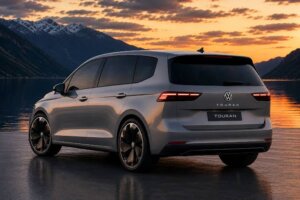
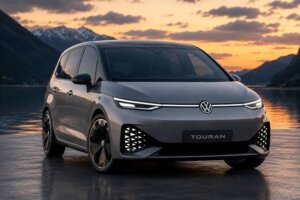
The Touran has always been understated. Penned by Walter de Silva, the second-generation car is about 4.5 metres long, 13 cm longer than its predecessor, with clean, upright lines, a practical tall roof and a family resemblance to the Golf. This 2027 Volkswagen Touran Review would call it handsome in a quiet, sensible way, and it has aged better than many rivals from the same era.
The 2020 facelift added updated lighting and a more modern front end, and higher trims wear alloy wheels and chrome details. There is nothing flashy here, and that is part of the charm for buyers who want a car that blends in and stays out of the way.
2027 Volkswagen Touran Review: Cabin Interior and Comfort
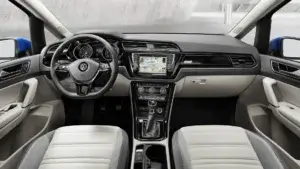
Inside is where the Touran earns its reputation. Versatile Vario rear seats slide, recline and fold, and the five-seat version offers about 26.2 cu ft of boot space, growing to as much as 69.9 cu ft (1,980 litres) with the rear seats folded. The optional third row turns it into a seven-seater, though space back there is tight, with only 4.8 cu ft of boot remaining when all seven seats are in use.
This 2027 Volkswagen Touran Review found the cabin practical and well insulated, with good visibility and a high seating position that families appreciate. Materials are durable rather than luxurious, and the dashboard design is conservative. Compared with the van-based Caddy, the Touran offers better noise insulation and a more car-like feel, and the ride stays comfortable on long journeys.
Infotainment and Connected Technology
The Touran offers a touchscreen infotainment system with smartphone integration for Apple CarPlay and Android Auto, plus an available digital driver display on higher trims. It is functional and easy to use, with physical controls for key functions that many drivers now miss in screen-heavy rivals.
This 2027 Volkswagen Touran Review has to flag the downside: the electronic architecture is old. That ageing system is part of the reason Volkswagen retired the car, and it means the Touran lacks the latest software features, over-the-air updates and connected services found in newer Volkswagens such as the Tiguan and Tayron.
2027 Volkswagen Touran Review: Safety Technologies
The Touran offers a solid range of driver aids, including front collision monitoring with emergency braking, lane assistance and adaptive cruise control, depending on the trim. It earned a five-star Euro NCAP rating when tested in 2015, though testing criteria have tightened considerably since then, so that result should be read in its historical context.
The honest headline for this 2027 Volkswagen Touran Review is that the car could not meet the UN’s General Safety Regulation II, Stage C, which took effect on 6 July 2026. Cars already built can still be sold and driven, but the Touran falls short of the latest standards, and buyers should check the current Euro NCAP safety ratings and compare them with newer rivals before deciding.
2027 Volkswagen Touran Review: Practicality and Ownership
Practicality is the Touran’s superpower. Conventional hinged rear doors, flexible seating, large windows, a big boot and low running costs make it easier to live with day to day than many SUVs, and few cars of this size can carry a family of five with luggage this comfortably. Towing up to 1,800 kg adds weekend versatility.
Ownership brings one new consideration. With no new Tourans being built, buyers should expect gradual changes in parts availability and resale value over time, although the sheer number of cars produced should keep servicing straightforward. This 2027 Volkswagen Touran Review recommends a service history check and a clear warranty on any used example.
Which Touran Should You Buy, and What Are the Alternatives?
Best all-rounder: the 1.5 TSI with the seven-speed DSG, smooth and frugal for most families. Best for long distances and towing: the 150 PS 2.0 TDI. Best for budget buyers: a well-maintained used example from 2019 to 2022, which costs far less than a new one.
If you want something new instead, the Volkswagen Tiguan is the closest in size, while the Tayron is the brand’s seven-seat option. The ID. Buzz offers electric people-carrying but starts at a much higher price, with the cheapest seven-seat UK version quoted at around £59,645 in 2025 reporting. Rivals such as the Škoda Kodiaq also cover seven-seat family duty. This 2027 Volkswagen Touran Review suggests that anyone who wants a modern safety and technology package should lean toward the Tiguan or Tayron.
2027 Volkswagen Touran Review: Scorecard
Frequently Asked Questions
Is there a 2027 Volkswagen Touran?
No. Volkswagen ended Touran production on 29 April 2026, and no direct successor has been confirmed.
Why did Volkswagen stop making the Touran?
The Touran could not meet the UN General Safety Regulation II, Stage C, effective 6 July 2026, without expensive changes, and falling demand for minivans meant Volkswagen saw no case for a new generation.
Will there be an electric Volkswagen Touran?
Reports in 2025 suggested an electric Touran MPV could arrive in 2027 or 2028, but Volkswagen has not confirmed it and later reporting says no replacement is in sight.
What engines did the last Touran offer?
A 1.5 TSI petrol with 150 PS and a 2.0 TDI diesel with 122 or 150 PS, with six-speed manual or seven-speed DSG gearboxes and front-wheel drive.
What should I buy instead of a Touran?
The Volkswagen Tiguan is the closest in size, the Tayron offers seven seats, and the ID. Buzz is the electric people carrier, though at a much higher price.
2027 Volkswagen Touran Review: Final Verdict and Is It Worth Buying?
There will be no 2027 Volkswagen Touran, and this 2027 Volkswagen Touran Review is, in effect, a goodbye. The last Touran remains one of the most practical and comfortable compact family cars ever built: spacious, flexible, frugal and pleasant to drive, with the option of seven seats and a boot that swallows a week’s luggage.
Its weaknesses are the reasons it was retired. The electronics are old, safety technology falls short of the newest rules, there is no hybrid or electric version, and a new car costs about as much as a more modern SUV. Buyers who want the latest technology and long-term support should look at the Tiguan or Tayron instead.
For families who value space over fashion and are happy to buy a well-looked-after used example, the Touran is still a smart, sensible choice. That is where this 2027 Volkswagen Touran Review lands, and we will revisit this 2027 Volkswagen Touran Review if Volkswagen ever confirms an electric successor.
2027 Volkswagen Touran Review Images
Specifications
Specifications
| Production year | 2027 |
| Body type & seats | 5-Door Compact MPV, 5–7 Seats |
| Dimensions | 4,527 × 1,829 × 1,674 mm |
| Weight | 1,450–1,620 kg, depending on engine and trim |
| Engine type | Turbocharged Petrol Inline-4 / Turbocharged Diesel Inline-4 |
| Engine size & cylinders | 1.5L TSI Petrol / 2.0L TDI Diesel, 4-Cylinder |
| Aspiration | Turbocharged |
| Power | 115 hp / 150 hp |
| Torque | 250 Nm Petrol / 340 Nm Diesel |
| Transmission | 6-Speed Manual / 7-Speed DSG Automatic |
| Drivetrain | Front-Wheel Drive (FWD) |
| Acceleration (0-100 km/h) | 8.9–11.5 seconds |
| Top speed | 188–209 km/h |
| Fuel type | Petrol (Gasoline) / Diesel |
| Fuel consumption | 6.3 L/100 km Petrol / 5.2–5.3 L/100 km Diesel |
| Fuel tank capacity | 58 L |
| Brakes | Ventilated Front Disc Brakes, Rear Disc Brakes, ABS |
| Steering | Electromechanical Power Steering |
| Infotainment | Volkswagen Discover Media Infotainment System, Touchscreen Display |
| Connectivity | Apple CarPlay, Android Auto, Bluetooth, USB-C, Wireless App-Connect (depending on trim) |
| Safety | Front Assist, Autonomous Emergency Braking, Lane Assist, Adaptive Cruise Control, Blind Spot Monitoring, Rear Traffic Alert, Park Assist, Electronic Stability Control, Multiple Airbags, ABS |
2027 Volkswagen Touran Review Price
 Price in USD |
48,500 USD |
 Price in European Union |
41,225 EUR |
 Price in United Kingdom |
35,890 GBP |
 Price in Australia |
74,205 AUD |
 Price in Canada |
66,930 CAD |
 Price in India |
4,234,050 INR |
 Price in China |
348,230 CNY |
 Price in Indonesia |
785,700,000 IDR |
 Price in Philippines |
2,764,500 PHP |
 Price in Malaysia |
204,670 MYR |
 Price in Nigeria |
74,447,500 NGN |
 Price in Russia |
3,902,310 RUB |
 Price in Pakistan |
13,725,500 PKR |
 Price in Saudi Arabia |
181,875 SAR |
 Price in Japan |
7,129,500 JPY |
 Price in South Africa |
855,540 ZAR |
 Price in Brazil |
263,355 BRL |
 Price in Bangladesh |
5,868,500 BDT |
 Price in Mexico |
910,345 MXN |
More Products from Volkswagen