New 2027 Toyota Fortuner : Price, Interior, Off-Road Specs, and Review
2027 Toyota Fortuner is finally here — and it brings the biggest transformation the nameplate has seen since its original launch in 2005. After a decade on the same platform and years of criticism about its aging interior, Toyota has responded decisively. The 2027 Toyota Fortuner keeps its body-on-frame DNA, gains a new platform, adopts Hilux-inspired styling, and offers a mild-hybrid diesel powertrain for the first time in the model’s history.
New 2027 Toyota Fortuner Overview
The 2027 Toyota Fortuner has dominated the premium body-on-frame SUV segment across Southeast Asia, India, the Middle East, and Africa for almost two decades. In South Africa alone, the current Fortuner sold nearly 10,000 units in 2025 — making it the 15th most popular passenger vehicle in the country.
That success has been built on a simple formula: combine Hilux-based durability with seven-seat family practicality and genuine off-road capability. Buyers have accepted the Fortuner’s known weaknesses — a dated interior and limited technology — because the core product is so fundamentally reliable.
The 2027 Toyota Fortuner changes that equation completely. According to Cars.co.za, test models have been spotted in Thailand and the new Fortuner is set to receive its most significant upgrades in platform, interior, technology, and powertrain in the nameplate’s entire history. The things buyers love most — toughness, reliability, and off-road capability — are carried forward unchanged.
2027 Toyota Fortuner Release Date and Market Availability
The 2027 Toyota Fortuner is expected to make its global debut in Thailand in late 2026. Production for core markets is targeted to begin in 2027. India launch is expected in early 2027, given the Fortuner’s enormous popularity in that market.
Key markets for the new 2027 Toyota Fortuner include Thailand, Indonesia, the Philippines, India, the Middle East, and South Africa. Australia discontinued the Fortuner without plans for its return. The United Kingdom and most of Western Europe will not receive official Fortuner allocations.
Multiple camouflaged test mules of the 2027 Toyota Fortuner have been spotted on public roads in Thailand. This confirms that development is in its advanced stages and the launch timeline is realistic.
2027 Toyota Fortuner Price
Official pricing for the 2027 Toyota Fortuner has not been confirmed by Toyota at time of writing. Based on current market positioning, a meaningful price increase over the outgoing model is expected to reflect the new platform, updated technology, and mild-hybrid powertrain.
In South Africa, the current Fortuner starts from approximately R685,900 for the 2.4 GD-6 manual. The top-spec 2.8 GD-6 4×4 GR-Sport sits at around R1,009,000. For the new 2027 Fortuner, Cars.co.za estimates a price increase of 8–12% over current figures.
In the Middle East, pricing for the 2027 Toyota Fortuner is expected to start from approximately $35,000–$45,000 USD equivalent. In India, industry projections place the base price at approximately INR 32–38 lakh ex-showroom — positioning it against the Mahindra XUV700 and MG Gloster.
2027 Toyota Fortuner Engine and Performance
2027 Toyota Fortuner Platform: Updated IMV Architecture
The 2027 Toyota Fortuner is expected to use an updated version of the IMV (Innovative International Multi-purpose Vehicle) ladder-frame platform — the same architecture that underpins the ninth-generation Hilux. Cars.co.za confirms: the new Fortuner will “follow the same route as the new ninth-generation Toyota Hilux and utilise an updated version of the current model’s IMV platform.”
This is consistent with Toyota’s cost and market logic. The TNGA-F platform used in the Land Cruiser Prado would push the 2027 Fortuner’s price into a different tier entirely. The updated IMV platform improves structural rigidity and ride comfort while keeping the Fortuner accessible in its target markets.
2027 Toyota Fortuner Diesel: 2.8L with 48V Mild Hybrid
The primary powertrain for the 2027 Toyota Fortuner is the proven 2.8-litre turbocharged diesel four-cylinder. In current GR-Sport form, this engine produces 201 horsepower and 500Nm of torque. With the 48V mild-hybrid system, output rises to approximately 215 horsepower and 564Nm of torque.
The 48V mild-hybrid system improves stop-start smoothness, reduces urban emissions, and lowers fuel consumption — all without requiring any charging infrastructure. For the 2027 Fortuner, this system is expected to be available across more trim levels than the current model. Higher specifications in markets with stricter emissions rules may receive it as standard.
2027 Toyota Fortuner Petrol and Hybrid Options
A 2.7-litre naturally aspirated petrol engine is expected to continue on the 2027 Toyota Fortuner as an entry-level option in select markets. For markets like India and parts of the Middle East, this provides an accessible entry point into the Fortuner range.
A 2.4-litre strong hybrid turbo petrol — used in various global Lexus and Toyota models — has been mentioned as a possible future option. However, Toyota has not confirmed this officially. It is expected to be a market-specific option rather than globally available at the 2027 Fortuner’s launch.
2027 Toyota Fortuner Horsepower and Acceleration
The 2027 Toyota Fortuner with the 2.8-litre mild-hybrid diesel is expected to deliver approximately 201–215 horsepower and 500–564Nm of torque depending on specification and market. The current Fortuner covers 0–100 km/h in approximately 9.5–10.5 seconds.
The mild-hybrid’s additional low-RPM torque should sharpen real-world acceleration — especially in urban stop-start conditions where the electric assist is most active. The flagship GR-Sport variant of the 2027 Fortuner is expected to continue at the top of the range with the highest output and the most aggressive off-road setup.
2027 Toyota Fortuner Fuel Consumption
The current 2.8-litre diesel Fortuner returns approximately 7.5–9.0L/100km in combined driving. The 48V mild-hybrid variants consume slightly less — around 7.3–8.5L/100km — particularly in urban conditions where the electric assist is most active.
For the 2027 Toyota Fortuner, the revised engine tune and more widely available 48V mild-hybrid system is expected to improve real-world fuel consumption by approximately 8–12% over the outgoing diesel-only variants. For fleet operators covering high annual mileages in the Middle East or South Africa, that efficiency saving adds up quickly over a full ownership cycle.
2027 Toyota Fortuner Battery and Hybrid Technology
The 48V mild-hybrid system on the 2027 Toyota Fortuner uses a small lithium-ion battery and an integrated starter generator connected to the engine. The battery charges through regenerative braking and engine operation. There is no external charging port and no pure electric driving range.
The system’s value lies in efficiency and refinement rather than electric range. It smooths the stop-start system, provides torque fill during gear changes, and allows the engine to shut down more aggressively at idle.
A fully electric 2027 Fortuner is not planned. AutoHit UK confirmed “no electric variant planned” for the next generation. The Fortuner’s core markets prioritise fuel availability and long-distance range over zero-emission credentials — the hybrid approach addresses efficiency concerns without the infrastructure compromise.
Driving the 2027 Toyota Fortuner
The 2027 Toyota Fortuner preserves the current model’s body-on-frame character while addressing the comfort criticisms that have followed it throughout its lifecycle. The updated IMV platform brings revised suspension tuning — confirmed by Cars.co.za — for improved ride comfort over the outgoing model.
On the new Hilux — which shares this updated architecture — early impressions have been positive. The ride is more planted and better controlled, reducing the firmness that makes the current Fortuner uncomfortable on sealed urban roads.
Off-road credentials remain central to the 2027 Toyota Fortuner’s identity. The locking rear differential, downhill assist control, and multi-terrain modes available on GR-Sport and VX variants are expected to continue. The platform’s improved structural rigidity means better torsional stiffness — improving wheel contact and control on uneven terrain in South Africa, India, and the Middle East.
2027 Toyota Fortuner Exterior Design
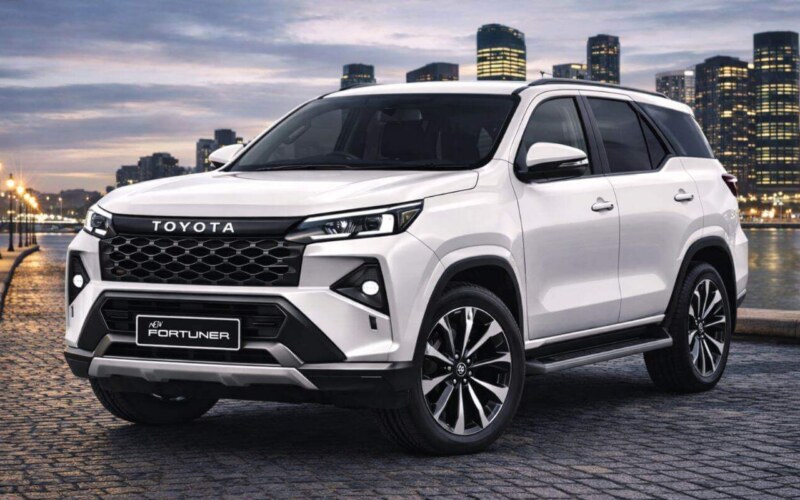
The 2027 Toyota Fortuner takes its design cues directly from the ninth-generation Hilux and its Cyber Sumo design language. Spy shots confirm slim LED headlights connected by a horizontal light bar carrying TOYOTA lettering, a squared-off lower bumper, and a wider, more upright front fascia.
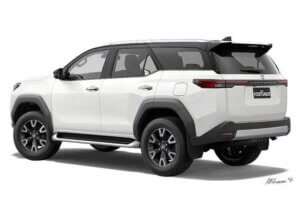
From the side, the 2027 Fortuner retains its familiar SUV stance but with more defined character lines and wider wheel arches. At the rear, a full-width LED light bar and bold FORTUNER lettering are expected — giving the new model a rear identity the current version lacks entirely.
The GR-Sport variant will continue as the visual and performance flagship of the 2027 Toyota Fortuner lineup. It adds unique bumpers, skid plates, sports suspension, and exclusive wheel designs. Dual-tone colour options, new alloy wheel designs, and available LED fog lights round out the exterior package across the range.

2027 Toyota Fortuner Interior and Technology
The interior upgrade is the most anticipated aspect of the 2027 Toyota Fortuner. The current model’s cabin has been the most consistent source of criticism — too plain and too plasticky for its price point. Toyota has prioritised the interior overhaul in the new generation above everything else.
Inspired by the ninth-generation Hilux’s cabin, the 2027 Toyota Fortuner interior is expected to feature dual 12.3-inch screens — a digital instrument cluster and a central touchscreen. Physical controls for climate and key functions are retained alongside them for ease of use during off-road driving.
Wireless Apple CarPlay and Android Auto are expected as standard on the new 2027 Fortuner. A wireless charging pad, multiple USB-C ports, and a panoramic sunroof — offered for the first time in the Fortuner’s history — are all expected on mid and upper-specification grades.
The seven-seat configuration across three rows continues as standard on the 2027 Toyota Fortuner. Second and third-row access, foldability, and headroom all benefit from the updated interior architecture. Soft-touch materials on mid and upper trims finally give the Fortuner a cabin worthy of its price tag.

2027 Toyota Fortuner Safety Systems
The 2027 Toyota Fortuner introduces full ADAS (Advanced Driver Assistance Systems) for the first time across the range. Multiple spy shots have confirmed sensor and camera clusters on prototype vehicles — indicating ADAS hardware is built into the new design from the ground up.
Expected standard safety equipment on the 2027 Fortuner includes autonomous emergency braking with pedestrian detection, adaptive cruise control, lane-keeping assist, blind-spot monitoring, rear cross-traffic alert, and automatic high beams. This brings the new Fortuner into line with safety standards set by the ninth-generation Hilux.
The updated IMV platform’s improved structural rigidity also contributes to passive safety — better crash protection in frontal, side, and pole impact scenarios. Toyota covers the current Fortuner with a three-year / 100,000km warranty in South Africa. The new generation’s warranty structure is expected to match or improve on those terms.
2027 Toyota Fortuner Pros and Cons
| ✅ Pros | ❌ Cons |
|---|---|
| Updated IMV platform — more rigid, more comfortable, better passive safety | Official specs and pricing not yet confirmed — all details based on pre-launch reports |
| 48V mild-hybrid diesel: 215 hp / 564Nm — more power and better fuel economy | No fully electric version planned — mild-hybrid only, no EV range |
| Dual 12.3-inch screens — biggest interior tech upgrade in Fortuner history | Price increase expected — platform, tech, and hybrid upgrades all add cost |
| Full ADAS suite including AEB, adaptive cruise, blind-spot — a first for the Fortuner | Not available in Australia, UK, or most of Western Europe |
| Hilux-inspired Cyber Sumo design — more modern and more muscular than current model | Third-row cargo space remains limited — inherent body-on-frame constraint |
| Panoramic sunroof offered for the first time in Fortuner history | Launch timing still unconfirmed officially by Toyota |
2027 Toyota Fortuner vs The Competition
The 2027 Toyota Fortuner competes in the premium body-on-frame SUV segment where it has been the volume leader for years. Its most direct rival is the Ford Everest. The Everest already offers a plug-in hybrid powertrain, a more refined cabin, and a wider powertrain range. The 2027 Fortuner’s technology and interior upgrades are Toyota’s direct answer.
The Isuzu MU-X is the value rival — less technologically advanced but extremely reliable and typically priced below the 2027 Fortuner. The Mitsubishi Pajero Sport has returned to the segment, adding another option for buyers in India and Southeast Asia who want a Japanese body-on-frame SUV.
In India, the 2027 Toyota Fortuner faces pressure from the Mahindra XUV700 — feature-packed and locally produced at a lower price. The XUV700 is not a body-on-frame vehicle, which limits off-road credentials, but for urban buyers it is a genuine alternative. The new Fortuner’s ADAS addition and interior upgrade are clearly aimed at closing that feature gap.
Against the Land Cruiser Prado, the 2027 Fortuner occupies a deliberate lower tier in Toyota’s own lineup. The Prado is more premium and more expensive. The Fortuner serves buyers who need the core capability at a more accessible price — and does that job better than any rival in its segment.
2027 Toyota Fortuner Final Verdict
The 2027 Toyota Fortuner is the update that Fortuner buyers around the world have been waiting for. The current model’s core strengths — unshakeable reliability, genuine off-road capability, and strong resale value — are preserved on an updated platform. The long-standing weaknesses — dated interior, limited technology, and absence of ADAS — are all directly addressed.
The mild-hybrid diesel is the right powertrain choice for 2027. It improves efficiency and refinement without the infrastructure demands of a plug-in hybrid or the range anxiety of a full EV. In markets like the Middle East, South Africa, and rural India, this approach is exactly correct.
The interior upgrade — dual 12.3-inch screens, improved materials, wireless connectivity, and an available panoramic sunroof — finally gives the 2027 Toyota Fortuner a cabin worthy of its price tag. Combined with full ADAS safety technology for the first time, the new Fortuner is not just a refresh of a proven formula. It is the version of the Fortuner that always should have existed — arriving at exactly the right moment, as rivals have been closing the gap the current model left open for too long.
All specifications and design details for the 2027 Toyota Fortuner are based on pre-launch reports and industry sources including Cars.co.za, AutoHit UK, CarLelo India, CarToq, and Carlelo. Toyota has not officially confirmed final specifications, pricing, or launch dates at time of writing. Current Fortuner variant figures sourced from Cars.co.za and Toyota South Africa official documentation.
New 2027 Toyota Fortuner Images
Specifications
Specifications
| Production year | 2027 |
| Body type & seats | Mid-Size SUV, 7 Seats |
| Dimensions | Length: 4,795 mm • Width: 1,855 mm • Height: 1,835 mm • Wheelbase: 2,850 mm |
| Weight | 2,020–2,180 kg |
| Engine type | Naturally Aspirated Petrol Engine |
| Engine size & cylinders | 2.7-liter (2,694 cc) Inline-4 |
| Aspiration | Naturally Aspirated |
| Power | 166 hp (122 kW) (expected) |
| Torque | 245 Nm (181 lb-ft) (expected) |
| Transmission | 6-Speed Automatic |
| Drivetrain | Rear-Wheel Drive (RWD) or Part-Time 4WD |
| Acceleration (0-100 km/h) | 11.8 sec (approx.) |
| Top speed | 175 km/h (approx.) |
| Fuel type | Regular Unleaded Gasoline |
| Fuel consumption | 10.8 L/100 km (combined) (estimated) |
| Fuel tank capacity | 80 Liters |
| Brakes | Ventilated Front Disc, Rear Disc, ABS, EBD, Brake Assist |
| Steering | Electric Power Steering (EPS) (expected) |
| Infotainment | 12.3-inch Touchscreen, 12.3-inch Digital Instrument Cluster (expected) |
| Connectivity | Wireless Apple CarPlay, Android Auto, Bluetooth, USB-C, Wireless Charging |
| Safety | Toyota Safety Sense 3.0, Pre-Collision System, Adaptive Cruise Control, Lane Departure Alert, Lane Tracing Assist, Blind Spot Monitor, Rear Cross Traffic Alert, 360° Camera, Parking Sensors, Automatic High Beams, Road Sign Assist, 7 Airbags, TPMS (expected). |
New 2027 Toyota Fortuner Price
 Price in USD
|
40,000 USD |
 Price in European Union
|
34,000 EUR |
 Price in United Kingdom
|
29,600 GBP |
 Price in Australia
|
61,200 AUD |
 Price in Canada
|
55,200 CAD |
 Price in India
|
3,492,000 INR |
 Price in China
|
287,200 CNY |
 Price in Indonesia
|
648,000,000 IDR |
 Price in Philippines
|
2,280,000 PHP |
 Price in Malaysia
|
168,800 MYR |
 Price in Nigeria
|
61,400,000 NGN |
 Price in Russia
|
3,218,400 RUB |
 Price in Pakistan
|
11,320,000 PKR |
 Price in Saudi Arabia
|
150,000 SAR |
 Price in Japan
|
5,880,000 JPY |
 Price in South Africa
|
705,600 ZAR |
 Price in Brazil
|
217,200 BRL |
 Price in Bangladesh
|
4,840,000 BDT |
 Price in Mexico
|
750,800 MXN |
More Products from Toyota