2028 Nissan Frontier Review: Price, Specs & Performance
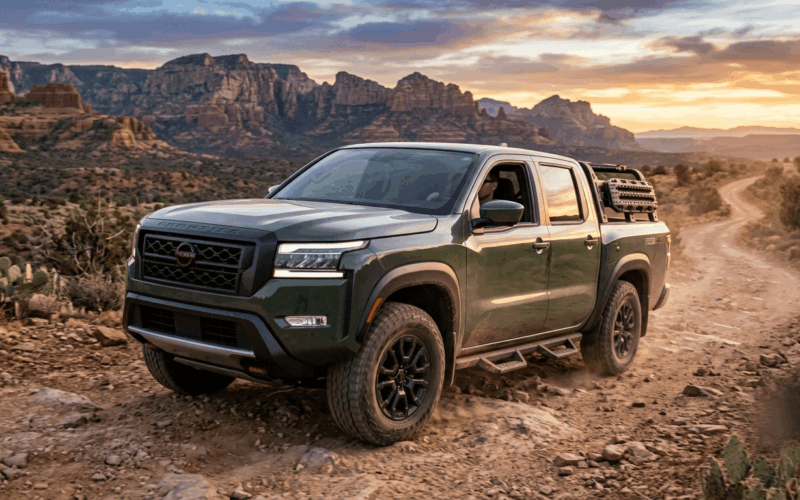
2028 Nissan Frontier Review coverage centers on what could be the most significant change to this midsize truck in years: an entirely new body-on-frame platform shared across five separate Nissan and Infiniti models, including the long-awaited return of the Xterra. Nissan has confirmed real details about this new architecture, but the automaker has deliberately left plenty unanswered, including whether this new Frontier actually lands as a genuine 2028 model or slips into 2029. This 2028 Nissan Frontier Review breaks down everything Nissan has confirmed so far, along with the honest uncertainty that still surrounds this truck’s biggest redesign in years.

2028 Nissan Frontier Review: Overview
The 2028 Nissan Frontier is expected to ride on an entirely new body-on-frame platform, first previewed to dealers at the NADA Show in Las Vegas and later confirmed publicly at a Nissan strategy event in Japan. That same architecture will also underpin the returning Xterra, a new body-on-frame Pathfinder, an Infiniti Xterra-style SUV, and an Infiniti QX60 variant, making this one of the most ambitious shared-platform strategies Nissan has pursued in years.
Anyone reading a 2028 Nissan Frontier Review should understand that Nissan has been notably vague about exact timing. The automaker has targeted a “late 2028” arrival for the Xterra specifically, but hasn’t clarified whether that translates to an actual 2028 model year or a 2029 designation, a distinction that genuinely matters for buyers tracking depreciation and warranty timelines. For a look at the current, unchanged Frontier that remains on sale in the meantime, see our earlier coverage of the 2027 Nissan Frontier Review.
2028 Nissan Frontier Review: Expected Price
Nissan hasn’t released any pricing information for the redesigned Frontier, and given how early this remains in the development and announcement process, official figures likely won’t surface for some time. What is known is that Nissan is investing roughly $500 million to retool its Canton, Mississippi plant specifically to build this new body-on-frame family, targeting an eventual output of 250,000 to 300,000 vehicles annually across all five related models.
Given that scale of investment and the platform’s shared use across multiple brands and models, buyers using this 2028 Nissan Frontier Review for early planning purposes should expect pricing broadly competitive with the current Frontier lineup, though any electrification the truck eventually receives could push starting prices somewhat higher than today’s gasoline-only range.
2028 Nissan Frontier Review: Release Date
Nissan is targeting a late 2028 debut for the Xterra, the first vehicle expected from this new platform family, with the redesigned Frontier following on a related but not yet fully specified timeline. Given the ambiguity around whether “late 2028” ultimately becomes a 2028 or 2029 model year designation, prospective buyers should treat any specific release date for the new Frontier as a reasonable estimate rather than a confirmed fact until Nissan issues more precise guidance.
2028 Nissan Frontier Review: Engine and Performance
Nissan has confirmed a hybrid V6 powertrain for the related Xterra, complete with a two-speed transfer case for genuine 4Lo off-road capability, though the automaker hasn’t specified exact displacement or output figures for that engine. The Frontier and other related models are expected to offer their own electrified powertrain option as well, though this hasn’t been confirmed with the same certainty as the Xterra’s hybrid V6.
Until Nissan provides more specific engineering details, buyers should treat any electrification news for the 2028 Nissan Frontier as a reasonable expectation based on the platform’s shared engineering with the Xterra, rather than a confirmed feature. It remains entirely possible the truck could launch with a more conventional gasoline powertrain option alongside any hybrid variant, similar to how many competitors currently structure their own lineups.
2028 Nissan Frontier Body-on-Frame Platform
Perhaps the most significant confirmed detail is that Nissan is building this new platform specifically in the United States to avoid tariffs and reduce costs, with Canton, Mississippi serving as the presumed assembly location alongside the current Frontier’s existing production. Some industry observers have expressed skepticism about whether Nissan has the financial resources for a fully clean-sheet platform given the company’s recent challenges, suggesting the new architecture could represent a significant evolution of the existing Frontier chassis rather than an entirely unrelated design.
2028 Nissan Frontier Review: Horsepower and Acceleration
Specific horsepower and torque figures for the 2028 Nissan Frontier’s expected powertrain lineup haven’t been released by Nissan at the time of writing. Given the hybrid V6 confirmed for the related Xterra, buyers should reasonably expect the redesigned Frontier to offer meaningfully more power and torque than the current truck’s 3.8-liter V6, though exact figures remain speculative until Nissan provides official specifications closer to launch.
2028 Nissan Frontier Review: Fuel Consumption
EPA fuel economy estimates for the 2028 Nissan Frontier don’t exist yet, since the truck hasn’t been finalized or tested. If the expected hybrid powertrain option does arrive as anticipated, buyers should expect a meaningful efficiency improvement over the current Frontier’s conventional V6, consistent with how hybrid assistance has generally improved fuel economy across other recently electrified trucks and SUVs in this segment.
2028 Nissan Frontier Review: Driving Experience
While independent testing of the redesigned Frontier obviously hasn’t occurred, Nissan’s confirmed engineering direction for the related Xterra offers some useful clues. Four-corner coil springs are expected to replace the traditional leaf-spring rear suspension found on older body-on-frame Nissan trucks and SUVs, a change aimed at improving on-road comfort without sacrificing genuine off-road capability.
The new Frontier is expected to remain similar in overall size to today’s truck, though reports suggest the rear seat could gain more space and better packaging, potentially delivering a noticeably more comfortable cabin experience than the current generation offers.
2028 Nissan Frontier Xterra Connection
Because the redesigned Frontier shares its fundamental architecture with the returning Xterra, buyers interested in the truck should pay close attention to how that SUV develops, since engineering decisions made for the Xterra’s off-road capability, including its two-speed transfer case and coil-spring suspension, will likely carry directly over to the Frontier given their shared platform.
2028 Nissan Frontier Review: Exterior Design
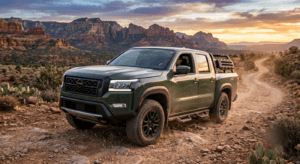
Nissan hasn’t released official images of the redesigned Frontier, though a teaser image for the related Xterra shows a bluff, upright design featuring a stamped NISSAN wordmark and amber marker lights, giving some indication of the design language likely to influence the broader body-on-frame family. Given how closely the two models will share underlying engineering, buyers can reasonably expect some visual and design philosophy connections between the new Frontier and Xterra, even if their specific styling ultimately differs.
2028 Nissan Frontier Review: Interior and Technology
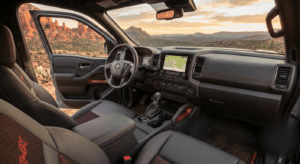
Interior photos and technology details for the redesigned Frontier haven’t been released by Nissan at the time of writing. Given the broader industry trend toward larger touchscreens and more advanced driver-assistance technology, buyers should reasonably expect the new Frontier’s cabin to represent a meaningful step forward from the current truck, though specific features remain unconfirmed until Nissan provides official details closer to launch.
2028 Nissan Frontier Review: Safety Systems
Because the 2028 Nissan Frontier remains in development, no crash-test data or specific safety equipment details are currently available. Buyers wanting to track updated information as it becomes available can check the Insurance Institute for Highway Safety (IIHS), which will evaluate the redesigned Frontier alongside its midsize truck rivals once testing becomes possible.
2028 Nissan Frontier Review: Pros and Cons
What We Like About the 2028 Nissan Frontier
✓ Entirely new body-on-frame platform signals real investment
✓ Shared engineering with Xterra suggests genuine off-road upgrades
✓ Expected hybrid powertrain option for improved efficiency
✓ U.S.-built platform helps avoid tariff-related cost increases
✓ Rear seat expected to offer more space and better packaging
What Could Be Better on the 2028 Nissan Frontier
✗ Exact model year designation remains genuinely unconfirmed
✗ No pricing, specifications, or images released at writing
✗ Some skepticism exists about Nissan’s financial capacity for the project
✗ Electrified powertrain not confirmed with certainty for Frontier specifically
2028 Nissan Frontier Review: Main Competitors
Once it arrives, the redesigned 2028 Nissan Frontier will continue competing against the Toyota Tacoma, Ford Ranger, and Chevrolet Colorado in the midsize truck segment. The Tacoma’s own recent redesign and available hybrid powertrain option set a genuine benchmark the new Frontier will need to match or exceed, particularly if Nissan’s own hybrid ambitions for this platform come to fruition as currently planned.
Against this field, the 2028 Nissan Frontier’s success will likely hinge on how effectively Nissan translates its ambitious new body-on-frame platform into genuine on-road refinement and off-road capability, rather than simply matching rivals on paper specifications alone.
2028 Nissan Frontier Review: Final Verdict
Based on everything confirmed so far, the 2028 Nissan Frontier represents a genuinely ambitious bet by Nissan, tying this truck’s future to an entirely new platform shared across five different vehicles and two brands. The combination of confirmed U.S. manufacturing investment, expected electrification, and shared engineering with the returning Xterra all suggest Nissan is taking this redesign seriously rather than treating it as an afterthought.
Plenty of genuinely important details remain unconfirmed, including exact pricing, specifications, and even the precise model year this truck will ultimately carry. Still, anyone following coverage of the 2028 Nissan Frontier will find a genuinely exciting redesign in progress, one that could meaningfully reshape Nissan’s truck and body-on-frame SUV lineup for years to come, assuming the automaker can deliver on the ambitious plans it’s already shared with dealers and the public.
2028 Nissan Frontier Review Images
Specifications
Specifications
| Production year | 2028 |
| Body type & seats | Midsize Pickup Truck, 4–5 Seats |
| Dimensions | Approx. 5,340 × 1,900 × 1,850 mm |
| Weight | Approx. 1,950–2,150 kg |
| Engine type | Naturally Aspirated Petrol V6 |
| Engine size & cylinders | 3.8L V6 |
| Aspiration | Naturally Aspirated |
| Power | Approx. 310–320 hp |
| Torque | Approx. 381–400 Nm |
| Transmission | 9-Speed Automatic |
| Drivetrain | RWD / 4WD |
| Acceleration (0-100 km/h) | Approx. 7.0–8.0 sec |
| Top speed | Approx. 180 km/h |
| Fuel type | Regular Gasoline |
| Fuel consumption | Approx. 10.5–12.5 L/100 km |
| Fuel tank capacity | Approx. 79–80 L |
| Brakes | 4-Wheel Disc Brakes, ABS |
| Steering | Hydraulic Power-Assisted Steering |
| Infotainment | 12.3-inch Touchscreen, Digital Instrument Display |
| Connectivity | Wireless Apple CarPlay, Wireless Android Auto, Bluetooth, USB-C, Wireless Charging, Wi-Fi Hotspot |
| Safety | Automatic Emergency Braking, Blind Spot Warning, Rear Cross Traffic Alert, Lane Departure Warning, Adaptive Cruise Control, 360° Camera, Parking Sensors, Multiple Airbags, TPMS |
2028 Nissan Frontier Review Price
 Price in USD
|
34,000 USD |
 Price in European Union
|
28,900 EUR |
 Price in United Kingdom
|
25,160 GBP |
 Price in Australia
|
52,020 AUD |
 Price in Canada
|
46,920 CAD |
 Price in India
|
2,968,200 INR |
 Price in China
|
244,120 CNY |
 Price in Indonesia
|
550,800,000 IDR |
 Price in Philippines
|
1,938,000 PHP |
 Price in Malaysia
|
143,480 MYR |
 Price in Nigeria
|
52,190,000 NGN |
 Price in Russia
|
2,735,640 RUB |
 Price in Pakistan
|
9,622,000 PKR |
 Price in Saudi Arabia
|
127,500 SAR |
 Price in Japan
|
4,998,000 JPY |
 Price in South Africa
|
599,760 ZAR |
 Price in Brazil
|
184,620 BRL |
 Price in Bangladesh
|
4,114,000 BDT |
 Price in Mexico
|
638,180 MXN |
More Products from Nissan