- Home
- Volkswagen
- 2025 Volkswagen T-Roc
2025 Volkswagen T-Roc: Price, Interior, Specs, Fuel Economy, and Review
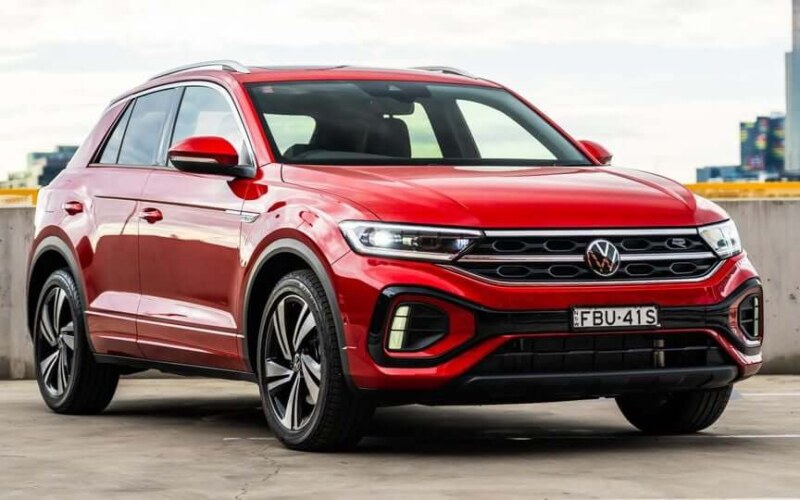
2025 Volkswagen T-Roc represents one of the most significant relaunches in Volkswagen’s recent SUV history — and that is saying something for a brand that has been relaunching things at pace for the better part of a decade. Unveiled in the summer of 2025 as a fully redesigned second-generation model, the 2025 Volkswagen T-Roc is not a facelift, a refresh, or an update. It is a complete ground-up reinvention of a car that sold over two million units in its first generation and still needed to move forward. Built on the latest MQB evo platform, longer and more premium than before, and arriving with mild-hybrid technology across the range, the 2025 Volkswagen T-Roc makes a clear argument for why the compact SUV segment remains one of the most fiercely contested in the automotive world.
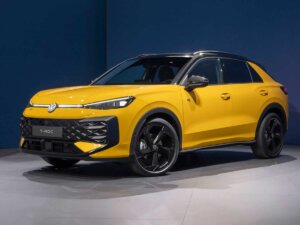
Overview: Why the 2025 Volkswagen T-Roc Matters
The original T-Roc launched in 2017 with modest ambitions and ended up becoming Volkswagen’s most successful SUV globally after the Tiguan, peaking at over 300,000 units annually following its 2021 facelift. That success created both an opportunity and a pressure: the new model needed to justify the T-Roc name while clearly moving the game forward. The 2025 Volkswagen T-Roc does both. It is longer, roomier, and more technologically advanced than its predecessor, with a cleaner coupe-influenced silhouette, a substantially upgraded interior, and a powertrain lineup that embraces electrification for the first time in the model’s history.
Positioned between the smaller T-Cross and the larger Tiguan, the 2025 Volkswagen T-Roc slots comfortably into the compact crossover segment it helped define. This generation sharpens that positioning by offering a more premium feel at a similar price point — something buyers increasingly expect as the segment matures. Whether you’re evaluating it as a practical family crossover, a style-led urban SUV, or a long-distance touring companion, the 2025 Volkswagen T-Roc has been engineered to make a compelling case in each scenario.
Expected Price: Starting Strong, Climbing Quickly
Pre-sales for the 2025 Volkswagen T-Roc began in Germany on August 28, 2025, with prices starting at €30,845 for the base 1.5 eTSI 85 kW (116 PS) variant. In the United Kingdom, the new T-Roc is on sale from £31,620, placing it at a slight premium over rivals like the Nissan Qashqai, Ford Puma, and Toyota C-HR — a positioning VW justifies through the quality of the interior, the breadth of the standard equipment list, and the engineering pedigree of the MQB evo platform.
Three trim levels are available at launch — Life, Style, and R-Line — each with meaningfully different equipment levels. The R-Line model, which adds IQ.LIGHT LED matrix headlamps as standard alongside sportier exterior styling, approaches €45,000 in fully optioned form, according to real-world test car pricing. Full hybrid variants and a new 200 hp 2.0-litre 4Motion all-wheel-drive model are expected to command further premiums when they arrive in 2026. The 2025 Volkswagen T-Roc is, in short, a car whose entry price is competitive but whose ambition runs considerably higher.
Release Date: On Sale Now, Range Expanding
The 2025 Volkswagen T-Roc made its world premiere on August 27, 2025, with European market launch scheduled for November of that year. By early 2026, the car had reached dealerships across the UK and most major European markets. The model received its five-star Euro NCAP safety rating in December 2025, providing independent validation of its safety credentials within months of going on sale — a timeline that speaks to VW’s confidence in the car’s underlying engineering.
The range launch in late 2025 initially covers mild-hybrid petrol engines with front-wheel drive. Full hybrid powertrains are confirmed for 2026, alongside the 201 hp 2.0-litre 4Motion AWD variant. A performance T-Roc R model — expected to carry over 300 hp from the previous generation’s DNA — has also been confirmed as a future addition. The 2025 Volkswagen T-Roc is therefore both a car you can buy today and a platform that will continue to evolve through the mid-2020s.
Engine and Performance: Mild Hybrid by Default, More Coming
The 1.5 eTSI: Two States of Tune, One Clear Direction
At launch, the 2025 Volkswagen T-Roc is offered exclusively with a 1.5-litre turbocharged petrol engine in two states of tune: 85 kW (116 PS / 115 hp) and 110 kW (150 PS / 148 hp). Both are fitted with 48-volt mild-hybrid technology — a belt-driven starter-alternator paired with a 48V lithium-ion battery — which provides energy recovery under deceleration, assists during acceleration, and enables extended engine-off coasting to improve real-world fuel economy. Neither variant offers pure electric driving, but the system operates seamlessly in the background, reducing consumption without asking anything of the driver.
Both engines use Volkswagen’s ACTplus Active Cylinder Management system, which deactivates two of the four cylinders during light-load driving to reduce fuel consumption and emissions. A VTG (variable turbine geometry) turbocharger — more familiar from diesel engines and sports cars — improves low-end response and high-rpm output simultaneously. The Miller cycle combustion process, which reduces pumping losses at part throttle, rounds out a powertrain that is genuinely high-tech beneath its understated presentation. Both variants of the 2025 Volkswagen T-Roc pair with a seven-speed dual-clutch DSG automatic gearbox and front-wheel drive as standard at launch. You can find the complete official technical documentation on the Volkswagen Newsroom drive systems page.
Power, Torque, and Acceleration
The entry-level 116 PS version of the 2025 Volkswagen T-Roc delivers 220 Nm of torque and completes the 0–100 km/h sprint in 10.6 seconds — adequate for everyday urban and suburban use, and more capable than its modest numbers suggest thanks to the mild-hybrid’s torque fill during low-speed acceleration. The 150 PS variant — the more popular choice among early buyers — produces 250 Nm and is noticeably more capable in overtaking situations and at motorway speeds, making it the recommended choice for drivers who regularly use the full performance range.
A 204 PS (150 kW) 2.0-litre TSI engine with 4Motion all-wheel drive and 320 Nm of torque is confirmed as an upcoming addition to the 2025 Volkswagen T-Roc range, alongside full hybrid variants offering 134 hp and 165 hp respectively. The latter are expected to offer approximately 15 percent better fuel economy than the equivalent mild-hybrid models, according to Volkswagen’s own statements — meaningful gains in a segment where running costs matter as much as headline performance.
Fuel Economy: Efficient by Compact SUV Standards
Volkswagen quotes WLTP fuel consumption of between 5.5 and 6.0 litres per 100 km for both mild-hybrid variants of the 2025 Volkswagen T-Roc, corresponding to CO₂ emissions of 124–137 g/km. Real-world testing by Auto Express in a 150 PS R-Line on 19-inch wheels — conditions that typically disadvantage official figures — returned 41.9 mpg (approximately 6.7 L/100km) on a mixed-speed route with a bias toward dual-carriageway driving. Under optimal conditions at moderate speeds, the official figures appear genuinely achievable. The 2025 Volkswagen T-Roc is not the most efficient car in its class, but it is honest about its consumption in a way that not all mild-hybrid competitors manage.
Battery, Hybrid System, and Electric Capability
The 2025 Volkswagen T-Roc uses a 48V mild-hybrid architecture rather than a full hybrid or plug-in system. The 1.6 kWh (gross) NMC battery stores energy recovered during braking and deceleration, redistributing it through the belt-driven starter-alternator to assist the combustion engine during acceleration and allow extended engine-off coasting. There is no purely electric driving mode and no charging port — the 48V system is transparent, working without driver input to smooth consumption and refinement. Full hybrid variants arriving in 2026 will pair the 1.5 TSI evo2 engine with an electric motor in three operating modes: electric, serial, and parallel — offering genuine low-speed electric driving for the first time in the T-Roc’s history. No fully electric version of the 2025 Volkswagen T-Roc has been announced; VW continues to separate its combustion and electric model lines for now.
Driving Experience: Competent, Comfortable, Occasionally Inspiring
The 2025 Volkswagen T-Roc drives exactly as the MQB evo platform suggests it should — with composure, refinement, and a sense of solidity that belies its compact dimensions. The suspension tuning prioritizes comfort over dynamics, which is the correct choice for this segment: most buyers will never ask the T-Roc to perform on a twisting mountain road, and the car is honest about that without being dismissive of driver engagement. Steering is precise and well-weighted, offering enough feedback to inspire confidence without overwhelming the driver with information they didn’t ask for.
Body roll is moderate and well-controlled through corners — the 2025 Volkswagen T-Roc leans, but it does so predictably and reassuringly, never threatening to unsettle the occupants or the car’s composure. The mild-hybrid drivetrain feels smooth and natural; the stop-start system reacts almost instantly and the engine-off coasting is seamless enough that many drivers will never consciously notice it operating. The 150 PS variant, tested extensively by What Car? and Auto Express, earns consistent praise for its mid-range flexibility — the ability to build speed on a motorway slip road or close a gap in traffic without demanding a full downshift from the DSG.
A rotary driving experience controller on the centre console allows selection of drive modes, with Eco, Comfort, Sport, and Individual settings adjusting throttle response, steering weight, and DSG behaviour. Sport mode sharpens the experience without transforming the 2025 Volkswagen T-Roc into something it isn’t — it remains, fundamentally, a crossover built for the real world. Wind noise is well-suppressed at motorway speeds, though road noise on larger wheel sizes follows the pattern of most compact SUVs in this class. Overall, the T-Roc delivers exactly the kind of confident, unflustered daily driving experience its target audience expects.
Exterior Design: Sharper, Longer, More Grown-Up
The design direction of the 2025 Volkswagen T-Roc makes its priorities clear from the first glance. The new generation is 122 mm longer than the outgoing car — a dimension that translates into genuinely improved rear legroom and a 30-litre increase in boot capacity, but also into a more assertive, stretched-looking silhouette that reads as more premium in its proportions. The coupe-like roofline, with its raked rear window and integrated roof spoiler, gives the 2025 Volkswagen T-Roc an SUV-coupe character without the compromised rear headroom that typically accompanies the style.
At the front, slim triangular LED headlights connect via a full-width light strip, creating a face that reviewers have compared — favourably — to both the Tiguan and, somewhat unexpectedly, the Lamborghini Urus in its angular aggression. A full-width lower grille reinforces the wider, more planted stance. The A and B-posts, window frames, and lower door panels feature blackened elements that emphasize the car’s height and create a floating-roof visual effect common to the premium end of the segment. At the rear, LED taillights echo the headlight shape with a connecting light bar, creating a strong, symmetrical visual identity. The 2025 Volkswagen T-Roc offers six exterior colours at launch, including new options like Canary Yellow Solid and Flame Red Metallic — a deliberate effort to attract younger buyers who view their car as a style statement.
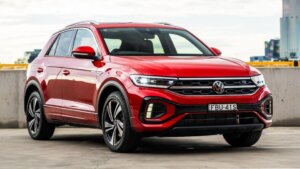
Interior and Technology: A Genuine Step Forward
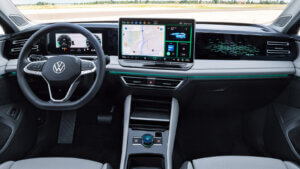
Step inside the 2025 Volkswagen T-Roc and the improvement over the previous generation is immediate and significant. The dashboard has been entirely redesigned, drawing visual DNA from the larger Tiguan and Tayron models and delivering a cabin that feels genuinely premium rather than simply adequate. Soft-touch fabric trim, full-width metal strips around the climate control vents, and ambient lighting applied across perforated artificial leather create what Volkswagen describes as a “lounge-like atmosphere” — language that would be dismissible marketing speak if the execution didn’t largely deliver on the promise.
The centrepiece is a 12.9-inch (33 cm) central touchscreen running Volkswagen’s latest infotainment system — the same unit found in the Tiguan — flanked by a 10-inch digital instrument cluster ahead of the driver. Wireless Apple CarPlay and Android Auto are standard across the range. Volkswagen’s Travel Assist adaptive cruise control system, which handles steering, acceleration, and braking up to highway speeds with minimal driver intervention, is standard equipment on the 2025 Volkswagen T-Roc — a feature previously reserved for significantly more expensive models. The gear selector has moved to a stalk behind the steering wheel, freeing the centre console for the driving experience rotary controller and additional storage space.
Rear legroom has improved meaningfully thanks to the extended wheelbase, and the boot capacity of 475 litres with seats in place — expandable via a 40:20:40 split-folding rear seat that folds completely flat — makes the 2025 Volkswagen T-Roc a genuinely practical family vehicle. A removable boot floor creates the choice between a deeper cargo well or a flat loading surface, a detail that earns consistent praise from reviewers who test cars in real family use rather than just press driving conditions. Easter egg design details — miniature swimmers in the wireless charging pad shaped like a swimming pool, small icons in the storage compartments — add a playful, youth-oriented character that the previous T-Roc’s more conservative interior lacked.
Safety Systems: Five Stars and Genuinely Deserved
The 2025 Volkswagen T-Roc received a five-star Euro NCAP rating in December 2025, earning particularly strong marks for its driver assistance systems under the organisation’s increasingly demanding 2025 test procedures. All T-Roc variants come with nine airbags as standard, Isofix child seat mounting points on the front passenger and both outer rear seats, and an automatic emergency braking system capable of detecting not only vehicles but also pedestrians and cyclists — the kind of breadth that previously required an expensive options package.
The standard safety suite on the 2025 Volkswagen T-Roc includes lane-keeping assist, traffic sign recognition with speed limit display, blind-spot monitoring, rear cross-traffic alert, front cross-traffic alert, a predictive speed limiter, and emergency autonomous braking with pedestrian and cyclist monitoring. Travel Assist — VW’s hands-on semi-autonomous highway driving system — is fitted across the range, representing a genuine upgrade from what comparable rivals offer at the same price point. The five-star result beats the now four-star-rated Nissan Qashqai, a detail Volkswagen’s marketing teams have been understandably quick to highlight.
Pros and Cons
✅ Pros
- Fully redesigned on MQB evo — not just a facelift
- Five-star Euro NCAP rating earned under demanding 2025 procedures
- Impressive 12.9-inch touchscreen and upgraded cabin quality
- Mild-hybrid standard across the range — real efficiency gains
- 122 mm longer with noticeably improved rear legroom and 475L boot
- Travel Assist semi-autonomous driving standard on all trims
- Sharp, modern design with coupe-like silhouette
- Full hybrid and AWD options confirmed for 2026
- Nine airbags and comprehensive ADAS suite as standard
❌ Cons
- Prices start higher than most direct rivals at launch
- Only mild-hybrid petrol engines available at launch — no diesel, no full hybrid yet
- No pure electric driving capability in current powertrain
- Higher trims and options push total cost toward premium territory
- Road noise noticeable on larger wheel sizes
- T-Roc R performance model not yet confirmed with full specs
- Previous generation ranked poorly in Driver Power reliability surveys
- No manual gearbox option — DSG only across the range
Competitors: A Strong Field the 2025 Volkswagen T-Roc Must Beat
The compact crossover segment is one of the most populated in the automotive market, and the 2025 Volkswagen T-Roc faces rivals that have spent years developing their own credentials. The Ford Puma undercuts the T-Roc on price and offers more performance-per-pound, though its interior quality lags behind the new Volkswagen’s significantly upgraded cabin. The Toyota C-HR has reinvented itself as a hybrid-only, style-forward crossover that appeals to a slightly different buyer — cleaner powertrain credentials but a smaller boot. The Nissan Qashqai, long the segment benchmark for practicality, now trails the T-Roc on Euro NCAP rating (four stars to the Volkswagen’s five) and interior quality.
The MINI Countryman competes directly in terms of price and premium positioning, offering more brand cachet and a more distinctive interior design at a similar or slightly higher cost. The Peugeot 2008 brings strong value and an attractive cabin but doesn’t match the 2025 Volkswagen T-Roc’s technology package or safety score. Within the Volkswagen Group, the Audi Q2 — the most direct luxury-positioning rival — offers premium badge appeal but an older platform and a cabin that no longer feels as current as the new T-Roc’s. The Skoda Karoq offers more outright space for a lower price but lacks the design flair. The T-Roc’s position at the premium-but-not-luxury intersection of the market is well-chosen and genuinely defensible.
Final Verdict: The 2025 Volkswagen T-Roc Raises Its Own Bar
The 2025 Volkswagen T-Roc is a confident, well-executed generational step for one of VW’s most commercially important models. It does not reinvent what the T-Roc is — a practical, style-led compact crossover for buyers who want premium quality without premium pricing — but it improves every aspect of the formula convincingly. The cabin is genuinely better. The technology is meaningfully more capable. The safety equipment is class-leading. The exterior design is sharper without being reckless. And the mild-hybrid powertrain, while not transformational, delivers real-world efficiency gains that matter over the life of the car.
The criticisms are real but manageable: pricing climbs quickly once you leave the base specification, the launch powertrain lineup is limited to mild-hybrid petrol engines for now, and the previous generation’s reliability record gives some buyers legitimate reason for caution. These are considerations, not dealbreakers. The 2025 Volkswagen T-Roc earns its five-star safety rating, its positive press reception, and its position near the top of the compact crossover segment without resorting to gimmicks or compromises that will frustrate owners over time.
With full hybrid engines and all-wheel drive still to come, the 2025 Volkswagen T-Roc is a platform that will only get more capable as the model year matures. If you are buying now, the 150 PS mild-hybrid in R-Line or Style trim represents the sweet spot of the current range — enough power, enough kit, and enough character to remind you why the original T-Roc sold over two million units before this one arrived to carry the name forward. The 2025 Volkswagen T-Roc earns its place at the front of its class.
2025 Volkswagen T-Roc Images
Specifications
Specifications
| Production year | 2025 |
| Body type & seats | Compact SUV (Crossover), 5 Seats |
| Dimensions | Length 4,371 mm × Width 1,829 mm × Height 1,572 mm; Wheelbase 2,629 mm |
| Weight | 1,399 kg (150 hp version) |
| Engine type | 1.5L eTSI Turbocharged Mild-Hybrid Petrol Engine |
| Engine size & cylinders | 1,498 cc, Inline 4-Cylinder |
| Aspiration | Turbocharged Direct Injection with 48V Mild-Hybrid System |
| Power | 150 hp |
| Torque | 250 Nm |
| Transmission | 7-Speed DSG Dual-Clutch Automatic |
| Drivetrain | Front-Wheel Drive (FWD) |
| Acceleration (0-100 km/h) | 8.9 Seconds |
| Top speed | 212 km/h |
| Fuel type | Petrol (Gasoline) |
| Fuel consumption | 5.7 L/100 km |
| Fuel tank capacity | 50 Liters |
| Brakes | Ventilated Disc Brakes (Front), Disc Brakes (Rear) |
| Steering | Electromechanical Power Steering with Progressive Steering System |
| Infotainment | 12.9-inch Touchscreen Infotainment System, Digital Cockpit, Navigation, Voice Control |
| Connectivity | Wireless Apple CarPlay, Wireless Android Auto, Bluetooth, USB-C Ports, Wireless Charging, Volkswagen Connect Services |
| Safety | Adaptive Cruise Control, Lane Assist, Front Assist, Emergency Braking, Travel Assist, Traffic Sign Recognition, Rear View Camera, Multiple Airbags |
2025 Volkswagen T-Roc Price
 Price in USD
|
36,000 USD |
 Price in European Union
|
30,600 EUR |
 Price in United Kingdom
|
26,640 GBP |
 Price in Australia
|
55,080 AUD |
 Price in Canada
|
49,680 CAD |
 Price in India
|
3,142,800 INR |
 Price in China
|
258,480 CNY |
 Price in Indonesia
|
583,200,000 IDR |
 Price in Philippines
|
2,052,000 PHP |
 Price in Malaysia
|
151,920 MYR |
 Price in Nigeria
|
55,260,000 NGN |
 Price in Russia
|
2,896,560 RUB |
 Price in Pakistan
|
10,188,000 PKR |
 Price in Saudi Arabia
|
135,000 SAR |
 Price in Japan
|
5,292,000 JPY |
 Price in South Africa
|
635,040 ZAR |
 Price in Brazil
|
195,480 BRL |
 Price in Bangladesh
|
4,356,000 BDT |
 Price in Mexico
|
675,720 MXN |
More Products from Volkswagen
BrandsView All
Show More Brands