2028 Toyota Camry : Price, Engine, Specs, and Features
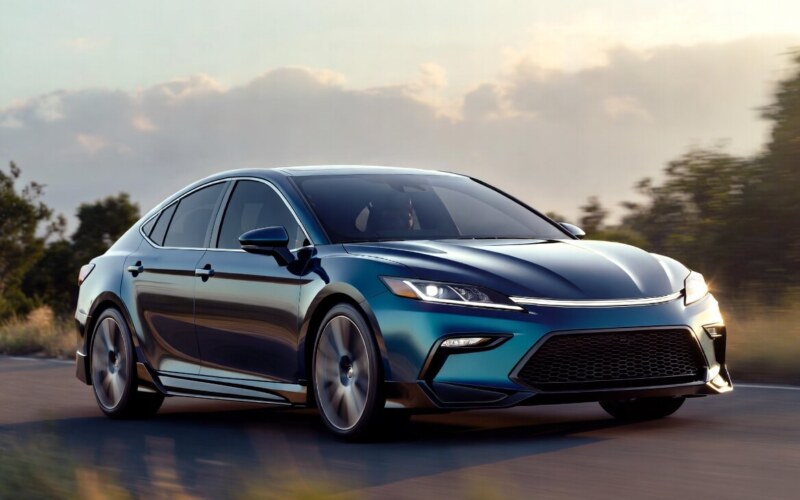
2028 Toyota Camry is shaping up to be one of the most anticipated updates in the nameplate’s recent history. After a ground-up redesign for the 2025 model year — and two largely unchanged carryover years in 2026 and 2027 — the 2028 Toyota Camry is confirmed for a midcycle refresh. According to Automotive News, Toyota’s traditional product cycle points squarely to 2028 as the year this generation receives its planned mid-life update. Expect updated styling, upgraded technology, and further improvements to what is already one of the most fuel-efficient midsize sedans on the market. The 2028 Camry goes on sale in late 2027 and starts from approximately $29,290.
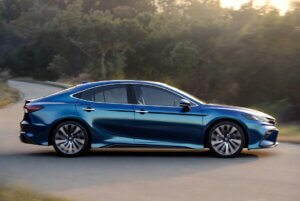
2028 Toyota Camry Overview
The Toyota Camry has been America’s best-selling car for over two decades. It earned that title through consistent reliability, strong fuel economy, broad model range, and the kind of long-term dependability that rivals struggle to match over full ownership cycles.
The current generation was completely redesigned for the 2025 model year — making a historic switch to a hybrid-only powertrain. No traditional gasoline-only engine is available. Every 2028 Toyota Camry sold in the US is a hybrid, producing up to 51 MPG combined in its most efficient configuration.
The 2028 Camry marks a natural midpoint in that generation’s lifecycle. The core architecture is unchanged — but Toyota is expected to deliver meaningful updates to the exterior, interior technology, and safety systems that keep the 2028 Toyota Camry competitive against rivals who have been updating their own products steadily since the Camry’s 2025 launch.
2028 Toyota Camry Release Date and Availability
The 2028 Toyota Camry is expected to go on sale in late 2027 — consistent with Toyota’s established pattern of releasing new model-year Camrys in late summer or early fall. CarsDirect projects a release date of fall 2027 based on historical patterns.
The 2028 Camry will be available at Toyota dealerships across the United States, Canada, the Middle East, and key international markets. The Camry is built at Toyota’s manufacturing plants in Georgetown, Kentucky — one of the most productive Toyota facilities in North America.
According to Autoblog, the 2027 Camry is “essentially a carryover model” — which makes the 2028 refresh the first real update buyers have been waiting for since the 2025 redesign. Toyota has not officially confirmed the full scope of 2028 changes at time of writing.
2028 Toyota Camry Price
The 2028 Toyota Camry is expected to start from approximately $29,290 for the base LE trim in front-wheel drive. CarsDirect projects this based on the current trend of approximately 1% annual price increases — the 2026 Camry started at $29,000, up $300 from 2025.
The full 2028 Toyota Camry lineup is expected to span five trims: LE, SE, Nightshade, XLE, and XSE — matching the current 2026 and 2027 structure. The AWD premium is expected to remain around $1,525 above equivalent FWD trims.
At the top of the range, the 2028 Camry XSE AWD is projected to land near $36,000–$37,500 including destination. That positioning keeps the Camry competitive against the Honda Accord Hybrid, Hyundai Sonata, and Kia K5 — all of which are expected to receive their own updates around the same model year window.
2028 Toyota Camry Engine and Performance
2028 Toyota Camry Powertrain: Hybrid Only
The 2028 Toyota Camry continues with the same hybrid-only powertrain strategy introduced in 2025. Every Camry — regardless of trim — uses a 2.5-litre naturally aspirated four-cylinder engine paired with one or two electric motors and a nickel-metal hydride battery pack.
Front-wheel-drive models use two electric motors and produce 225 horsepower combined. All-wheel-drive models add a third electric motor at the rear axle, raising combined output to 232 horsepower. The rear electric motor operates independently of the front powertrain — it adds AWD traction without a mechanical driveshaft connecting the axles.
No gasoline-only Camry is planned. Toyota made the hybrid-only decision for the Camry permanent with the 2025 redesign. The 2028 Toyota Camry carries that commitment forward — and given the powertrain’s outstanding efficiency credentials, there is no compelling reason to revisit it.
2028 Toyota Camry Horsepower and Acceleration
The 2028 Toyota Camry FWD produces 225 horsepower and 163 lb-ft of torque. The AWD model produces 232 horsepower. Both use a continuously variable automatic transmission (CVT) that is smooth in everyday driving and well-calibrated for efficient power delivery.
The 2027 Camry AWD covers 0–60 mph in approximately 7.0 seconds according to Autoblog’s testing. The FWD model takes slightly longer — around 7.4–7.6 seconds. These figures are adequate for daily driving and confident highway merging, though the 2028 Toyota Camry makes no claim to being a performance sedan.
The hybrid system delivers its power smoothly and quietly. There is meaningful torque available from a near-standstill — a characteristic of the electric motor assist that makes the 2028 Camry feel punchier in city traffic than its horsepower figure alone suggests.
2028 Toyota Camry Fuel Consumption
Fuel economy is one of the strongest arguments for the 2028 Toyota Camry. The current 2026 and 2027 models achieve up to 52 city / 49 highway / 51 combined MPG in FWD form — among the highest EPA ratings for any non-plug-in hybrid sedan on the market.
AWD models are rated at 44 city / 41 highway / 43 combined MPG — still exceptionally efficient for a midsize sedan with all-wheel drive. The 2028 Camry is expected to maintain these figures unless the midcycle refresh brings changes to the hybrid system.
In real-world driving, owners consistently report combined fuel economy in the 45–50 MPG range for FWD models in mixed conditions. For a full-size family sedan producing 225 horsepower, these numbers represent remarkable engineering — and they are the primary reason the 2028 Toyota Camry remains relevant in an era of SUV dominance.
2028 Toyota Camry Battery and Hybrid System
The 2028 Toyota Camry is not a plug-in hybrid. The battery pack — a nickel-metal hydride unit — charges through regenerative braking and engine operation only. There is no external charging port and no pure electric driving range.
This self-charging approach is deliberate. Toyota’s mass-market hybrid strategy prioritises convenience and accessibility over electric range — the 2028 Camry requires no behaviour change from the driver. You fill it with petrol and the hybrid system manages itself entirely.
A plug-in hybrid Camry is not planned for the 2028 model year. Toyota’s plug-in hybrid technology is currently deployed in the RAV4 Prime, Crown Plug-In Hybrid, and Prius Prime — not the Camry. Buyers who want plug-in capability in a Toyota sedan should consider the Crown PHEV instead.
Driving the 2028 Toyota Camry
The 2028 Toyota Camry drives the way a Camry always has — quietly, smoothly, and without drama. Autoblog’s 2027 review described it as “comfortable, roomy, and reliable” — and those qualities carry directly into the 2028 model year.
The hybrid powertrain is one of the most refined in the segment. Transitions between electric and combustion power are nearly imperceptible. The CVT is smooth and unobtrusive. Road and wind noise are well-managed at highway speeds.
The XSE trim adds sport-tuned suspension, 19-inch wheels, and front canards that give the 2028 Camry a more engaged feel without sacrificing the everyday comfort buyers expect. The XLE is the comfort flagship — soft suspension, 18-inch wheels, and all the available technology in a quieter, more refined package.
The 2028 Toyota Camry’s steering is light and accurate. Body control is good for a front-wheel-drive sedan. The AWD system adds reassurance in wet or slippery conditions without fundamentally changing the car’s character. This is a sedan that rewards relaxed, confident driving — not one that invites you to push limits.
2028 Toyota Camry Exterior Design
The 2025 redesign gave the Camry its most distinctive exterior in years — C-shaped daytime running lights, triangular headlights, a slim rectangular grille, and a prominent body line connecting the front fenders to the C-shaped taillights. The 2026 and 2027 models carried this design unchanged.
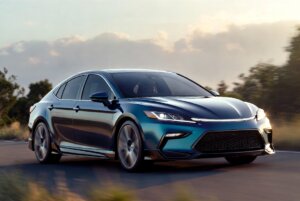
The 2028 Toyota Camry refresh is expected to bring updated front and rear styling — revised bumpers, new LED lighting signatures, and potentially updated grille designs across trims. Toyota typically uses midcycle refreshes to modernise the lighting and bumper treatment while preserving the overall silhouette.
New colour options are expected for 2028. The Nightshade trim — which added gloss-black exterior accents for 2026 — is expected to continue and may receive updated wheel designs. The XSE’s aerodynamic front canards and colour-matching mesh grille give it the sportiest look in the 2028 Camry range. The XLE’s chrome-finished accents and two-tone machined wheels remain the prestige choice.
2028 Toyota Camry Interior and Technology
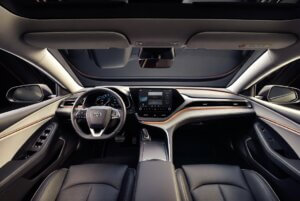
The current Camry’s interior is one of the strongest in the segment. The flat dashboard with its elongated L-shaped layout, triangular air vents, and clean horizontal lines give it a modern, premium feel. Soft-touch materials appear on key surfaces. The overall quality comfortably exceeds what buyers expect from this price point.
Standard technology on the 2028 Toyota Camry is expected to include an 8-inch touchscreen, a 7-inch digital instrument cluster, wireless Apple CarPlay and Android Auto, a wireless charging pad, five USB ports, a Wi-Fi hotspot, and six audio speakers. An available 12.3-inch digital instrument cluster with a head-up display is expected to continue on upper trims.
The midcycle refresh for 2028 is expected to bring software improvements and an updated Toyota Multimedia system — better over-the-air update capability, improved voice recognition, and a faster, more responsive touchscreen interface. Toyota’s connected services suite — including Drive Connect with Traffic Jam Assist — is expected to expand its feature set for 2028.
Interior space remains one of the 2028 Camry’s strongest practical arguments. Front and rear headroom are generous. Rear legroom at 41.3 inches is class-competitive. Boot space measures 15.1 cubic feet — slightly reduced from pre-2025 Camrys due to the hybrid battery packaging, but entirely adequate for family use.
2028 Toyota Camry Safety Systems
The 2028 Toyota Camry comes standard with Toyota Safety Sense 3.0 across every trim. This covers forward collision warning with pedestrian and cyclist detection, automatic emergency braking, lane departure warning with steering assist, lane-centering assist, adaptive cruise control, automatic high beams, road-sign recognition, and blind-spot monitoring.
Traffic Jam Assist — which manages steering, acceleration, and braking in stop-and-go motorway traffic — is available on upper trims via the Drive Connect subscription service. Rear cross-traffic alert and front and rear parking sensors are also available on higher specifications.
The current-generation Camry received a five-star NHTSA overall safety rating and top IIHS scores across key crash test categories. The 2028 Toyota Camry is expected to maintain those results — and the midcycle refresh may bring additional pedestrian and intersection detection improvements to the TSS 3.0 suite. Toyota covers the Camry with a three-year / 36,000-mile basic warranty and a five-year / 60,000-mile powertrain warranty, plus two years of free scheduled maintenance.
2028 Toyota Camry Pros and Cons
| ✅ Pros | ❌ Cons |
|---|---|
| Up to 51 MPG combined — best fuel economy in the midsize hybrid sedan class | No plug-in hybrid option — 0 miles of pure electric driving range |
| Midcycle refresh confirmed for 2028 — updated styling, tech, and safety expected | Full scope of 2028 changes not yet officially confirmed by Toyota |
2028 Toyota Camry Images
Specifications
Specifications
| Production year | 2028 |
| Body type & seats | Mid-Size Sedan, 5 Seats |
| Dimensions | Length: 4,920 mm • Width: 1,840 mm • Height: 1,445 mm • Wheelbase: 2,825 mm |
| Weight | 1,595–1,680 kg |
| Engine type | Hybrid Petrol Engine |
| Engine size & cylinders | 2.5-liter (2,487 cc) Inline-4 |
| Aspiration | Naturally Aspirated |
| Power | 225 hp (FWD) / 232 hp (AWD) (expected) |
| Torque | 221 Nm (engine) |
| Transmission | eCVT Automatic |
| Drivetrain | Front-Wheel Drive (FWD) or All-Wheel Drive (AWD) |
| Acceleration (0-100 km/h) | 7.0–7.3 sec (approx.) |
| Top speed | 180 km/h (estimated) |
| Fuel type | Regular Unleaded Gasoline |
| Fuel consumption | 4.5–5.0 L/100 km (combined) (estimated) |
| Fuel tank capacity | 50 Liters |
| Brakes | Ventilated Front Disc, Rear Disc, ABS, EBD, Brake Assist |
| Steering | Electric Power Steering (EPS) |
| Infotainment | 8-inch or 12.3-inch Toyota Audio Multimedia Touchscreen |
| Connectivity | Wireless Apple CarPlay, Android Auto, Bluetooth, Wi-Fi Hotspot, USB-C, Wireless Charging |
| Safety | Toyota Safety Sense 3.0, Pre-Collision System, Full-Speed Adaptive Cruise Control, Lane Tracing Assist, Lane Departure Alert, Blind Spot Monitor, Rear Cross Traffic Alert, Automatic High Beams, Road Sign Assist, Parking Sensors, 360° Camera (higher trims), 10 Airbags, TPMS. |
2028 Toyota Camry Price
 Price in USD
|
30,000 USD |
 Price in European Union
|
25,500 EUR |
 Price in United Kingdom
|
22,200 GBP |
 Price in Australia
|
45,900 AUD |
 Price in Canada
|
41,400 CAD |
 Price in India
|
2,619,000 INR |
 Price in China
|
215,400 CNY |
 Price in Indonesia
|
486,000,000 IDR |
 Price in Philippines
|
1,710,000 PHP |
 Price in Malaysia
|
126,600 MYR |
 Price in Nigeria
|
46,050,000 NGN |
 Price in Russia
|
2,413,800 RUB |
 Price in Pakistan
|
8,490,000 PKR |
 Price in Saudi Arabia
|
112,500 SAR |
 Price in Japan
|
4,410,000 JPY |
 Price in South Africa
|
529,200 ZAR |
 Price in Brazil
|
162,900 BRL |
 Price in Bangladesh
|
3,630,000 BDT |
 Price in Mexico
|
563,100 MXN |
More Products from Toyota