2026 BMW M3 EV : Price, Range, Specs & Interior
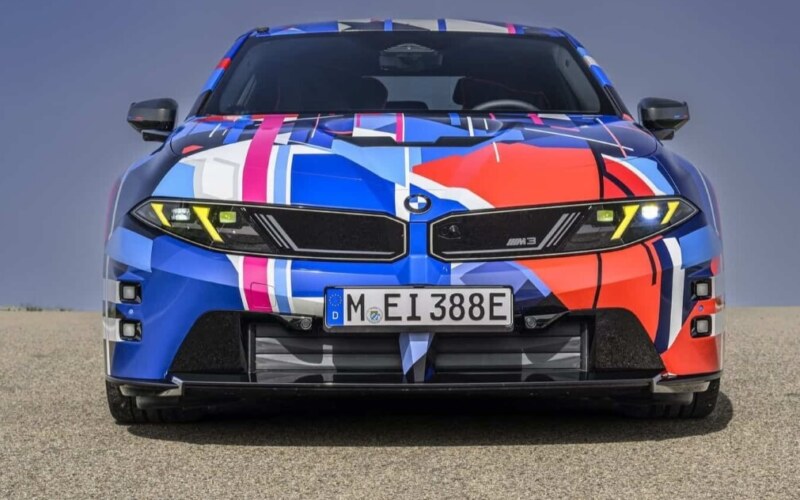
2026 BMW M3 EV is the car BMW fans have argued about for years: a fully electric M3 with four motors, an 800-volt system, and no inline-six under the hood. BMW previewed it at the Le Mans 24 Hours on June 12 with the M Concept Neue Klasse, and in October it confirmed that Plant Munich will build the production car. What BMW has not done is publish a price, a power figure, or a range. The “2026” in the name refers to the year the car was previewed, not a model you can order. This guide to the 2026 BMW M3 EV sorts what BMW has confirmed from what outlets are guessing, and explains why the horsepower number keeps changing.

2026 BMW M3 EV: Overview
The 2026 BMW M3 EV is the first fully electric M3, built on the Neue Klasse platform that already underpins the new iX3 and the i3 sedan. BMW M boss Frank van Meel has confirmed the production car will be called simply M3, without the “i” prefix BMW uses on its other electric models. Internally it’s codenamed ZA0, and the sedan is being developed alongside a petrol M3 with a hybrid inline-six, which reports say arrives later, in 2028.
The hardware BMW has described is dramatic: four electric motors, one per wheel but not in the wheels themselves, packaged in two drive units with their own gearboxes, plus an 800-volt architecture and a battery larger than 100 kWh. A control unit called “Heart of Joy” manages driving dynamics, and a system BMW calls M eDrive was developed by the M division’s engineers. For BMW’s other recent M news, see our 2027 BMW M2 Review.
2026 BMW M3 EV: What BMW Has Actually Confirmed
The confirmed list is shorter than the rumor list, so here it is plainly. BMW has confirmed that an electric M3 is coming, that it will use M Neue Klasse technology, and that it will wear the M3 name. In early October, during a ceremony marking the one-millionth BMW M car, an orange M3 built in Munich, the company said Plant Munich will be the exclusive home of the first fully electric M3. It will be the second Neue Klasse model built there after the i3.
Munich becomes an EV-only factory in 2027 after about 650 million euros of investment, and BMW says the electric and petrol M3 will be positioned at similar price points. Everything else, including power, range, and the reveal date, is still unconfirmed. Carexpert’s report on the milestone is blunt that BMW hasn’t confirmed the production car’s full specifications or exact launch timing.
The Power Figure Keeps Changing
| Reported figure | Where it comes from |
|---|---|
| 1,341 hp | The M Concept Neue Klasse (concept only) |
| 650 to 750 hp | Van Meel’s comments on the production launch, reported by autoevolution |
| 800 to 900 hp | Industry sources cited by Notebookcheck |
| About 838 hp (625 kW) | A provisional figure cited by one European outlet |
| About 750 kW (roughly 1,000 hp) | Overseas reports mentioned by Carexpert |
None of those is an official production number. The sensible reading is that BMW is still tuning the car and that the final figure will probably land between the low 800s and 900 horsepower, though that is inference, not fact.
2026 BMW M3 EV: Expected Price
BMW hasn’t announced pricing for the 2026 BMW M3 EV, so every number you see is a guess. Estimates range from “north of $80,000” in the U.S., to $85,000 to $100,000 from one preview site, to “past 100,000 pounds” in the UK. A European outlet says the press expects a price close to the current M3’s, which fits BMW’s statement that the electric and petrol cars will sit at similar price points.
That last point matters most. If BMW keeps both versions close in price, buyers will choose on powertrain preference rather than budget. If you’re using this guide to the 2026 BMW M3 EV to plan a purchase, wait for BMW’s official price list, and expect options to push real-world prices higher, as they do on every M car.
2026 BMW M3 EV: Release Date
The timeline is still moving. BMW is expected to unveil the production car in early 2027, and BMWBlog previously reported a March 2027 start of production. Press expectations for deliveries are summer 2027 in Europe, while Auto Express reported through autoevolution that the car would be unveiled in 2027 and reach the market in 2028. One U.S.-focused preview site expects American availability in late 2027.
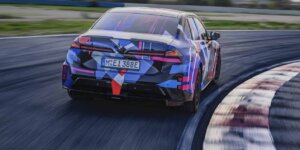
A camouflaged prototype was spotted testing in California on October 27, wearing the concept’s hood vent and a white paint job, so development is well advanced. The prototype also carries an M3 graphic on its roof, matching BMW’s teaser.
2026 BMW M3 EV: Motors and Performance
The 2026 BMW M3 EV uses four electric motors, one at each wheel, giving it torque vectoring that no single-motor car can match. BMW says the motors sit in two drive units with their own gearboxes, which keeps the weight low and the packaging tight. Notebookcheck reports that the car offers a rear-wheel-drive mode and simulated gearshifts, details aimed at making an electric M3 feel like an M3.
BMW M’s own priorities seem unusual for an EV. According to Notebookcheck, van Meel stressed repeatable performance over multiple track laps rather than chasing four-digit peak figures, which suggests the car is being designed around thermal endurance, not headline power.
Regenerative Braking
BMWBlog reports that the electric M3 can recover up to 540 kW under braking, 140 kW more than a Porsche Taycan Turbo GT. If that figure holds, the car could capture a large amount of energy in hard driving, which should also take some load off the friction brakes.
2026 BMW M3 EV: Horsepower and Acceleration
BMW hasn’t released an official 0-60 mph time. With power in the 800 to 900 horsepower range reported by industry sources, and all-wheel-drive traction from four motors, the car should be devastatingly quick off the line, but speculation about specific times isn’t useful. For context, the current gasoline M3 Competition makes 503 horsepower, or 523 with xDrive, according to one preview site’s comparison table.
The bigger question is how the car delivers that power. A concept-car figure of 1,341 horsepower proves the hardware can do it, but BMW M clearly doesn’t intend to chase that headline for the road car. Expect a calibrated, repeatable performance envelope.
2026 BMW M3 EV: Battery, Range and Charging
BMW says the M Concept Neue Klasse carries a battery over 100 kWh, and the related i3 sedan uses a 108 kWh pack, which may hint at the M3’s capacity. BMW hasn’t published a range figure. Some outlets guess at roughly 400 miles of EPA range, but that’s speculation, and a car built for track use will likely trade some efficiency for performance.
Charging should be fast. The i3 sedan charges at up to 400 kW and goes from 10 to 80 percent in about 21 minutes, and Notebookcheck expects the M3’s 800-volt system to exceed the standard iX3’s 400 kW peak. Treat that as an expectation until BMW publishes official numbers.
2026 BMW M3 EV: Driving Experience
No journalist has driven the production 2026 BMW M3 EV, so there are no driving impressions to report. What the concept and prototype testing suggest is a car designed to feel like an M3: a low center of gravity, four-motor torque vectoring, and a control brain focused on balance. BMW’s own language about “joy” and driving dynamics hints at that philosophy.
The prototype has also run on the Nürburgring Nordschleife, according to Notebookcheck, and on public roads in California. Final tuning is the big unknown: how it sounds, how the steering feels, and whether the simulated gearshifts add engagement or feel gimmicky will decide how enthusiasts respond.
2026 BMW M3 EV: Exterior Design
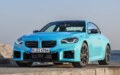
The M Concept Neue Klasse “jazzes up” the i3 sedan, in the words of one UK outlet, with a more aggressive stance and the M division’s styling cues. The production prototype looks similar enough that, at first glance, it might be mistaken for the concept in a new livery, with changes that point to a production car in disguise.
One concept detail has survived: the hood vent. BMWBlog notes the prototype in California retains it, which suggests BMW wants the cooling hardware visible. Beyond that, final design details such as wheels, aerodynamics, and lighting remain unconfirmed.

2026 BMW M3 EV: Interior and Technology
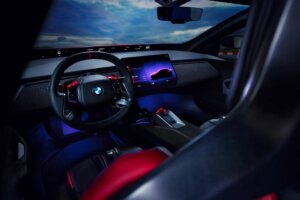
BMW hasn’t shown the production interior. Because the M3 EV shares its platform with the i3 and iX3, it will likely use BMW’s Panoramic iDrive system, which debuted on the iX3. That system runs on the “superbrain” architecture, with the Heart of Joy handling driving dynamics.
Expect M-specific seats, trim, and a performance-focused display layout, but treat that as expectation. BMW hasn’t published an equipment list or interior images for the production car.
2026 BMW M3 EV: Safety Systems
There are no crash-test results for the 2026 BMW M3 EV, and BMW hasn’t described its driver-assistance package. Results for related models, such as the iX3, don’t automatically carry over to a different body with a different weight and performance envelope. When testing happens, European results will appear on Euro NCAP’s website and American ratings on the IIHS ratings page.
For the latest reporting, BMWBlog’s prototype report, Notebookcheck’s technical rundown, and Carexpert’s production news are good starting points.
2026 BMW M3 EV vs. the Petrol M3
BMW plans to sell both. The current gasoline M3 will be followed by a new petrol version, reportedly with a hybrid inline-six, and BMW has said the electric and petrol cars will be priced similarly. That’s a rare approach for a manufacturer in the middle of an electric transition, and it means M3 buyers won’t be forced to choose between the two for budget reasons.
The electric car should be quicker in a straight line and cheaper to run if you charge at home, while the petrol car keeps the sound and the familiar feel. Which one is better depends on what you want from an M3. The petrol car is the safer choice for tradition, the electric one the bolder bet for the future.
2026 BMW M3 EV: Pros and Cons
What We Like About the 2026 BMW M3 EV
✓ Four motors and torque vectoring promise exceptional dynamics
✓ 800-volt architecture and very fast charging expected
✓ BMW prioritizes repeatable track performance over headline numbers
✓ Petrol M3 continues alongside, so buyers have a choice
✓ Production confirmed at Plant Munich
What Could Be Better on the 2026 BMW M3 EV
✗ No official power, range, or price figures
✗ Power reports range from 650 to nearly 1,000 horsepower
✗ Weight hasn’t been disclosed and is likely substantial
✗ Simulated gearshifts may divide enthusiasts
✗ U.S. timing remains unconfirmed
2026 BMW M3 EV: Main Competitors
The electric M3 will face the Porsche Taycan, the Audi RS e-tron GT, and the electric Mercedes-AMG GT 4-Door, along with the Tesla Model 3 Performance at the more affordable end, which we cover in our 2026 Tesla Model 3 Review. Note that Tesla has ended production of the Model S, so the Plaid is no longer a rival you can order new.
Against that field, the M3 EV’s pitch is brand heritage and a bespoke four-motor system tuned by BMW M. Whether it justifies the likely price depends on real-world testing, which hasn’t happened yet.
2026 BMW M3 EV: Final Verdict
On paper, the 2026 BMW M3 EV looks like a serious attempt to carry the M3 into the electric era. The four-motor layout, 800-volt architecture, and focus on repeatable track performance suggest BMW is taking the job seriously, and the decision to keep a petrol M3 alongside shows some humility about how fans will react.
But it’s still a preview. There’s no price, no confirmed power, no range, and no drive reports. Anyone following the 2026 BMW M3 EV should enjoy the technical details, treat the horsepower numbers as provisional, and wait for BMW’s early-2027 unveiling before drawing conclusions.
2026 BMW M3 EV Images
Specifications
Launch
| Announced | 2026, June 11 |
| Status | Coming soon. Expected release 2027 |
Body
| Type | 5 door sedan, 5 seats |
| Wheelbase | 2897 mm (114.1 in) |
| Suspension | Front: forged-aluminum swivel bearing, control arm and tension strut; aluminum composite axle carrier; Rear: five forged-aluminum links per side; cast-aluminum hub carriers; cast and welded aluminum a |
| Wheels | R20, R20/R21 |
| Frunk | Yes |
| Towing | No |
Performance
| Power | AWD 625 kW (838 hp) |
| Torque | 1200 Nm (885 lb-ft) |
| Acceleration | 2.8 sec 0-100 km/h |
Battery
| Capacity | 100 kWh usable |
| Tech | Liquid-cooled Li-ion (800V type) |
| Range | 650 km WLTP (483 km EPA) |
| Recuperation | Yes |
| Heat pump | Yes |
| AC Charging |
Type 2 11 kW Type 2 22 kW |
| DC Charging | CCS 420 kW max |
Displays
| Center | 17.9" touchscreen |
| Driver's | 43.3" (only a portion of it) |
| Head-up | Yes, projector type |
Comfort
| Seats | Heated front seats |
| Roof | Panoramic glass sunroof, tilt & slide or Panoramic glass sunroof with matt light transmission |
| Parking aids | Front and rear sensors, multiple cameras, Automatic Parking Assistance System |
| Connectivity | Wireless Android Auto and Apple CarPlay |
Safety
| Airbags | Front, side, rear, head airbag system |
| Driving aids | Front radar, multiple cameras. Front/Rear Crossing-Traffic Warning, Exit warning function, Parking Assist, Steering and Lane Control Assistant, Front collision warning with brake intervention, Active Lane Change Assistant, traffic light detection |
2026 BMW M3 EV Price
 Price in USD |
97,000 USD |
 Price in European Union |
82,450 EUR |
 Price in United Kingdom |
71,780 GBP |
 Price in Australia |
148,410 AUD |
 Price in Canada |
133,860 CAD |
 Price in India |
8,468,100 INR |
 Price in China |
696,460 CNY |
 Price in Indonesia |
1,571,400,000 IDR |
 Price in Philippines |
5,529,000 PHP |
 Price in Malaysia |
409,340 MYR |
 Price in Nigeria |
148,895,000 NGN |
 Price in Russia |
7,804,620 RUB |
 Price in Pakistan |
27,451,000 PKR |
 Price in Saudi Arabia |
363,750 SAR |
 Price in Japan |
14,259,000 JPY |
 Price in South Africa |
1,711,080 ZAR |
 Price in Brazil |
526,710 BRL |
 Price in Bangladesh |
11,737,000 BDT |
 Price in Mexico |
1,820,690 MXN |
More Products from BMW