2027 Mercedes AMG GT 63 SUV : Price, Range, Performance & Release Date
2027 Mercedes AMG GT 63 SUV is the most powerful production SUV ever built, and it’s electric. Mercedes-AMG revealed it in mid-October as the flagship of a new all-electric GT SUV family, with three axial-flux motors, a headline 1,153 horsepower, and a claimed 0-60 mph time of roughly 2.4 to 2.6 seconds. It’s also big, with a curb weight close to 6,000 pounds, and expensive, with UK estimates near 180,000 pounds. Mercedes writes the name “Mercedes-AMG GT 63 SUV,” and this guide to the 2027 Mercedes AMG GT 63 SUV explains the numbers, the pricing, and why the model year changes depending on which country you’re in.

2027 Mercedes AMG GT 63 SUV: Overview
The 2027 Mercedes AMG GT 63 SUV is AMG’s first full-size SUV developed entirely in-house. Until now, AMG’s SUVs have been tuned versions of standard Mercedes models like the GLE and GLS. This one is built on AMG.EA, a bespoke electric platform that reports describe as the second model on that architecture after the electric GT 4-Door Coupe. (For the naming overlap with the two-door car, see our 2027 Mercedes-AMG GT 55 Review.)
The family has three versions: the GT 53, the GT 55, and the flagship GT 63. The GT 53 uses two motors, while the GT 55 and GT 63 use three oil-cooled axial-flux motors, two driving the rear wheels and one at the front. Mercedes-AMG’s own GT SUV page positions the GT 63 as the high-performance flagship, and the numbers back that up.
2027 Mercedes AMG GT 63 SUV vs. Its Siblings
| Version | Motors | Peak power | 0-100 km/h (claimed) |
|---|---|---|---|
| GT 53 | 2 | 400 kW (544 PS) | 3.8 s |
| GT 55 | 3 | 600 kW (816 PS) | 2.8 s |
| GT 63 | 3 | 860 kW (1,169 PS) | 2.5 s |
2027 Mercedes AMG GT 63 SUV: Expected Price
Pricing for the 2027 Mercedes AMG GT 63 SUV isn’t official in most markets yet. In the UK, the entry-level GT 53 is confirmed at 113,775 pounds and can be ordered now, while CAR magazine estimates around 180,000 pounds for the GT 63 and says it will cost close to 200,000 pounds once options are added. In Germany, the GT 53 starts at 113,050 euros, and the GT 63’s price hasn’t been announced.
American pricing is also unannounced. Edmunds expects the GT 53 to start in the low $100,000s and says the GT 63 could pass $200,000. For comparison, Electrek notes that the rival Porsche Cayenne Turbo Electric is priced at $163,000 in the United States. If you’re using this guide to the 2027 Mercedes AMG GT 63 SUV to budget, treat every figure here as an estimate until Mercedes publishes official price lists.
2027 Mercedes AMG GT 63 SUV: Release Date
Timing depends on the version and the country. Orders for the GT 53 opened first in the UK and Germany, while the GT 55 and GT 63 are expected in spring 2027. For the United States, Forbes reports that the GT SUV will reach showrooms in summer 2027 as a 2028 model, while Edmunds lists an early 2027 release. That’s why you’ll see both “2027” and “2028” attached to the same car.
In practice, the “2027” in this car’s name is mostly a European label. American buyers should expect the model year on their window sticker to read 2028, and should verify the on-sale date with a Mercedes dealer.
2027 Mercedes AMG GT 63 SUV: Motors and Performance
The GT 63 uses three axial-flux motors supplied by the British firm YASA, according to CAR magazine. Axial-flux designs are shorter and lighter than conventional motors, which is why they’re popular in racing. Mercedes pairs them with an 800-volt electrical system and a Central Coolant Hub that keeps the battery and motors in their ideal temperature range, so the car can deliver repeated hard launches without heat soak.
Mercedes quotes a peak output of 860 kW, which is 1,169 PS in Europe and 1,153 horsepower in the American convention. Peak torque is 2,000 Nm, or 1,475 pound-feet. The AMG ACTIVE RIDE CONTROL+ suspension and carbon-ceramic brakes come standard on the GT 63.
Peak Power vs. Continuous Power
This is the detail that matters most. The 1,153 horsepower figure is a peak, available for about 63 seconds according to CAR. Under sustained load, Mercedes says 530 kW remains available, which is about 711 horsepower. That’s still enormous, and it’s roughly what the GT 63 delivers until the battery runs low, but it explains why the headline number should be read with care.
2027 Mercedes AMG GT 63 SUV: Horsepower and Acceleration
Mercedes claims 0-100 km/h in 2.5 seconds and 0-200 km/h in 6.8 seconds, with a top speed of 270 km/h, about 168 mph. US-style figures vary by source. Electrek lists 0-60 mph in 2.6 seconds, or 2.4 seconds with a one-foot rollout, while other databases show 2.7 seconds to 62 mph. These differences come from the measurement method and rounding, and all of them are manufacturer estimates rather than independent tests.
CAR magazine, which was among the first to drive the car, notes the GT 63 has about 100 horsepower more than the AMG One hypercar and nearly twice the power of AMG’s most powerful gasoline SUV, the GLE 63 S. For a look at that car, see our 2027 Mercedes-AMG GLE 63 S Review.
2027 Mercedes AMG GT 63 SUV: Battery and Driving Range
The GT 63 carries a 128 kWh usable battery, listed at 140 kWh gross by one database. Mercedes quotes up to 700 km of WLTP range, which is around 435 miles, and a combined energy consumption of 21.2 to 23.8 kWh per 100 km. WLTP ratings usually read higher than the EPA figures American buyers will see, and a car this powerful will use far more energy if driven hard.
The charging numbers are the real headline. Mercedes says the car can accept up to 710 kW on a compatible DC charger, which adds up to 454 km of WLTP range in 10 minutes, roughly 280 miles. Electrek reports a 10 to 80 percent charge in about 12 minutes. That requires an exceptionally powerful charger, so the headline speed will be hard to match on today’s public networks.
2027 Mercedes AMG GT 63 SUV: Driving Experience
CAR magazine’s first drive calls the GT 63 extremely fast and extremely capable, but it also questions the point of such excess. The car weighs about 2.7 tonnes, or 5,942 pounds, and the review flags that mass and the near-200,000-pound price as the catches. Forbes similarly notes the vehicle weighs nearly 6,000 pounds.
That weight is the trade-off for the battery and the performance. Active aerodynamics, rear-axle motor units, and adaptive suspension are meant to keep the car composed, and AMG says it’s engineered for repeated track use rather than one-off launches. Expect a car that feels more like a rocket than a sports car.
Simulated V8 Sound
AMG fits a synthetic sound system that mimics a V8, and coverage describes it as strong enough to shake the seats. Whether enthusiasts accept it or find it gimmicky will be one of the car’s more divisive talking points.
2027 Mercedes AMG GT 63 SUV: Exterior Design
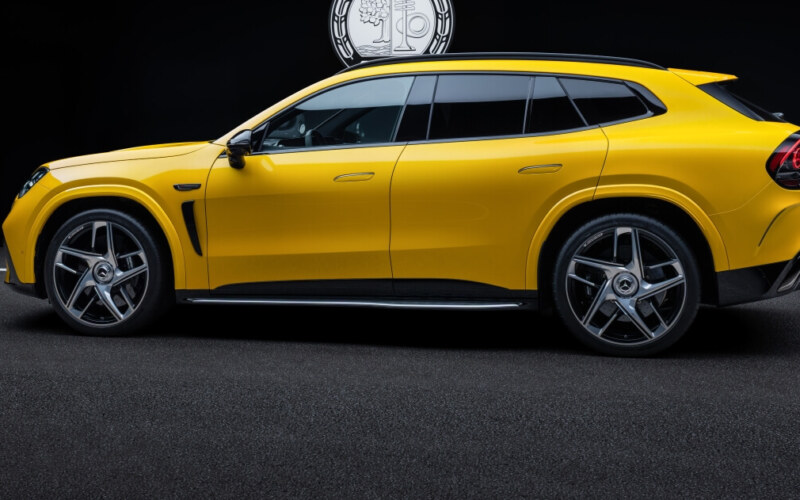
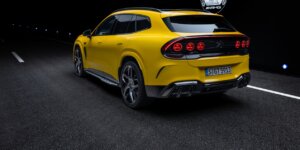
Mercedes’s photos show illuminated circular turbine-style LED lamps at the rear, a functional lower diffuser, and an active roof spoiler it calls AEROKINETICS. Mercedes quotes a top speed of 270 km/h, so the aerodynamics aren’t just for show.
Overall dimensions weren’t listed in the material we reviewed, but the car is described as full-size and seats five. One database lists cargo volume of 607 liters with the seats up and 1,740 liters with them folded, though that comes from a single secondary source.

2027 Mercedes AMG GT 63 SUV: Interior and Technology
Inside, the 2027 Mercedes AMG GT 63 SUV replaces traditional SUV seating with a low, sporty driving position. A triple-screen digital dashboard, ambient lighting, and a Burmester 4D sound system with stainless-steel speaker grilles round out the cabin highlights Mercedes has shown so far.
A full trim-by-trim equipment list wasn’t available in the material we reviewed. If you’re considering the car, ask your dealer what’s standard on the GT 63 and what is an extra-cost option, because Mercedes usually leaves a long options list.

2027 Mercedes AMG GT 63 SUV: Safety Systems
No crash-test results exist for the 2027 Mercedes AMG GT 63 SUV yet. Euro NCAP publishes European results on its website, and the IIHS lists American ratings on its ratings page. Given the car’s weight and speed, standard carbon-ceramic brakes are an important safety feature in their own right.
For independent impressions, CAR magazine’s first-drive review is the most detailed we found, and Electrek’s reveal coverage breaks down the numbers against rivals.
2027 Mercedes AMG GT 63 SUV vs. the GT 55: Which Should You Choose?
The GT 55 is the more sensible way into the three-motor family. It keeps the same axial-flux layout but trims peak output to 600 kW (816 PS), and Electrek reports the same 711 horsepower of continuous output for both the GT 55 and the GT 63, which suggests the day-to-day difference is smaller than the headline gap implies. In other words, the flagship’s extra power is mostly a short burst, and many drivers will rarely notice it outside of a hard launch. The GT 55 also offers a smaller 106 kWh battery option, which should cut cost and weight.
The GT 63 is for buyers who want the biggest number, the quickest claimed acceleration, and standard carbon-ceramic brakes. If you’ll mostly drive on public roads, the cheaper GT 55 may deliver nearly everything you’ll ever use, and the GT 53 is the most affordable way to get the AMG.EA platform. Buyers should wait for official pricing, since the gap between the versions will decide whether the flagship feels like a bargain or a vanity purchase.
2027 Mercedes AMG GT 63 SUV: Pros and Cons
What We Like About the 2027 Mercedes AMG GT 63 SUV
✓ World’s most powerful production SUV at 1,153 horsepower peak
✓ Claimed 0-60 mph time between 2.4 and 2.6 seconds
✓ Up to 710 kW charging, 10 to 80 percent in about 12 minutes
✓ Up to roughly 435 miles of WLTP range
✓ Carbon-ceramic brakes and active suspension standard
What Could Be Better on the 2027 Mercedes AMG GT 63 SUV
✗ Weighs nearly 6,000 pounds
✗ Peak power lasts only about 63 seconds at a time
✗ No official U.S. price, with estimates above $200,000
✗ Charging speeds depend on very powerful chargers
✗ Simulated V8 sound may divide enthusiasts
2027 Mercedes AMG GT 63 SUV: Main Competitors
The 2027 Mercedes AMG GT 63 SUV’s most direct rival is the Porsche Cayenne Turbo Electric. Electrek’s comparison lists the Porsche at 1,139 horsepower, 2.4 seconds to 60 mph, a 113 kWh battery, and 400 kW charging, against the Mercedes’s 1,153 horsepower, a 128 kWh pack, and 710 kW charging. The Porsche costs $163,000 in the United States, while the Mercedes has no official American price.
Against that field, the Mercedes wins on paper for charging and battery size, though the Porsche has the advantage of a published price. For a more attainable electric Mercedes, see our 2026 Mercedes C400 4MATIC guide.
2027 Mercedes AMG GT 63 SUV: Final Verdict
On paper, the 2027 Mercedes AMG GT 63 SUV is an extraordinary machine. It combines headline-grabbing power, race-derived motors, and charging speeds that no rival matches, and early drives confirm that it’s astonishingly fast. It’s also a car of excess, with a weight problem close to 6,000 pounds, a price that could top $200,000, and peak numbers that you can’t hold for long.
Anyone considering the 2027 Mercedes AMG GT 63 SUV should wait for American pricing, read independent road tests, and decide whether they want the flagship or the cheaper GT 55, which keeps the three-motor layout for less. Whichever version they choose, this is AMG’s loudest statement yet about the electric future, and a sign of how quickly the performance-SUV race is moving beyond gasoline engines.
2027 Mercedes AMG GT 63 SUV Images
Specifications
Launch
| Announced | 2026, October 17 |
| Status | Coming soon. Expected release 2027 |
Body
| Type | 5 door sedan, 4 seats |
| Dimensions | 5084 x 2001 x 1656 mm (200.2 x 78.8 x 65.2 in) |
| Drag coef. | 0.27 Cd |
| Wheelbase | 3040 mm (119.7 in) |
| Weight | EU: 2695 kg unladen |
| Suspension | AMG Active Ride Control suspension with semi-active roll stabilisation, Multi-link front and rear axles, rear-axle steering up to 6˚ |
| Wheels | R19, R20, R21 |
| Trunk | EU: 607 l, 1740 l max |
| Frunk | 111 l |
| Towing | No |
Performance
| Power | AWD 860 kW (1169 hp) |
| Torque | 2000 Nm (1475 lb-ft) |
| Acceleration | 2.5 sec 0-100 km/h |
| Max speed | 270 km/h (168 mph) |
Battery
| Capacity | 128 kWh usable |
| Tech | Liquid-cooled NCMA (800V type) |
| Range | 700 km WLTP |
| Consumption | 21.2 kWh/100 km WLTP |
| Recuperation | Yes |
| Heat pump | Yes |
| AC Charging | Type 2 11 kW |
| DC Charging | CCS 710 kW; 10-80% in 12 min 10 minute charge = 454 km |
Displays
| Center | 14" touchscreen |
| Driver's | 10.2" |
| Head-up |
Yes, with augmented reality Passenger display 14" |
Comfort
| Seats | Heated and cooled front seats, heated outer rear seats, hot-stone massaging seats |
| Roof | Panoramic glass sunroof with electrochromic variable light transmission and illuminated AMG crests |
| Parking aids | Front and rear sensors, 360 camera, reversing camera, self parking, remote parking assist |
| Connectivity |
Fingerprint sensor for biometric authentication of the driver to activate profile, Front/Rear Automatic Doors with smart power open/close THERMOTRONIC automatic air conditioning |
Safety
| Airbags | Front, side, rear, center, head airbag system, front seats knee airbags, belt airbags for rear seats, third row side head aibags |
| Driving aids | 5 radars, 10 cameras, 12 ultrasonic sensors. Traffic sign assistant, Active Lane Keeping Assist, Active distance assistant Distronic, Adaptive high beam assistant, Active Brake Assist with cross-traffic function, Pedestrian warning function in the area of zebra crossings, Active Emergency Stop Assist, Active Evasive Steering Assist, Congestion emergency braking function, PRE-SAFE PLUS and Impulse Side with body-raising function |
2027 Mercedes AMG GT 63 SUV Price
 Price in USD |
131,000 USD |
 Price in European Union |
111,350 EUR |
 Price in United Kingdom |
96,940 GBP |
 Price in Australia |
200,430 AUD |
 Price in Canada |
180,780 CAD |
 Price in India |
11,436,300 INR |
 Price in China |
940,580 CNY |
 Price in Indonesia |
2,122,200,000 IDR |
 Price in Philippines |
7,467,000 PHP |
 Price in Malaysia |
552,820 MYR |
 Price in Nigeria |
201,085,000 NGN |
 Price in Russia |
10,540,260 RUB |
 Price in Pakistan |
37,073,000 PKR |
 Price in Saudi Arabia |
491,250 SAR |
 Price in Japan |
19,257,000 JPY |
 Price in South Africa |
2,310,840 ZAR |
 Price in Brazil |
711,330 BRL |
 Price in Bangladesh |
15,851,000 BDT |
 Price in Mexico |
2,458,870 MXN |
More Products from Mercedes