2026 Tesla Roadster : Price, Range, Performance & Release Date
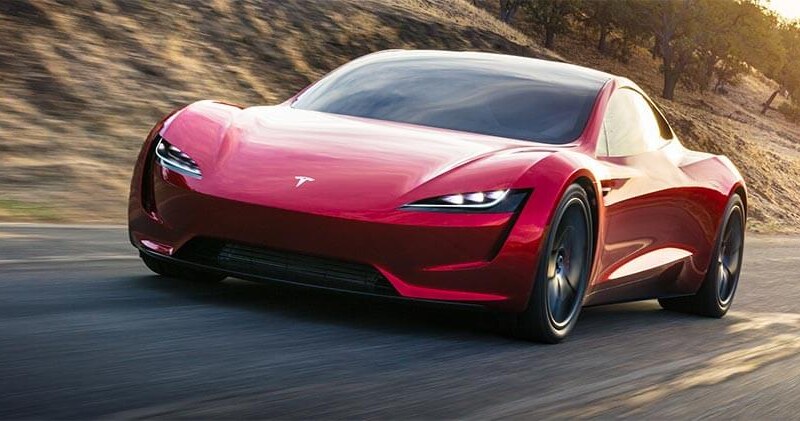
2026 Tesla Roadster is the first headline in nearly nine years that comes with real footage attached. On the night of October 15, Tesla finally pulled the cover off its second-generation sports car at SpaceX’s test site in McGregor, Texas, and then did something no production-bound car has ever done on stage: it drove up a curved ramp, hung upside down on suction, launched off the top, flipped, and landed on cold-gas thrusters before hopping over a row of Tesla vehicles. What the company did not do is announce a price or a delivery date. This guide to the 2026 Tesla Roadster sorts out what Tesla has actually claimed, what it left out, and why the “2026” in the name describes the reveal rather than a car you can buy today.

2026 Tesla Roadster: Overview
The 2026 Tesla Roadster arrives as a three-tier family rather than a single car. The base Performance version is billed as road-ready, seats two, and uses active aerodynamics plus what Tesla calls a multi-mode suction system. Above it sit two add-on packages that Tesla treats as “augments”: Thrust, a race-oriented two-seater with rear-mounted cold-gas thrusters, and Rocket, a single-seat version with thrusters around the body for upward and rotational movement. Elon Musk said on the reveal stream that production should begin in 2028, while Tesla’s own Roadster page gives no date at all.
It helps to be blunt about where things stand. Nobody outside Tesla has driven this car, every number below is a manufacturer claim, and the stunts in the demo were performed by the Rocket configuration, which Tesla itself marks as not approved for public road use. That context matters for anyone weighing a reservation. For a look at how an earlier, long-delayed Tesla halo project behaved once it reached real customers, see our 2027 Tesla Cybertruck Review.
2026 Tesla Roadster Versions at a Glance
| Version | Seats | Claimed 0-60 mph | Reservation |
|---|---|---|---|
| Performance | 2 | Under 1.6 seconds | $50,000 deposit |
| Thrust | 2 | Under 0.9 seconds | $250,000 deposit |
| Rocket | 1 | Under 0.59 seconds | Invite only |
2026 Tesla Roadster: Nine Years of Slipped Dates
You can’t read anything about the 2026 Tesla Roadster without the history, because the history is the reason for the skepticism. Tesla first showed a prototype in November 2017 and promised production in 2020. The target then moved to 2021 in July 2020, to 2022 in January 2021, and to 2023 that September. In early 2024 the company said it had radically raised the car’s design goals and pointed to a demo by the end of that year and production in 2025.
The most recent stretch has been just as bumpy. At the November 2025 shareholder meeting, Musk set a tentative demo date of April 1, 2026, with production roughly 12 to 18 months later. In June 2026, The Information reported the demo had slipped to August or later. Tesla then teased a “Go for launch” event for October 1 and moved it to October 15 because of rain in the forecast. Measured from a mid-October demo, Musk’s own 12-to-18-month guidance lands in late 2027 or early 2028, which is consistent with the 2028 production target he gave on stage.
2026 Tesla Roadster: Expected Price
Tesla did not announce a price for any version of the 2026 Tesla Roadster. What exists is a reservation structure. The Performance version requires a $50,000 deposit, reported as $5,000 due at reservation and the remaining $45,000 within 10 days or the reservation is canceled. The Thrust version requires a $250,000 deposit, five times the Performance figure, and the Rocket cannot be reserved without an invitation.
For context, the 2017 version carried a stated base price of $200,000, with a $250,000 Founders Series, and the original 2008 Roadster started at $98,950. Those numbers are anchors, not forecasts. With Tesla saying nothing about final pricing, anyone using this 2026 Tesla Roadster guide to budget should treat every dollar figure as a deposit or a historical reference rather than a sticker price.
What the Reservation Money Actually Buys
A reservation is a place in line, not a purchase contract for a priced car. Because no final price or confirmed delivery date has been published, the deposit effectively commits buyers to a vehicle whose cost and timing are still open. Read the reservation agreement closely, particularly the refund terms, before sending money.
2026 Tesla Roadster: Release Date
Musk said production of the 2026 Tesla Roadster should start in 2028 at Giga Texas. Tesla’s website lists no date, and news outlets covering the reveal noted that the company has not announced a delivery schedule for any version. Given the car’s track record of moving targets, 2028 is best read as an intention rather than a promise.
It also helps to separate the three versions. Performance is by reservation, Thrust is described as a limited release, and Rocket is invitation-only and not offered in every region. Which of them reaches customers first, and in what order, hasn’t been spelled out.
2026 Tesla Roadster: Engine and Performance
As an electric car, the 2026 Tesla Roadster has no engine, and Tesla followed its usual habit of leaving motor count, power output, and battery capacity off the reveal. Performance claims instead center on 0-60 mph times and on the thruster hardware developed with SpaceX. The car is built around a lightweight structure that Teslarati’s rundown describes as mixing magnesium, titanium, and carbon fiber.
The unusual part is the hardware around the powertrain. Performance gets active aerodynamics and a multi-mode suction system, essentially fans that pull the car toward the road. Thrust adds rear cold-gas thrusters. Rocket adds roughly ten thrusters distributed around the body, a figure Musk himself offered, to push the car up and rotate it in the air.
How the Cold-Gas Thrusters Work
Cold-gas thrusters are not rocket engines. They release compressed gas through nozzles to create thrust, with no combustion involved. Reporting on the reveal describes pressure vessels holding compressed air that onboard compressors refill. Tesla claims the thrusters can produce four to five times the force the tires can handle, which is the whole point: a conventional car’s acceleration is capped by tire grip, and thrust bypasses that limit.
2026 Tesla Roadster: Horsepower and Acceleration
Tesla has not published horsepower or torque for the 2026 Tesla Roadster. The acceleration claims are the headline instead. Performance is listed at under 1.6 seconds to 60 mph, which already beats the 1.9 seconds promised in 2017. Thrust is claimed at under 0.9 seconds, and Rocket at under 0.59 seconds with a top speed above 230 mph. Tesla showed a launch video displaying a 0.81-second run, according to one outlet’s tally of the reveal materials.
Tesla’s own Roadster page says the headline specifications reflect the optional Thrust upgrade, so buyers shouldn’t assume the road-going Performance version delivers the fastest numbers without it. Also worth remembering: Musk said back in 2019 that a base model would manage 2.1 seconds before adding thrusters. As Electrek pointed out, the new claims sit well beyond anything on the market, including the Rimac Nevera. None of it has been independently measured.
2026 Tesla Roadster: Battery and Driving Range
Range is one place where the story has moved backward. The 2017 promise was 620 miles on a charge, and the 2026 Tesla Roadster is now quoted at over 300 miles. Tesla hasn’t announced a battery capacity or charging rate, and several outlets covering the reveal flagged the missing range and battery details as one of the biggest open questions.
The halved range target may simply reflect the added hardware and the performance ambitions, but that is speculation. Until Tesla publishes real figures, treat the 300-mile number as a marketing target rather than an EPA-style rating. Fuel-economy ratings obviously don’t apply, and no efficiency data has been released.
2026 Tesla Roadster: Driving Experience
No journalist has driven the 2026 Tesla Roadster, so there is no honest way to describe how it feels. What the October 15 demo did show is capability under controlled conditions: a car clinging to a ramp upside down, launching, rotating, and landing on thrusters. That’s an engineering showpiece, and it was performed by the Rocket configuration, not by something you could register.
The more practical question is what the Performance trim is like on an ordinary road. Tesla calls it road-ready, with active aero and suction to keep it planted, but it hasn’t provided driving impressions, weight, tire specifications, or suspension details. Anyone expecting a firm verdict on handling, ride quality, or noise will have to wait for independent testing, which is still at least a year away if the 2028 timeline holds.
The Thrust Trade-Off
Thrust is described as race-ready, which hints at who it’s for: track-day buyers who want launch performance no tire can deliver. How the thrusters behave in sustained use, how often the tanks need refilling, and what that costs in time and energy are all unanswered. Those details will decide whether the augments are a daily feature or a party trick.
2026 Tesla Roadster: Exterior Design
Visually, the 2026 Tesla Roadster looks like a Tesla that’s been through a rocket company. The car in the demo was finished in Ano White, a paint Tesla says is inspired by aerospace coatings, with gold-tinted glass modeled on spacesuit visors. Hidden headlights and a full-length taillight round out the details Tesla has shared so far.
Electrek described the design as the latest round of Tesla’s “cyberfication,” and the sharp, low silhouette fits that description. Since Thrust and Rocket are add-ons to the Performance car, the core body should look similar across the lineup, with the thruster nozzles and perimeter hardware being the most visible differences on the flight-capable version.
2026 Tesla Roadster: Interior and Technology
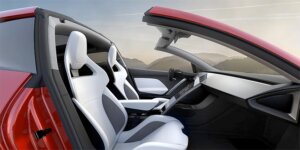
Tesla hasn’t shown a detailed cabin or published an infotainment specification for the 2026 Tesla Roadster. We know the Performance and Thrust versions seat two and the Rocket seats one. One reported detail is a steer-by-wire system, though that comes from a single secondary source, so it deserves a grain of salt until Tesla confirms it. Teslarati’s rundown also mentions a fixed seat position, consistent with a weight-focused build.
Expect Tesla’s usual minimalism, but treat that as an assumption. For anything concrete, the company’s own Roadster page is the place to check as details are added.
2026 Tesla Roadster: Safety Systems
There is no crash-test data, no airbag or structure details, and no driver-assistance specification for the 2026 Tesla Roadster. Tesla calls the Performance version road-ready, but it has not described any homologation work, and its website states plainly that the Rocket is not approved for public road use. Musk himself said he wasn’t sure the flight-capable version would be legal everywhere, and reporting on the reveal found no FAA certification for a thruster-equipped car.
In practice, road-legal status will come down to federal and state rules that Tesla hasn’t yet addressed publicly. Buyers can follow vehicle regulations through the National Highway Traffic Safety Administration, which sets the safety standards any road-going Roadster would have to meet.
2026 Tesla Roadster: Pros and Cons
What We Like About the 2026 Tesla Roadster
✓ Claimed acceleration beyond anything currently on sale
✓ Three-tier lineup lets buyers choose road, track, or showpiece
✓ SpaceX-developed thrusters are real engineering, demonstrated live
✓ Performance trim’s claim already beats the 2017 promise of 1.9 seconds
✓ Striking, aerospace-inspired design with distinctive details
What Could Be Better on the 2026 Tesla Roadster
✗ No price announced for any version
✗ No delivery date, only a 2028 production target from Musk
✗ Range target roughly halved from 620 to over 300 miles
✗ Battery size, power output, and charging details missing
✗ Rocket not approved for public road use, with legality uncertain
2026 Tesla Roadster: Main Competitors
On paper, the 2026 Tesla Roadster competes with the quickest electric hypercars, and the Rimac Nevera is the usual yardstick. Electrek noted that even the Performance trim’s claim and the far more extreme Thrust and Rocket numbers go beyond what the Nevera offers. The catch is that the Nevera is real, priced, and delivering, while the Roadster is a set of claims with a 2028 target.
Against traditional combustion and hybrid supercars, the Roadster’s pitch is simple and brash: Musk described the original idea as delivering a hardcore smackdown to gasoline cars. Whether it holds up depends entirely on real-world testing, real pricing, and real delivery, none of which exist yet. Shoppers who want a Tesla they can actually order today can start with our 2027 Tesla Model Y Review.
2026 Tesla Roadster: Should You Reserve One?
That depends on how much risk a buyer is comfortable carrying. The Performance reservation is reported at $50,000 in total, with $5,000 due up front and $45,000 within 10 days. The Thrust deposit is $250,000. Both are large sums to commit to a car with no stated price, no delivery date, and a long record of missed deadlines. This isn’t financial advice, but the sensible move is to read the reservation terms carefully, confirm what is refundable and when, and avoid assuming 2028 is guaranteed.
For buyers who just want to follow along, there’s no cost to watching. The best signals will be Tesla publishing real battery, power, and pricing figures, followed by independent road tests. Until then, the 2026 Tesla Roadster is best understood as a headline-grabbing demonstration of what Tesla and SpaceX can build together, not a car on a delivery calendar.
2026 Tesla Roadster: Final Verdict
As a spectacle, the 2026 Tesla Roadster delivered. Seeing a car flip in midair and land on thrusters made the long wait feel, briefly, worthwhile, and the claimed performance numbers, if even partly true, would reset expectations for what a road car can do. The decision to build the lineup around optional thruster augments also gives Tesla a clever way to separate everyday buyers from the track-and-showpiece crowd.
As a product, it’s still unfinished business. There’s no price, no delivery date, no battery or power figures, and a range target that has been cut roughly in half since 2017. Anyone following the 2026 Tesla Roadster should enjoy the show, keep their expectations measured, and wait for independent testing and official pricing before treating any of these numbers as settled.
2026 Tesla Roadster Images
Specifications
Launch
| Announced | Expected announcement 2026 |
| Status | Coming soon. Expected release 2026 |
Body
| Type | 2 door, coupe convertible, 4 seats |
| Suspension | Adaptive Air suspension |
| Wheels | R |
| Frunk | No |
| Towing | Yes |
Performance
| Power | AWD |
| Torque | 10000 Nm (7376 lb-ft) |
| Acceleration | 1 sec 0-60 mph |
| Max speed | 402 km/h (250 mph) |
Battery
| Capacity | 200 kWh total |
| Tech | Liquid-cooled Li-ion |
| Range | 1000 km WLTP |
| Recuperation | Yes |
| Heat pump | Yes |
| AC Charging | Type 2 11 kW |
| DC Charging | CCS 250 kW max |
Displays
| Center | 17" touchscreen |
| Driver's | Yes |
| Head-up | No |
Comfort
| Seats | Heated and ventilated front seats |
| Roof | Retractable glass hard top |
| Parking aids | Yes |
Safety
| Driving aids | 3 front, 2 side and 3 rear cameras, 6 front and 6 rear sensors (up to 250m object detection). Automatic Emergency Braking, Dynamic Brake Lights, Lane Assist, Collision Avoidance Assist, Speed Assist, Lane Departure Avoidance, Traffic Light and Stop Sign Control |
| Self driving | Autopilot with full Self-Driving capability |
2026 Tesla Roadster Price
 Price in USD |
250,000 USD |
 Price in European Union |
212,500 EUR |
 Price in United Kingdom |
185,000 GBP |
 Price in Australia |
382,500 AUD |
 Price in Canada |
345,000 CAD |
 Price in India |
21,825,000 INR |
 Price in China |
1,795,000 CNY |
 Price in Indonesia |
4,050,000,000 IDR |
 Price in Philippines |
14,250,000 PHP |
 Price in Malaysia |
1,055,000 MYR |
 Price in Nigeria |
383,750,000 NGN |
 Price in Russia |
20,115,000 RUB |
 Price in Pakistan |
70,750,000 PKR |
 Price in Saudi Arabia |
937,500 SAR |
 Price in Japan |
36,750,000 JPY |
 Price in South Africa |
4,410,000 ZAR |
 Price in Brazil |
1,357,500 BRL |
 Price in Bangladesh |
30,250,000 BDT |
 Price in Mexico |
4,692,500 MXN |
More Products from Tesla