- Home
- Volkswagen
- 2027 Volkswagen Teramont
2027 Volkswagen Teramont: Price, Interior, Specs, Towing Capacity, and Review
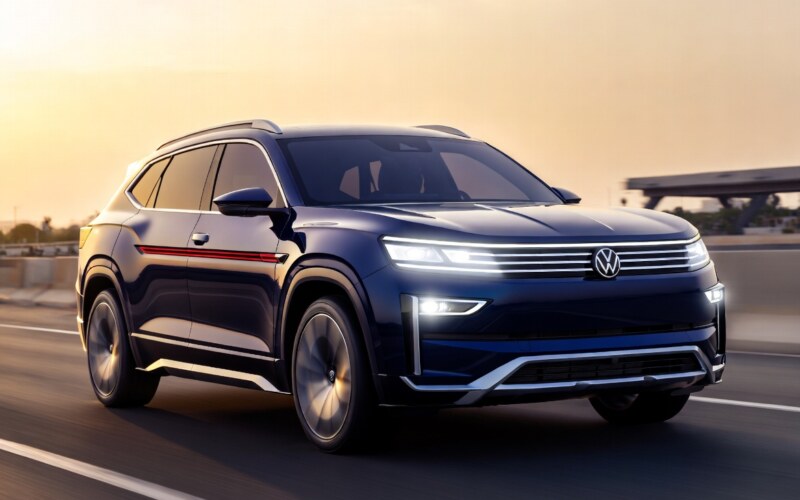
2027 Volkswagen Teramont arrives as one of the most significant updates the nameplate has ever received — a genuine second-generation redesign that touches virtually everything, from the platform underneath to the pixels on the screen. Unveiled in its global form at the New York International Auto Show on March 31, 2026, this isn’t a facelift dressed up as something more. The 2027 Teramont is new bodywork, new interior architecture, a new platform, a revised engine, and a technology suite that finally brings the large family SUV into line with what buyers in 2027 actually expect. For families in the Middle East and beyond who have long trusted the Teramont as their go-to three-row SUV, the timing couldn’t be better.
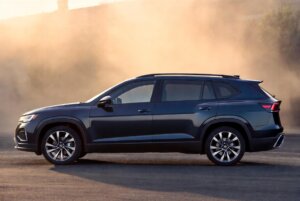
2027 Volkswagen Teramont: Overview of the New Generation
The Volkswagen Teramont — marketed as the Atlas in North America, Canada, and a handful of other markets — has been a quiet success story since its original 2017 debut. Built around the straightforward proposition of maximum space at a competitive price, it found a loyal audience among families who needed genuine three-row practicality without the badge premium of an Audi or the styling boldness of American rivals. It received meaningful updates in 2021 and a substantial interior overhaul for 2024, but the 2027 Volkswagen Teramont represents something more fundamental: Volkswagen calling the first generation complete and starting fresh.
The brief for the 2027 Teramont was clearly to address every significant criticism the first generation accumulated over a decade of production: dated technology at launch, a powertrain that felt conservative even by family SUV standards, interior materials that didn’t quite justify the asking price, and a third row that adults treated as a last resort rather than a genuine seat. Volkswagen appears to have listened carefully. The result is a second-generation Teramont that is larger, sharper, more powerful, better equipped, and far more technologically convincing than what it replaces.
2027 Volkswagen Teramont Release Date and Market Availability
The 2027 Volkswagen Teramont was officially revealed without camouflage on March 31, 2026, following a prototype drive program in Canada in February of the same year. North American deliveries under the Atlas name are expected to begin at dealerships in the fall of 2026, with the vehicle registering as a 2027 model year.
For Middle Eastern markets — where the 2027 Volkswagen Teramont name is used — launch timing is expected in early 2027, following the North American rollout. The Teramont is produced at the Volkswagen plant in Chattanooga, Tennessee, which serves global markets outside China. According to Autoblog, who drove an early prototype, the new generation represents a wholesale transformation rather than an incremental improvement — a characterization that aligns with Volkswagen’s own description of the update as a full second generation.
2027 Volkswagen Teramont Price: What to Expect
Official pricing for the 2027 Volkswagen Teramont has not been confirmed across all markets at time of writing. In North America, where it is sold as the Atlas, Kelley Blue Book and CarGurus both estimate a starting price in the low-$40,000 range — a modest increase over the 2026 model’s $40,785 entry point, in line with what a full-generation redesign typically commands. Top-trim SEL Premium configurations are expected to approach the upper-$50,000 range.
For Middle Eastern markets, the 2027 Volkswagen Teramont has historically been priced competitively against the Kia Telluride, Toyota Highlander, and Hyundai Palisade, and Volkswagen’s positioning strategy suggests that tradition will continue. The Teramont’s value proposition — European engineering at a price point below German premium alternatives — remains central to its identity in the region.
Engine and Performance of the 2027 Volkswagen Teramont
2027 Volkswagen Teramont: New EA888 Evo5 Engine
The headline powertrain story for the 2027 Volkswagen Teramont is the adoption of the fifth-generation EA888 evo5 2.0-litre turbocharged four-cylinder engine — the same significantly revised unit that powers the latest Tiguan in its more potent configurations. In Teramont duty, this engine produces 282 horsepower (approximately 210kW) and an estimated 258 lb-ft (350Nm) of torque, representing a gain of 13 horsepower over the 2026 model. Volkswagen achieved this improvement through a higher compression ratio, strengthened internals, and a variable geometry turbocharger — the same technology that also brings meaningful efficiency gains alongside the performance uplift.
Horsepower, Acceleration, and Towing Capacity
The 282-horsepower output pairs with an eight-speed automatic transmission, replacing the previous setup. Front-wheel drive is standard on entry trims, with Volkswagen’s 4Motion all-wheel-drive system available across the range — and standard on higher specifications that Middle Eastern buyers typically favor. The previous 269-horsepower Teramont/Atlas covered 0–100 km/h in approximately 7.3–7.5 seconds; the new model’s additional power and revised transmission calibration should bring that figure closer to seven seconds flat.
Towing capacity remains at 2,268kg (5,000 lb) when properly equipped — unchanged from the previous generation and a genuinely competitive number in the three-row family SUV segment. The 2027 Volkswagen Teramont also confirms that a hybrid powertrain variant is planned, with Volkswagen stating it is “pencilled in for the midcycle refresh” — expected around 2029. That electrified option will add a new dimension to the Teramont’s efficiency story when it arrives.
Fuel Consumption of the 2027 Volkswagen Teramont
The EA888 evo5 engine in the 2027 Volkswagen Teramont delivers EPA-rated figures of 22 city / 29 highway / 25 combined MPG with front-wheel drive, and 20 city / 27 highway / 23 combined MPG with 4Motion all-wheel drive — improvements of approximately 2 MPG combined over the previous generation. In metric terms, that translates to roughly 9.4L/100km combined with AWD — a respectable result for a large, three-row family SUV. These gains come directly from the evo5 engine’s higher compression ratio and improved thermal efficiency, making the 2027 Teramont the most fuel-efficient version of the nameplate ever produced for global markets.
Battery and Hybrid Future: Electrification Plans for the 2027 Volkswagen Teramont
The 2027 Volkswagen Teramont launches without a plug-in hybrid or fully electric powertrain option — a gap that will be addressed during the model’s lifecycle. Volkswagen has explicitly confirmed that a hybrid variant is in development and expected to arrive with the midcycle refresh, anticipated around the 2028–2029 timeframe. The Chinese-market Teramont Pro, which underpins much of the design language that influenced the global model, already previews what this electrification path might look like: it uses the fifth-generation EA888 engine paired with a 48-volt mild-hybrid system in some configurations.
For buyers in markets where hybrid incentives or fuel economy regulations are significant factors, the confirmation of a coming hybrid variant adds meaningful long-term relevance to the 2027 Teramont. Buying now means eventual access to electrified options within the same generation — a more encouraging outlook than some rivals whose hybrid plans remain unannounced.
Driving the 2027 Volkswagen Teramont: Ride and Handling
Journalists who drove the camouflaged prototype at Lake Sacaomie in Québec, Canada in early 2026 reported that the 2027 Volkswagen Teramont is impressively difficult to unsettle — a quality that translates from ice testing to the composed, family-friendly dynamics that Teramont buyers actually need. The new MQB Evo platform brings a wider track width, revised suspension bushings, and retuned electrically assisted variable-weight steering — changes that collectively produce better stability through corners and improved composure on imperfect road surfaces.
Noise insulation receives meaningful attention through thicker glass and additional sound-deadening material throughout the cabin, addressing a criticism that lingered from the first generation. The overall driving character of the 2027 Volkswagen Teramont is exactly what a large family SUV should be: relaxed and confidence-inspiring at highway speeds, maneuverable enough for urban environments, and composed enough when loaded with passengers and luggage that the experience doesn’t deteriorate into something stressful. It won’t excite enthusiasts, but it was never designed to.
Exterior Design of the 2027 Volkswagen Teramont
The 2027 Volkswagen Teramont retains the upright, boxy silhouette that made the first generation so practically effective, but wraps it in significantly sharper, more current styling. The front fascia is the most dramatic change: double-stacked LED headlights flank a masked upper grille, connected by a full-width LED light bar, with an illuminated Volkswagen logo on all but the entry-level trim. The lower bumper receives an angular air intake treatment that reads as purposeful rather than decorative.
The profile reveals a single, clean character line running from front to rear — a deliberate restraint that gives the 2027 Teramont a more premium appearance than the busier bodywork of some rivals. At the rear, triangular taillights are connected by a horizontal light bar, with an illuminated red VW logo completing the look on higher trims. New alloy wheel designs ranging from 18 to 22 inches depending on specification round out an exterior package that represents a genuine step forward for the nameplate. Three new color options — Blackberry, Sandstone, and Sacramento Green — expand the palette beyond the conservative choices that dominated the first generation.

Interior and Technology Inside the 2027 Volkswagen Teramont
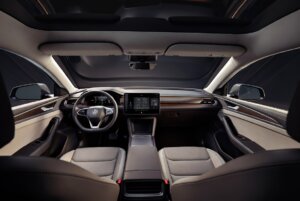
The cabin of the 2027 Volkswagen Teramont is where the generational leap is most striking. The previous model’s interior, while functional, struggled to justify the asking price against rivals who offered richer materials and more intuitive technology. The 2027 version addresses this directly with a ‘bold loop’ design philosophy that integrates a completely redesigned dashboard, redesigned door panels, new ambient lighting in 10 or 30 colors depending on trim, and — most significantly — genuine wood interior decor as standard across the lineup. Leatherette upholstery is now standard on the base variant, with Varenna or Nappa leather available on higher specifications.
The technology story is equally compelling. A 12.9-inch touchscreen is standard on the base trim, with a 15-inch floating infotainment display available on higher specifications — a meaningful upgrade that addresses the first generation’s dated screen proportions. The 10.25-inch configurable digital driver information display pairs with wireless Apple CarPlay and Android Auto, dual wireless charging pads, USB-C fast charging ports, and a new “Driver Experience Dial” on the centre console that manages volume, drive modes, and the new Atmospheres feature combining ambient lighting and audio settings into a single interface.
The nine-speaker audio system is standard, with an upgraded 14-speaker Harman Kardon system available on the Teramont’s range-topping trim. Front seats on higher specifications offer 12-way power adjustment with ventilation, memory, and massage functionality — a level of comfort that was previously reserved for vehicles significantly more expensive than this. The third row, notably, receives improved accommodation for adult passengers, directly addressing one of the most consistent criticisms of the first-generation model. Total cargo capacity reaches approximately 96.8 cubic feet with all rows folded — exceeding the Honda Pilot and Kia Telluride in this critical family SUV metric.
Safety Systems in the 2027 Volkswagen Teramont
The 2027 Volkswagen Teramont comes equipped with Volkswagen’s IQ.DRIVE 3.0 suite of driver assistance technologies as standard equipment across the lineup — a genuine upgrade over the previous generation’s piecemeal approach to safety feature availability. Standard equipment includes automatic emergency braking, forward collision warning, adaptive cruise control with stop-and-go functionality, blind-spot monitoring, rear cross-traffic alert, lane-keeping assist, lane departure warning, and front and rear parking sensors.
Higher trims add Traffic Jam Assist, Emergency Assist, and Travel Assist — Volkswagen’s semi-autonomous highway driving feature that manages steering, acceleration, and braking within lane markings. An available 360-degree Area View camera system proves particularly valuable for a vehicle of the Teramont’s size, simplifying parking and low-speed maneuvering in tight urban environments. The overall safety package represents one of the most comprehensive standard-equipment suites in the three-row family SUV segment.
Pros and Cons of the 2027 Volkswagen Teramont
| ✅ Pros | ❌ Cons |
|---|---|
| Full second-generation redesign — new platform, new engine, new interior | No hybrid or electric powertrain at launch — electrification delayed to midcycle refresh |
| New EA888 evo5 engine adds power (282hp) and improves fuel economy simultaneously | Touch-capacitive HVAC controls on some trims sacrifice tactile simplicity |
| 15-inch infotainment screen (available) with wireless CarPlay and Android Auto | Pricing expected to increase over the outgoing model |
| Real wood decor and Nappa leather now available — genuine interior quality upgrade | V6 engine no longer offered — four-cylinder only at launch |
| IQ.DRIVE 3.0 safety suite now standard across the full lineup | Middle East launch expected in early 2027 — some buyers will wait months |
| Up to 96.8 cubic feet of cargo capacity — best-in-class among key rivals | Driver Experience Dial is an unproven multi-function control — usability TBC |
2027 Volkswagen Teramont vs. The Competition
The 2027 Volkswagen Teramont enters a segment that has never been more competitive, and its rivals are formidable. The Kia Telluride and Hyundai Palisade — sister vehicles sharing a platform — have dominated the three-row family SUV conversation since their 2020 debuts, earning praise for interior quality, standard equipment generosity, and V6 powertrains that the Teramont’s four-cylinder must now defend against. The Telluride in particular has become the benchmark for value in this class, and the Teramont’s new interior and technology standards are clearly a direct response to that competitive pressure.
The Toyota Highlander offers hybrid power as standard across most of its lineup — a meaningful advantage in efficiency-conscious markets that the 2027 Teramont cannot yet match. The Honda Pilot brings an engaging TrailSport off-road variant and broad reliability credentials that appeal to risk-averse family buyers. The Mazda CX-90 positions slightly above on interior quality and driving dynamics, blurring the line between mainstream and premium in a way that challenges the Teramont’s value argument at the higher end of its trim range.
Against all of them, the 2027 Volkswagen Teramont’s strongest arguments are the new platform’s ride quality and refinement, the now-genuinely-competitive technology suite, and the largest cargo capacity in the segment. The incoming hybrid variant — when it arrives — will address the efficiency gap and complete the Teramont’s competitive repositioning. Until then, buyers who prioritize interior space, European engineering credentials, and up-to-date connectivity will find the new Teramont a considerably stronger proposition than its predecessor.
Final Verdict: Is the 2027 Volkswagen Teramont Worth Buying?
The 2027 Volkswagen Teramont is the version this nameplate needed to be — the one that closes the gap on better-equipped rivals, addresses the interior shortcomings that prevented the first generation from fully delivering on its promise, and brings the kind of technology that buyers shopping in this segment have been expecting for years. The new EA888 evo5 engine is more powerful and more efficient than what it replaces. The interior is more premium than anything the Teramont has previously offered. The platform is newer, the safety systems are more comprehensive, and the exterior design is more convincing.
The absence of hybrid power at launch is a genuine limitation — particularly in markets where fuel prices make efficiency a priority — but it is a temporary one that Volkswagen has publicly committed to resolving. And the 2027 Volkswagen Teramont is more than strong enough in its current form to stand as the right choice for families who need genuine three-row practicality with the refinement and technology that European engineering typically brings to the table.
After a decade of punching above its weight and not quite landing the decisive blow, the 2027 Volkswagen Teramont finally punches at the right weight class entirely.
Specifications and pricing referenced from Autoblog, CarGurus, Kelley Blue Book, Cars24 UAE, and official Volkswagen communications. Middle East launch timing based on industry estimates at time of publication. Hybrid powertrain timeline reflects Volkswagen’s official confirmation of a midcycle refresh addition.
2027 Volkswagen Teramont Images
Specifications
Specifications
| Production year | 2027 |
| Body type & seats | Mid-Size SUV, 7 Seats |
| Dimensions | Length 5,169 mm × Width 1,991 mm × Height 1,781 mm; Wheelbase 2,980 mm |
| Weight | 2,040 kg (Curb Weight, Approx.) |
| Engine type | 2.0L EA888 evo5 Turbocharged Petrol Engine |
| Engine size & cylinders | 1,984 cc, Inline 4-Cylinder |
| Aspiration | Turbocharged Direct Injection with Intercooler |
| Power | 282 hp (210 kW) |
| Torque | 400 Nm |
| Transmission | 8-Speed Automatic |
| Drivetrain | 4MOTION All-Wheel Drive (AWD) |
| Acceleration (0-100 km/h) | 6.8 Seconds (Estimated) |
| Top speed | 210 km/h (Electronically Limited) |
| Fuel type | Premium Unleaded Petrol (Gasoline) |
| Fuel consumption | 9.1 L/100 km (Combined, Estimated) |
| Fuel tank capacity | 70 Liters |
| Brakes | Ventilated Disc Brakes (Front & Rear) |
| Steering | Electromechanical Progressive Power Steering |
| Infotainment | 15.0-inch Floating Touchscreen Infotainment System, 10.25-inch Digital Instrument Cluster, Built-in Navigation, Voice Assistant, Available Front Passenger Display, Harman Kardon Premium Audio (Available) |
| Connectivity | Wireless Apple CarPlay, Wireless Android Auto, Bluetooth, Multiple USB-C Ports, Wireless Smartphone Charging, Volkswagen Connected Services, Over-the-Air (OTA) Updates |
| Safety | Adaptive Cruise Control, IQ.DRIVE, Front Assist, Lane Assist, Blind Spot Monitor, Rear Cross Traffic Alert, Automatic Emergency Braking, Park Assist Plus, 360-Degree Camera, Driver Attention Monitor, Traffic Sign Recognition, Multiple Airbags |
2027 Volkswagen Teramont Price
 Price in USD
|
40,000 USD |
 Price in European Union
|
34,000 EUR |
 Price in United Kingdom
|
29,600 GBP |
 Price in Australia
|
61,200 AUD |
 Price in Canada
|
55,200 CAD |
 Price in India
|
3,492,000 INR |
 Price in China
|
287,200 CNY |
 Price in Indonesia
|
648,000,000 IDR |
 Price in Philippines
|
2,280,000 PHP |
 Price in Malaysia
|
168,800 MYR |
 Price in Nigeria
|
61,400,000 NGN |
 Price in Russia
|
3,218,400 RUB |
 Price in Pakistan
|
11,320,000 PKR |
 Price in Saudi Arabia
|
150,000 SAR |
 Price in Japan
|
5,880,000 JPY |
 Price in South Africa
|
705,600 ZAR |
 Price in Brazil
|
217,200 BRL |
 Price in Bangladesh
|
4,840,000 BDT |
 Price in Mexico
|
750,800 MXN |
More Products from Volkswagen