- Home
- Volkswagen
- 2026 Volkswagen Virtus GT
2026 Volkswagen Virtus GT: Price, Turbo Engine, Specs, Interior, and Features
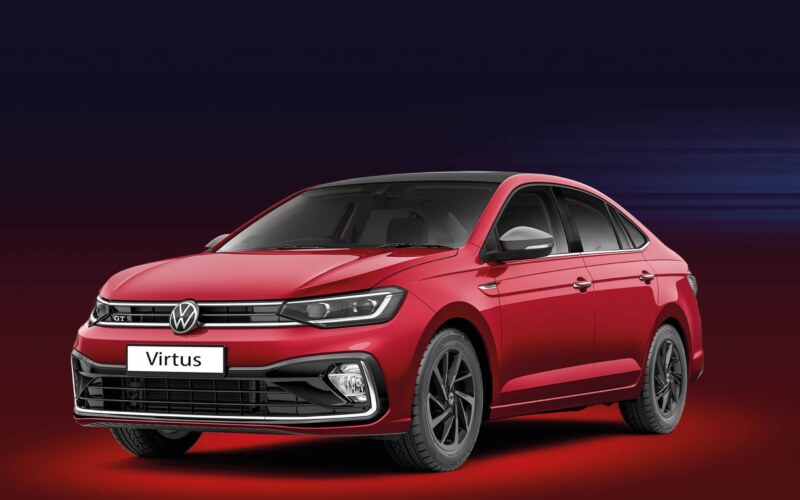
2026 Volkswagen Virtus GT is the answer to a question that the Indian automotive market has been asking for years: can a midsize sedan be both genuinely fast and genuinely practical, built to European standards, priced within reach of the ambitious buyer, and designed to age with dignity in a segment where rivals update constantly and loyalty is hard-won? The short answer is yes — and the 2026 Volkswagen Virtus GT makes that case with a 150 PS turbocharged four-cylinder engine, a seven-speed dual-clutch DSG gearbox, a 521-litre segment-leading boot, and the German engineering pedigree that has made the Virtus one of the fastest-selling sedans in India since its 2022 launch. Now carrying a mid-cycle facelift expected before Diwali 2026, the 2026 Volkswagen Virtus GT arrives with Level 2 ADAS, a panoramic sunroof, and a redesigned interior that positions it more convincingly than ever as the performance choice in a segment crowded with feature-heavy but dynamically uninteresting alternatives.

Overview: What the 2026 Volkswagen Virtus GT Represents
The 2026 Volkswagen Virtus GT is the performance flagship of Volkswagen’s midsize sedan for India, positioned in the GT and GT Plus Sport trim levels above the entry Comfortline and Highline variants. It is built on the MQB A0 IN platform — a version of Volkswagen’s modular transverse matrix architecture localised for India — and is assembled at Volkswagen’s Pune facility in Maharashtra. The 2026 Volkswagen Virtus GT range tops out with the GT Plus Sport DSG, which packages the 1.5-litre TSI engine, the seven-speed DSG, a limited-slip differential function via XDS+, and the full GT visual treatment in a package that Autocar India describes as making the Virtus “the most powerful midsize sedan on sale” in the Indian market alongside its Skoda Slavia sibling.
The facelift arriving in 2026 does not change the Virtus’s fundamental formula — it sharpens it. Level 2 ADAS is introduced for the first time, bringing autonomous emergency braking, adaptive cruise control, lane-keeping assist, and blind-spot monitoring to a segment where safety technology has historically lagged behind pricing ambitions. A panoramic sunroof — one of the most requested features by Indian buyers, according to multiple manufacturer surveys — is expected to join the GT’s standard equipment list. And interior revisions drawing on global VW cues will upgrade the dashboard, ambient lighting, and soft-touch material coverage to address the one area where the current Virtus has faced consistent criticism: that its cabin feels slightly behind its price promise in material quality. The 2026 Volkswagen Virtus GT addresses these gaps without abandoning what already makes it exceptional — the driving dynamics.
Expected Price: Performance Accessible, Not Affordable
The current 2026 Volkswagen Virtus GT range in India spans from approximately ₹14.90 lakh for the GT 1.5 TSI Manual to ₹19.00 lakh (ex-showroom) for the GT Plus Sport 1.5 TSI DSG — the top-specification variant that combines the most powerful engine, the dual-clutch automatic, and the full GT Plus visual package. The GT 1.5 DSG sits at approximately ₹16.62 lakh, making it the most popular GT variant among buyers who want the automatic without the additional GT Plus styling. With the facelift expected before Diwali 2026, prices across the range are expected to increase by approximately ₹50,000–₹80,000, reflecting the addition of Level 2 ADAS, panoramic sunroof, and interior updates. A post-facelift GT Plus Sport DSG is therefore expected to price at approximately ₹19.50–₹20.00 lakh ex-showroom.
In Brazil and other Latin American markets where the Virtus is also sold, the GT trim commands a similar premium over the base range, with the 1.4-litre 250 TSI engine producing 150 PS serving the performance role that the 1.5 TSI fills in India. Across all markets, the 2026 Volkswagen Virtus GT’s value argument rests on the same foundation: it provides European engineering standards, the most powerful engine in the segment, and a 521-litre boot at a price that consistently undercuts the Honda City e:HEV hybrid and challenges the Hyundai Verna’s most aggressive pricing. Full specification and pricing details for the 2026 Volkswagen Virtus GT facelift will be confirmed closer to the official India launch and available on the official Volkswagen India Virtus page.
Release Date: Facelift Before Diwali 2026
The 2026 Volkswagen Virtus GT facelift has been confirmed for launch before Diwali 2026 — India’s most important automotive retail window, typically falling in October. Multiple sources including CardEkho and Wowcar confirm the Indian launch timeline, with CarDekho specifically citing a September 25, 2026 estimated launch date. Testing of the facelifted Virtus has been observed on Indian roads, with concealed prototypes revealing updated front and rear styling, revised headlights, and interior changes consistent with a thorough mid-cycle update. The facelift follows the updated Taigun SUV, which launched in early 2026, and both form part of Volkswagen India’s strategy to keep its compact product portfolio fresh and competitive through to the end of the decade.
For buyers of the current 2026 Volkswagen Virtus GT — the pre-facelift version that remains on sale through mid-2026 — the equation is clear: buy now and benefit from pre-facelift pricing and current specification, or wait for the ADAS-equipped, panoramic sunroof-fitted facelift and pay the premium it commands. Neither decision is wrong. The current car’s driving dynamics are unchanged by the facelift, and buyers who prioritise performance over technology will find the existing 2026 Volkswagen Virtus GT entirely satisfying. Those who want Level 2 ADAS and the panoramic sunroof as standard should wait for the updated model, which will arrive at dealerships in the festive season.
Engine and Performance: The 1.5 TSI That Changed Indian Sedan Expectations
Two Engines, Two Characters — One GT Badge
The 2026 Volkswagen Virtus GT is available with two engine options that define two distinct buyer profiles. The entry GT variant uses a 1.5-litre four-cylinder TSI turbocharged petrol engine producing 150 PS (147.5 bhp) and 250 Nm of torque, available with a six-speed manual for purists or — in GT Plus Sport specification — the seven-speed dual-clutch DSG automatic. The larger engine’s Active Cylinder Management (ACT) technology automatically deactivates two of the four cylinders under light load — a fuel-saving measure that reduces consumption without affecting performance when the throttle is used more firmly. This is the engine that Autocar India confirmed makes the Virtus “the most powerful midsize sedan” in the segment, and the one that Team-BHP’s 11,000 km real-world owner review described as providing “turbo-petrol punch” that left competing naturally aspirated alternatives feeling inadequate on Indian highways.
The entry point to the GT range uses the 1.0-litre three-cylinder TSI producing 115 PS (113 bhp) and 178 Nm of torque, available with a six-speed manual or a six-speed torque converter automatic. This engine is less exotic than the 1.5 TSI but delivers strong real-world performance for urban and mixed-road use, with the turbocharger ensuring accessible torque from low revs that naturally aspirated 1.2-litre and 1.3-litre rivals cannot match in the same way. The 2026 Volkswagen Virtus GT in 1.0 TSI form is the more affordable gateway to the GT badge, while the 1.5 TSI DSG is where the car’s performance credentials become genuinely exceptional by segment standards.
Performance, Acceleration, and the XDS+ Differential
The 1.5 TSI DSG variant of the 2026 Volkswagen Virtus GT covers 0–100 km/h in approximately 8.1 seconds — the quickest time available in the midsize sedan segment in India. The XDS+ electronic differential lock function, available on the GT Plus Sport specification, improves cornering stability by applying braking force to the inside wheel during cornering and redirecting torque to the outside, reducing understeer and improving the car’s ability to exit corners with composure under power. This is the same XDS technology used across Volkswagen Group’s performance-oriented MQB models, and its inclusion in the 2026 Volkswagen Virtus GT gives it a dynamic sophistication that no naturally aspirated rival in the segment can replicate. Top speed is electronically limited to 205 km/h — a figure that places the Virtus GT beyond the reach of most Indian road situations, but one that confirms the engine’s genuine performance reserve rather than merely its segment-relative numbers.
Fuel Economy: Active Cylinder Management Earns Its Keep
The 2026 Volkswagen Virtus GT 1.5 TSI DSG delivers an ARAI-certified fuel efficiency of 18.67 kmpl according to CarLelo — strong for a 150 PS turbocharged sedan, and significantly better than the non-ACT 1.5-litre engines offered in competing vehicles. The 1.0 TSI variants achieve up to 20.08 kmpl according to CarDekho’s specification data, making the entry GT engine one of the most fuel-efficient turbocharged options in the segment. Team-BHP’s 11,000 km long-term review confirmed that real-world highway fuel economy “exceeds expectations” for the GT Plus specification. The 45-litre fuel tank provides a theoretical range of approximately 840 km per fill at highway efficiency — meaningful for Indian buyers who cover significant distances between metro centres on long-distance road trips.
Battery and Electric Drive: Petrol Only
The 2026 Volkswagen Virtus GT is a purely petrol-powered vehicle. There is no hybrid system, no mild-hybrid assist, no plug-in option, and no electric drive capability across any GT variant. The Active Cylinder Management technology provides fuel savings through cylinder deactivation rather than electrical assistance. Honda’s City e:HEV strong hybrid system — which achieves over 26 kmpl in real-world testing — is the primary competitor that the Virtus GT cannot challenge on pure efficiency grounds. For buyers whose priorities include electrified fuel savings, the Honda City’s hybrid is the benchmark the 2026 Volkswagen Virtus GT has no answer to in its current powertrain. For buyers who prioritise turbocharged performance, driving dynamics, and the seven-speed DSG over hybrid economy, the Virtus GT’s combustion-only powertrain is not a limitation — it is the point.
Driving Experience: The Sedan That Earns Enthusiast Loyalty
Ask any owner of the 2026 Volkswagen Virtus GT what made them choose it over the Honda City or Hyundai Verna, and the answer almost always comes back to the same thing: it drives better. Not marginally better. Noticeably, meaningfully better — in a way that you feel every time you merge onto a highway, exit a roundabout under throttle, or point the car at a long, fast curve. Team-BHP’s 11,000 km owner review described it as “a drivers’ car” and confirmed that the XDS+ differential makes a “real, perceptible difference” to how the car rotates through corners compared to a standard open-differential front-wheel-drive sedan. The steering is more communicative than the segment average. The body roll is well-controlled by the sport suspension tune applied to GT variants. And the 1.5 TSI’s turbocharged power delivery — broad, linear, and accessible — makes overtaking on Indian national highways feel effortless rather than calculated.
The seven-speed DSG gearbox is one of the 2026 Volkswagen Virtus GT’s strongest assets in daily use. It shifts quickly when provoked and smoothly when left to its own devices, with a paddle-shift mode that gives the driver meaningful control during performance driving without the complexity of a manual clutch. The torque converter automatic on 1.0 TSI variants is less engaging but more forgiving in stop-start city traffic — the right choice for buyers who prioritise comfort over involvement. At highway speeds, both the 1.5 TSI DSG and 1.0 TSI AT generate “minimal road and wind noise,” according to VatsaDriveHub’s 2026 review, with the Virtus’s body rigidity providing a quietness that exceeds what the segment price usually delivers.
The ride quality deserves specific mention. The 2026 Volkswagen Virtus GT rides on a suspension tune that is firmer than the Hyundai Verna’s softer setup but more controlled than the Honda City’s road-feedback at higher speeds. On smooth highways — where Indian buyers typically evaluate a car’s long-distance character — the Virtus GT is composed, stable, and quiet. Over poor urban surfaces, the firmer GT suspension communicates more road texture than some buyers expect. CardekHo’s comparison review noted “strong seat contouring” that makes the Virtus “best used as a four-seater” in terms of rear-seat width comfort — a genuine limitation for buyers who regularly carry three rear passengers.
Exterior Design: German Restraint, GT Specifics
The exterior design of the 2026 Volkswagen Virtus GT is defined by the restraint that characterises all VW products — clean lines, strong proportions, and detailing that rewards close inspection rather than demanding attention from a distance. At 4,561 mm long, 1,752 mm wide, and 1,507 mm tall with a 179 mm ground clearance, the Virtus GT is the tallest midsize sedan in its segment and has the highest ground clearance — dimensions that matter on Indian road surfaces where competitors with lower ground clearances accumulate more underbody contact. The Virtus is longer than the Skoda Slavia but shorter than the Honda City and Hyundai Verna, placing it at a useful middle ground in terms of urban maneuverability and highway presence.
GT-specific exterior elements on the 2026 Volkswagen Virtus GT include sportier front and rear bumpers, a blacked-out honeycomb front grille, GT badging at the front and rear, and 16-inch or 17-inch alloy wheel designs depending on variant level. The Virtus GT Plus Sport adds a more aggressive front splitter and the GT Plus badge treatment. The facelift arriving before Diwali 2026 is expected to update the front grille with a more horizontal design inspired by the international Virtus and global VW family design language, revised LED headlight clusters with a full-width light bar aesthetic on higher trims, and updated tail lamp graphics at the rear. Colour options include Lava Blue — the colour chosen by Team-BHP’s long-term tester as a “Highway Charm” — alongside Curcuma Yellow, Carbon Steel Grey, Candy White, Reflex Silver, Rising Blue, and Deep Black Pearl, giving the 2026 Volkswagen Virtus GT a broader palette than most segment rivals.
Interior and Technology: A Premium Step Up
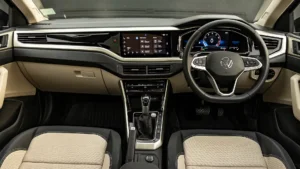
The current 2026 Volkswagen Virtus GT interior pairs a 10-inch touchscreen infotainment system with an 8-inch digital instrument cluster — the latter configurable across multiple display modes including a GT-specific performance layout. Wireless Apple CarPlay and Android Auto are standard on all GT variants. The front seats — ventilated as standard on GT Plus specification — provide good lateral support and are praised by owners for long-distance comfort. Ambient lighting, dual-zone automatic climate control, and leatherette upholstery on GT variants create a cabin quality that CardekHo summarises as “sophisticated” with “classy, understated styling.” The Bose eight-speaker sound system available on top variants draws praise from owners and reviewers alike for its output quality in this price range.
The facelift arriving in the 2026 Volkswagen Virtus GT is expected to upgrade the infotainment to a larger screen format — expected at 10.1 inches or larger — with improved software and a more responsive interface. The digital driver’s display is likely to gain sharper graphics and expanded customisation. A panoramic sunroof — expected to be standard on GT Plus and above — will address one of the most consistent buyer complaints about the current model, which offers only a single-pane electric sunroof. Interior material upgrades include a redesigned dashboard with broader use of soft-touch materials, new ambient lighting themes with colour options, and a dual-tone interior colour scheme that creates a more spacious visual impression. These changes, as Wowcar noted, are “subtle yet effective,” improving the cabin’s premium feel without altering its fundamental character.
The 521-litre boot of the 2026 Volkswagen Virtus GT is the segment’s largest — confirmed by CardekHo’s comparison data — and represents a meaningful practical advantage over the Hyundai Verna (528 litres on the latest generation, 481 litres on older variants) and Honda City (506 litres). The 60:40 split-folding rear seat extends cargo capacity for longer items when the rear bench is not fully occupied. In segment terms, the 2026 Volkswagen Virtus GT’s combination of a 521-litre boot, 45-litre fuel tank, and five genuine seating positions makes it one of the most practically versatile sedans at any price in the Indian market.
Safety Systems: Five Stars and Level 2 ADAS Arriving
The 2026 Volkswagen Virtus GT earned a five-star Global NCAP safety rating — confirmed by multiple sources as one of the strongest safety results in the Indian midsize sedan segment. This rating was achieved with six airbags standard, electronic stability control, hill-start assist, and the structural integrity of the MQB A0 IN platform. The Virtus was specifically noted for its strong adult and child occupant protection scores, which multiple reviewers including Cars24 described as “five-star global NCAP rating” and “five-star child safety rating.” In a segment where some rivals have achieved lower ratings with more features on the specification sheet, the Virtus GT’s safety credentials represent a genuine differentiator.
The facelift arriving before Diwali 2026 introduces Level 2 ADAS to the 2026 Volkswagen Virtus GT for the first time — a significant addition that brings the Virtus in line with international VW standards and ahead of several segment rivals on active safety technology. The confirmed ADAS suite includes autonomous emergency braking, adaptive cruise control, lane-keeping assist, blind-spot monitoring, and auto high beam control. Wowcar confirmed that the addition of ADAS “brings Virtus in line with both international VW standards and local Indian rivals who are increasingly equipping their sedans with ADAS functions.” A 360-degree surround camera system is also expected to arrive with the facelift, addressing the parking camera limitations of the current model’s single rear-camera-only setup.
Pros and Cons
✅ Pros
- 150 PS 1.5 TSI — most powerful engine in the midsize sedan segment
- XDS+ electronic differential improves cornering composure measurably
- 521-litre boot — segment-leading cargo capacity
- Five-star Global NCAP safety rating with six airbags standard
- Seven-speed DSG — best dual-clutch in its class for sheer response
- 18.67 kmpl with 1.5 TSI DSG — strong efficiency for 150 PS output
- 179 mm ground clearance — highest in segment, important for Indian roads
- Level 2 ADAS arriving with 2026 facelift — first time in the Virtus
- Panoramic sunroof expected on GT Plus with facelift
❌ Cons
- No hybrid option — Honda City e:HEV achieves 26+ kmpl in real world
- 1.5 TSI available only with DSG — no manual in GT Plus Sport
- Rear seat width feels tight with three passengers — best as a four-seater
- Pre-facelift interior material quality criticised as below asking price
- ADAS and panoramic sunroof only confirmed for facelift — not current model
- Firmer GT suspension setup not ideal for very rough urban surfaces
- No diesel option — Hyundai Verna offers diesel in some variants
- Volkswagen service costs higher than mass-market Indian brands
Competitors: The Midsize Sedan Segment in 2026
The 2026 Volkswagen Virtus GT competes in India’s most contested midsize sedan segment, against rivals that cover the full spectrum of buyer priorities. The Honda City is the longest-standing competitor and the most versatile opponent: available in multiple configurations including the e:HEV strong hybrid that achieves over 26 kmpl, with a larger 506-litre boot and a smoother, more refined ride character. CardekHo notes that the City’s starting price is higher than the Virtus’s but that “corresponding variants of the City are more affordable than the Virtus” on a feature-by-feature comparison. The City is the better choice for hybrid-focused buyers; the 2026 Volkswagen Virtus GT is the better choice for performance-focused ones.
The Hyundai Verna has been fully redesigned for its current generation, bringing a more dramatic exterior, a feature-heavy interior including ventilated seats and a 10.25-inch infotainment screen, and the same 1.5-litre turbo petrol engine producing 160 PS — 10 more than the Virtus GT’s 150 PS. ZigWheels’ comparison data shows the Verna’s turbo-petrol DCT variant as a direct performance competitor to the 2026 Volkswagen Virtus GT, though CardekHo noted the Virtus provides “stronger engine options” in the overall GT vs standard Verna comparison. The Skoda Slavia shares the Virtus’s MQB A0 IN platform and engines, making it the most mechanically identical competitor — the choice between the two typically comes down to exterior styling preference and brand loyalty, with the Slavia offering a slightly more conservative look and the Virtus GT’s more aggressive GT visual treatment.
Final Verdict: The 2026 Volkswagen Virtus GT Makes the Enthusiast Argument
The 2026 Volkswagen Virtus GT has earned its reputation the hard way — through driver engagement, proven long-term reliability, and a performance package that no naturally aspirated rival in the Indian midsize sedan segment can match on pure dynamics. Team-BHP’s owner, after 11,000 km and two years of ownership, described the experience as consistently rewarding and concluded that “it will always perform at the same level when it was born” — the kind of endorsement that reflects long-term confidence rather than honeymoon enthusiasm. The 521-litre boot, the 179 mm ground clearance, the five-star NCAP rating, and the 150 PS 1.5 TSI DSG combine to create a car that is genuinely exceptional in its segment context.
The 2026 facelift arriving before Diwali addresses the most significant gaps in the current car’s specification: Level 2 ADAS, a panoramic sunroof, and upgraded interior quality. These additions will make the 2026 Volkswagen Virtus GT facelift the most complete version of the Virtus formula available since the car’s 2022 launch — and will close the gap with rivals who have spent the intervening years adding features to their own lineups. The price increase the facelift brings is real, but so is the specification improvement it delivers.
For Indian buyers who want to drive something rather than simply sit in it, who care about the seven-speed DSG’s behaviour at a motorway on-ramp, who appreciate that XDS+ makes a sedan corner like a purpose-built car rather than an appliance, the 2026 Volkswagen Virtus GT remains the clearest choice in the midsize segment. Volkswagen hasn’t reinvented the Virtus with this update. It didn’t need to. It has improved what mattered and kept everything that was already right — and that, in a segment this competitive, is more than enough.
2026 Volkswagen Virtus GT Images
Specifications
Specifications
| Production year | 2026 |
| Body type & seats | 4-Door Sedan, 5 Seats |
| Dimensions | Length 4,561 mm × Width 1,752 mm × Height 1,507 mm; Wheelbase 2,651 mm |
| Weight | 1,275 kg (Curb Weight, DSG) |
| Engine type | 1.5L TSI EVO Turbocharged Petrol Engine |
| Engine size & cylinders | 1,498 cc, Inline 4-Cylinder |
| Aspiration | Turbocharged Direct Injection with Active Cylinder Technology (ACT) |
| Power | 150 hp (110 kW) |
| Torque | 250 Nm |
| Transmission | 7-Speed DSG Dual-Clutch Automatic |
| Drivetrain | Front-Wheel Drive (FWD) |
| Acceleration (0-100 km/h) | 8.1 Seconds |
| Top speed | 210 km/h |
| Fuel type | Premium Unleaded Petrol (Gasoline) |
| Fuel consumption | 18.7–19.6 km/L (Combined, depending on market and transmission) |
| Fuel tank capacity | 45 Liters |
| Brakes | Ventilated Disc Brakes (Front), Disc Brakes (Rear) |
| Steering | Electromechanical Power Steering |
| Infotainment | 10.1-inch Touchscreen Infotainment System, 10.25-inch Digital Cockpit, Navigation, Voice Control, Premium Audio System |
| Connectivity | Wireless Apple CarPlay, Wireless Android Auto, Bluetooth, USB-C Ports, Wireless Phone Charging, Volkswagen Connect |
| Safety | Six Airbags, Electronic Stability Control (ESC), ABS with EBD, Front Assist, Hill Hold Control, Tire Pressure Monitoring System (TPMS), Rear View Camera, Rear Parking Sensors, ISOFIX Child Seat Mounts, Automatic Emergency Braking |
2026 Volkswagen Virtus GT Price
 Price in USD
|
17,000 USD |
 Price in European Union
|
14,450 EUR |
 Price in United Kingdom
|
12,580 GBP |
 Price in Australia
|
26,010 AUD |
 Price in Canada
|
23,460 CAD |
 Price in India
|
1,484,100 INR |
 Price in China
|
122,060 CNY |
 Price in Indonesia
|
275,400,000 IDR |
 Price in Philippines
|
969,000 PHP |
 Price in Malaysia
|
71,740 MYR |
 Price in Nigeria
|
26,095,000 NGN |
 Price in Russia
|
1,367,820 RUB |
 Price in Pakistan
|
4,811,000 PKR |
 Price in Saudi Arabia
|
63,750 SAR |
 Price in Japan
|
2,499,000 JPY |
 Price in South Africa
|
299,880 ZAR |
 Price in Brazil
|
92,310 BRL |
 Price in Bangladesh
|
2,057,000 BDT |
 Price in Mexico
|
319,090 MXN |
More Products from Volkswagen