- Home
- Volkswagen
- 2026 Volkswagen Taos
2026 Volkswagen Taos: Price, Fuel Economy, Specs, and Review
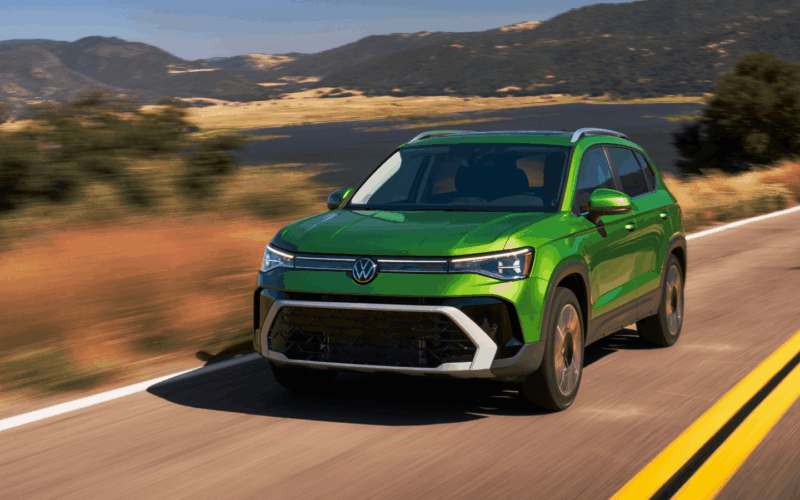
2026 Volkswagen Taos is the smallest SUV in Volkswagen’s American lineup, and it has spent the better part of four years quietly making the case that small does not have to mean basic, underpowered, or cheap-feeling. Introduced for 2022 and significantly refreshed for 2025 with updated exterior styling, a revised interior, and a more powerful engine, the 2026 Volkswagen Taos carries those improvements into a second year with targeted upgrades: wireless App-Connect is now standard across the range, wireless charging has been upgraded to 15 watts, rear-seat pretensioners are fitted for improved safety, and the SEL trim gains the eight-speaker premium audio system. Edmunds put it plainly after testing: the Taos “is quicker to accelerate than its rivals and feels much more composed when cornering, making it noticeably more enjoyable to drive.” At a starting price of $27,975, that assessment is a compelling proposition.
Overview: The 2026 Volkswagen Taos and Its Place in the Lineup
The 2026 Volkswagen Taos sits beneath the Tiguan and Atlas in Volkswagen’s North American SUV hierarchy, positioned as the entry point to the brand’s crossover family for buyers who want German engineering and a well-equipped cabin without committing to the larger footprints or higher prices of its siblings. At 175.8 inches long with a 105.9-inch wheelbase — 9.3 inches shorter than the Tiguan — the Taos is genuinely compact in the ways that matter for urban and suburban daily driving: easier to park, easier to manoeuvre through tight gaps, and lighter on its feet through the kind of everyday driving that large SUVs handle with more effort. Yet inside, J.D. Power’s review described the cabin as “surprisingly upscale” following the 2025 refresh, with rear-seat legroom and cargo capacity that consistently surprise first-time passengers who expect a small car’s interior behind the small car’s exterior.
Four trim levels define the 2026 Volkswagen Taos range in the United States: S, SE, SE Black, and SEL. All share the same 1.5-litre turbocharged four-cylinder engine and eight-speed automatic transmission, with front-wheel drive standard on the S, SE, and SE Black, and 4Motion all-wheel drive available across all trims — standard on the SEL, optional elsewhere. Assembled in Volkswagen’s Puebla, Mexico, facility, the 2026 Volkswagen Taos continues the formula that made the original a strong seller in its first few years: more equipment than rivals expect at this price, better driving dynamics than the segment average, and a brand identity that carries weight in a class where generic crossovers are in abundant supply.
Expected Price: Entry-Level German, Not Entry-Level Quality
The 2026 Volkswagen Taos starts at $27,975 including the $1,475 destination charge for the base S in front-wheel drive, according to Cars.com and KBB. The range escalates through four trim levels: the SE at approximately $30,735 FWD, the SE Black at $32,985 FWD, and the SEL at $37,375 with standard 4Motion AWD. Adding AWD to the S costs $1,700; the SE AWD commands a $2,250 premium over the FWD equivalent. KBB Fair Purchase Pricing suggests most buyers are paying $685 to $1,585 below MSRP depending on trim and configuration, meaning real transaction prices for the most popular SE trim typically land in the mid-to-high twenties with FWD.
Edmunds’ recommendation targets the SE trim as the sweet spot — a “rather modest price increase over the base S” that adds keyless entry, dual-zone climate control, upgraded audio, and the wireless charging pad that makes the cabin feel more premium. Their second recommendation is significant: because the 4Motion AWD system on the Taos includes an upgraded rear suspension that improves the car’s overall handling composure, Edmunds suggests “everyone opt for it” rather than reserving that advice only for buyers in snow-prone regions. That recommendation pushes the practical sweet spot to approximately $32,000–$33,000 for an SE AWD — still meaningfully below comparably equipped compact SUVs from Hyundai, Kia, or Mazda. Full pricing and specifications are detailed on the official Volkswagen USA Taos page.
Release Date: On Sale Now, Refreshed and Carrying Forward
The 2026 Volkswagen Taos went on sale in early 2026 across U.S. dealerships, carrying forward the significant 2025 refresh without major changes. As Cars.com confirmed, “little changes for the small SUV” in 2026, with the targeted additions of wireless App-Connect, upgraded wireless charging, rear-seat pretensioners, and the SEL’s new eight-speaker audio system representing the sum of the year-over-year updates. That continuity is a positive sign for buyers: the 2026 Volkswagen Taos enters showrooms as a tested, validated product in its second year on the refreshed platform rather than a first-year proposition with first-year unknowns.
The 2025 refresh was the Taos’s most significant update since its 2022 introduction, bringing exterior styling changes that aligned the Taos more closely with the Tiguan’s face — including illuminated VW logos, updated LED headlights, and a grille-spanning light bar on higher trims. The interior received new touch-sensitive climate controls and a revised dashboard layout. For buyers considering the 2026 Volkswagen Taos, the platform is now in a mature, well-developed state, and the available inventory across all four trim levels makes for good selection at dealerships in most markets.
Engine and Performance: 174 Horsepower, One Engine, All Trims
The 1.5 TSI: Turbocharged, Eight-Speed Automatic, Front or All-Wheel Drive
Every 2026 Volkswagen Taos trim is powered by the same 1.5-litre turbocharged four-cylinder engine producing 174 horsepower and 184 lb-ft (250 Nm) of torque, paired with an eight-speed automatic transmission. This is the updated engine introduced with the 2025 refresh — a power increase over the previous generation’s 158 hp — which gave the Taos a meaningful performance advantage over rivals. J.D. Power noted that getting up to freeway speed “is not much of a problem,” and Edmunds’ track testing confirmed a 0–60 mph time of 8.8 seconds in the FWD model, with the AWD variant running approximately one second quicker. For a subcompact SUV at this price point, those are genuinely competitive numbers — faster than the Honda HR-V’s 158 hp engine and comparable to the Kia Seltos in equivalent specification.
The eight-speed automatic transmission shifts smoothly in everyday driving and responds adequately to spirited inputs, though it is not the performance-focused DSG found in VW’s performance models. Front-wheel drive models deliver the better fuel economy figures and the lighter, more nimble character that urban buyers typically prefer. The 4Motion AWD system — which adds an upgraded rear multi-link suspension in place of the FWD model’s torsion beam — is worth the $1,700–$2,250 premium not only for all-weather traction but for the improved handling composure that the independent rear setup provides. Four drive modes are available on AWD models: Eco, Sport, Snow, and Off-Road — the last of these adjusting throttle response and traction control calibration for light trail use.
Acceleration and Real-World Performance
The 2026 Volkswagen Taos is, as Edmunds confirmed, “one of the quickest” in the subcompact SUV class. The turbocharged engine builds boost quickly from low revs and maintains useful mid-range pull for overtaking at motorway speeds — a capability that naturally aspirated rivals at similar prices cannot match as convincingly. The engine does produce “a gritty noise under hard acceleration” according to J.D. Power’s reviewer, and KBB noted it can feel “a bit jerky” under certain throttle inputs — limitations that are consistent with the class rather than specific to the Taos. At steady highway cruise, the cabin quiets considerably, with U.S. News confirming that a 200-mile Michigan-to-Indiana road trip produced “minimal road or wind noise” that permeated the cabin — an impressive result for a vehicle at this price point.
Fuel Economy: Among the Best in Its Class
The EPA rates the FWD 2026 Volkswagen Taos at 28 mpg city, 36 mpg highway, and 31 mpg combined — figures that KBB describes as among the better results in the subcompact SUV segment. The AWD model returns 25/33/28 mpg — a 3 mpg combined penalty for the added traction hardware, consistent with the segment pattern. U.S. News’ real-world test of the SEL AWD confirmed 28 mpg on the trip computer during a 200-mile mixed drive, matching the AWD EPA estimate precisely. The 2026 Volkswagen Taos achieves these figures on regular-grade fuel, not premium — a practical consideration that reduces running costs meaningfully over the ownership period. The one area where competitors have a clear advantage: the Subaru Crosstrek Hybrid achieves an estimated 36 mpg combined, and no hybrid variant of the 2026 Volkswagen Taos is available to match it.
Battery and Electric Drive: None Available Yet
The 2026 Volkswagen Taos is a purely combustion-powered vehicle. There is no mild-hybrid assistance, no plug-in capability, and no hybrid powertrain option in the current range — a gap that U.S. News and Edmunds both flag as a competitive limitation against rivals who offer hybrid variants. The stop-start system standard across all trims provides the only concession to efficiency at standstill. Volkswagen’s broader electrification strategy includes the ID.4 as the brand’s electric SUV option, but no electric or electrified Taos has been confirmed. For buyers whose priorities include electrified fuel savings, the 2026 Volkswagen Taos is honest about what it currently offers — a well-engineered combustion crossover with competitive but not class-leading efficiency against the hybrid competition.
Driving Experience: Better Than the Class Expects
Test the 2026 Volkswagen Taos back-to-back with its subcompact SUV rivals and the driving quality difference registers quickly. Edmunds described it as “noticeably more enjoyable to drive” than competitors — a conclusion reached through their standardised testing process rather than impressionistic assessment. The handling composure in corners is the primary source of that advantage: the 2026 Volkswagen Taos responds to direction changes with a precision and body-motion control that most small SUVs at this price struggle to match, and the steering — described by Edmunds as “nice to hold and responds to your commands dutifully” — contributes a level of engagement that makes the daily driving experience more rewarding than the segment average.
Ride quality is where the Taos draws more nuanced assessments. J.D. Power and OurAutoWorld both noted that the ride is “firm” and “transmits road imperfections more noticeably than some competitors,” particularly with the larger 19-inch wheels fitted to higher trims. U.S. News’ reviewer, taking the Taos on a 200-mile interstate run on Michigan’s characteristically rough roads, reported that “the suspension did a nice job of keeping the ride smooth” — a result that suggests the firmness is better characterised as controlled than uncomfortable in real-world conditions. The AWD model’s independent rear suspension meaningfully improves the ride quality and handling balance compared to the FWD torsion-beam setup, reinforcing Edmunds’ recommendation that all buyers consider the AWD regardless of weather needs.
The 2026 Volkswagen Taos’s compact dimensions contribute to its most immediate appeal in daily use. At 175.8 inches long, it threads through city traffic and into parking spaces with the ease that larger SUVs cannot replicate, while the elevated seating position and broad glass area provide the visibility that buyers cite as one of their primary reasons for choosing an SUV over a sedan. The result is a vehicle that K.D. Power’s reviewer described as “enjoyable to drive, with good handling and a smooth ride, making it a great option for road trips or daily chores” — a verdict that covers the full range of what the 2026 Volkswagen Taos’s buyers actually use their cars for.
Exterior Design: Tiguan Family DNA in a Smaller Package
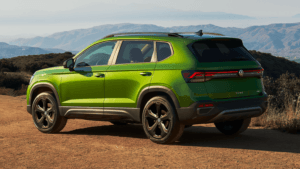
The 2025 refresh gave the 2026 Volkswagen Taos a visual identity that aligns it clearly with the Tiguan family, and the effect is a small SUV that looks more expensive than its price tag suggests. U.S. News described the Taos as “sporty-looking” with “styling cues similar to the larger Tiguan, including illuminated logos, signature LED running lights and light bars spanning the front and rear.” The “chiseled hood flanked by LED headlights” noted by Volkswagen of Ann Arbor’s review creates a strong front-end character that avoids the anonymous quality that afflicts many small crossovers at this price point. Eight exterior colour options were available at launch, including Cornflower Blue — the distinctive premium paint that J.D. Power’s reviewer specifically selected for their SEL test vehicle — alongside more conservative choices like Platinum Gray Metallic and Deep Black Pearl.
Wheel sizes increase with trim level: 17-inch alloys on the S, 18-inch on SE and SE Black, and 19-inch two-tone alloys on the SEL — a progression that sharpens the visual presence at higher trims but does introduce the firmer ride noted in reviews. A panoramic sunroof is available from the SE trim upward, adding to the visual openness of the cabin and providing the kind of premium feature that buyers at this price point increasingly expect to find. The 2026 Volkswagen Taos’s profile — with a strong character line running from the front fender to the tail — establishes a clear visual connection to the Atlas and Tiguan above it in the range, giving the smallest Volkswagen SUV a design coherence that reinforces the brand’s overall identity.

Interior and Technology: More Space Than the Exterior Suggests
Open the door of the 2026 Volkswagen Taos and the first impression is of space that the car’s exterior dimensions do not obviously promise. KBB praised the cabin as one that “feels more spacious than its exterior dimensions would suggest,” and that assessment applies particularly to rear-seat legroom — an area where the Taos provides enough room for adults to sit without the knees-to-chest posture that characterises genuinely tight back seats. J.D. Power noted that “wide door openings and a user-friendly step-in height make child seat installation easier” — a practical detail that families with young children will appreciate on a daily basis. Total passenger volume reaches 99.5 cubic feet, and cargo capacity behind the rear seat measures 27.9 cubic feet FWD or 24.9 cubic feet AWD, expanding to 65.9 and 60.2 cubic feet respectively when the 60/40-split rear seat is folded.
The technology centrepiece is an 8-inch touchscreen with wireless Apple CarPlay and Android Auto — now standard on every trim for 2026. Higher trims add a 10.25-inch Digital Cockpit Pro configurable instrument cluster that displays navigation guidance, speed, and travel information. J.D. Power’s reviewer noted that the infotainment system “is easy to navigate, featuring large, easy-to-read icons and physical buttons surrounding the screen with shortcuts to audio, navigation, and other menu items” — the physical shortcut buttons around the display being a meaningful usability advantage over purely touchscreen systems. The 15-watt wireless charging pad, now standard from the SE upward, charges compatible smartphones without requiring a cable. The SEL adds native navigation and the new eight-speaker premium audio system confirmed for 2026.
One criticism that surfaces consistently across 2026 Volkswagen Taos reviews is the 8-inch touchscreen’s size. J.D. Power called it “small by today’s standards, especially compared with competitors like the Kia Seltos or Subaru Crosstrek, which offer much larger displays” — a valid observation given that screen size expectations in the segment have escalated significantly in recent years. The 2026 Volkswagen Taos uses the previous-generation MIB3 infotainment system rather than the newer MIB4 found in VW’s more recent models, a detail that buyers who compare the Taos cabin against a current Tiguan will notice. The climate controls — now touch-sensitive sliders on SE and SEL models — have drawn criticism from multiple reviewers and owners for requiring more attention to operate safely while driving than the traditional knobs they replaced. The base S trim retains more conventional controls, which ironically makes it easier to operate in motion.

Safety Systems: Full IQ.Drive Standard at Every Price Point
One of the 2026 Volkswagen Taos‘s most compelling arguments against rivals is the breadth of its standard safety equipment at every trim level. J.D. Power’s reviewer specifically noted that “it’s unusual for features like adaptive cruise control and rear cross-traffic warning to be standard on an SUV with such a low starting price” — a distinction that holds against direct rivals including the Honda HR-V and Subaru Crosstrek, where comparable features require higher trim levels or option packages. IQ.Drive on the 2026 Volkswagen Taos includes forward collision warning with automatic emergency braking and pedestrian detection, active blind-spot monitoring, lane-keeping assist with lane-centering, adaptive cruise control with stop-and-go capability, rear cross-traffic alert, and emergency assist. Travel Assist — the semi-autonomous highway driving system that handles steering, acceleration, and braking together — is also included, a technology level more commonly associated with premium brands.
The 2026-specific addition of rear-seat pretensioners improves rear occupant protection in frontal crash scenarios, following the same engineering logic that benefited the larger Atlas when Volkswagen updated its rear seatbelts for 2026. Higher 2026 Volkswagen Taos trims add the Adaptive Front-lighting System (AFS) with swivel-mounted headlamps that illuminate corners when turning, front and rear park distance control with manoeuvre braking, and a dynamic road sign display. The full surround-view parking camera system available on rivals including the Kia Seltos and Hyundai Kona is not offered on the 2026 Volkswagen Taos — a gap that OurAutoWorld identified as a comparative limitation in the parking assistance category. Overall, however, the safety equipment breadth relative to starting price makes the 2026 Volkswagen Taos stand out in its segment.
Pros and Cons
✅ Pros
- Quicker and more composed in corners than most subcompact SUV rivals
- Full IQ.Drive suite standard on every trim — including adaptive cruise and lane-centering
- 28/36/31 mpg FWD — competitive efficiency on regular fuel
- 65.9 cubic feet of cargo space with rear seats folded — class-competitive
- Wireless Apple CarPlay and Android Auto now standard for 2026
- 15W wireless charging upgraded and standard from SE upward
- Rear-seat legroom genuinely adult-friendly for a subcompact SUV
- AWD 4Motion includes upgraded independent rear suspension
- Two years of complimentary scheduled maintenance included
❌ Cons
- No hybrid option — Subaru Crosstrek Hybrid achieves 36 mpg combined
- 8-inch touchscreen feels small versus Kia Seltos and Subaru Crosstrek
- MIB3 infotainment — older generation than newer VW models use
- Touch-sensitive climate sliders on SE and SEL require attention while driving
- Ride quality firm on 19-inch wheels — noticeable on rough urban roads
- Engine can sound gritty under hard acceleration
- No surround-view camera system available — rivals offer it
- SEL at $37,375 AWD approaches compact SUV pricing territory
Competitors: A Crowded Segment With Strong Alternatives
The subcompact SUV segment is the automotive market’s most populated category, and the 2026 Volkswagen Taos competes directly against a field that has continued to improve. The Subaru Crosstrek is the rival that U.S. News most directly references — standard AWD, 8.7 inches of ground clearance, available hybrid powertrain at 36 mpg combined, and a lower base price, at the cost of less power and a less composed highway ride. The Honda HR-V undercuts the Taos on price and offers a larger 9-inch touchscreen standard, though with only 158 hp it is meaningfully slower and less engaging to drive. The Kia Seltos and Hyundai Kona offer more powerful engine options, larger infotainment screens, and in the Kona’s case a hybrid variant — competitive advantages that Edmunds acknowledges before concluding that the Taos “stands out among these economically minded crossovers with its driving experience.”
The Mazda CX-30 competes most directly on the driving quality dimension — composed, precise, and engaging in a way that few subcompact SUVs manage — but at a higher entry price and without the Taos’s equipment breadth at the base specification. The Nissan Rogue is a step larger but frequently cross-shopped, where the 2026 Volkswagen Taos offers better fuel economy and easier urban maneuverability at a lower price. Within the Volkswagen family, the Tiguan sits one step up in size and price, offering more passenger space and cargo volume for buyers who find the Taos’s dimensions too compact. The Taos’s strongest competitive position remains at the S and SE trim levels, where the combination of standard equipment, driving quality, and price creates genuine value that newer and more fashionable rivals have not yet fully displaced.
Final Verdict: The 2026 Volkswagen Taos Earns Its Price
The 2026 Volkswagen Taos is a subcompact SUV that consistently delivers more than its category and price suggest. The driving dynamics are genuinely above the class average — Edmunds tested it, confirmed it, and recommended it on that basis, not on brand loyalty. The standard safety equipment is broader than buyers paying under $30,000 have any right to expect. The rear-seat space and cargo capacity routinely surprise people who assume a small exterior means a cramped interior. And the 2025 refresh gave it an interior quality and exterior design that, as J.D. Power noted, feels “surprisingly upscale” for its market position. Two years of complimentary scheduled maintenance further reduces the real cost of ownership beyond the sticker price.
The 2026 Volkswagen Taos limitations are real and worth naming clearly. The absence of a hybrid option matters in a segment where the Subaru Crosstrek Hybrid achieves 36 mpg combined without requiring premium fuel. The 8-inch touchscreen has been outgrown by competitor displays and will continue to feel dated as the model year progresses. The touch-sensitive climate controls are a step backward from the physical knobs they replaced, and the firm ride on 19-inch wheels will not suit every buyer or every road surface. These are genuine trade-offs, not minor imperfections.
- But for the buyer who wants the best-driving car in the subcompact SUV segment at a starting price under $28,000, with full adaptive safety technology included and enough cargo and passenger space for real-world family use, the 2026 Volkswagen Taos makes a case that is difficult to argue against convincingly. It is the smallest Volkswagen SUV, and in the ways that matter most — dynamics, equipment value, and daily usability — it might also be the one that works the hardest for its money.
2026 Volkswagen Taos Images
Specifications
Specifications
| Production year | 2026 |
| Body type & seats | Compact SUV, 5 Seats |
| Dimensions | Length 4,466 mm × Width 1,841 mm × Height 1,638 mm; Wheelbase 2,689 mm |
| Weight | 1,498 kg (Curb Weight) |
| Engine type | 1.5L TSI Turbocharged Petrol Engine |
| Engine size & cylinders | 1,498 cc, Inline 4-Cylinder |
| Aspiration | Turbocharged Direct Injection with Intercooler |
| Power | 174 hp (130 kW) |
| Torque | 250 Nm |
| Transmission | 8-Speed Automatic |
| Drivetrain | Front-Wheel Drive (FWD) / 4Motion All-Wheel Drive (AWD) |
| Acceleration (0-100 km/h) | 8.2 Seconds |
| Top speed | 200 km/h |
| Fuel type | Premium Unleaded Petrol (Gasoline) |
| Fuel consumption | 7.4 L/100 km (Combined) |
| Fuel tank capacity | 50 Liters |
| Brakes | Ventilated Disc Brakes (Front), Disc Brakes (Rear) |
| Steering | Electromechanical Power Steering |
| Infotainment | 8.0-inch Touchscreen Infotainment System, 10.25-inch Digital Cockpit, Navigation (Available), Voice Control |
| Connectivity | Wireless Apple CarPlay, Wireless Android Auto, Bluetooth, USB-C Ports, Wireless Phone Charging, Volkswagen Car-Net |
| Safety | Adaptive Cruise Control, Front Assist, Lane Assist, Blind Spot Monitor, Rear Traffic Alert, Automatic Emergency Braking, Rear View Camera, Park Distance Control, Driver Attention Monitor, Multiple Airbags |
2026 Volkswagen Taos Price
 Price in USD
|
28,000 USD |
 Price in European Union
|
23,800 EUR |
 Price in United Kingdom
|
20,720 GBP |
 Price in Australia
|
42,840 AUD |
 Price in Canada
|
38,640 CAD |
 Price in India
|
2,444,400 INR |
 Price in China
|
201,040 CNY |
 Price in Indonesia
|
453,600,000 IDR |
 Price in Philippines
|
1,596,000 PHP |
 Price in Malaysia
|
118,160 MYR |
 Price in Nigeria
|
42,980,000 NGN |
 Price in Russia
|
2,252,880 RUB |
 Price in Pakistan
|
7,924,000 PKR |
 Price in Saudi Arabia
|
105,000 SAR |
 Price in Japan
|
4,116,000 JPY |
 Price in South Africa
|
493,920 ZAR |
 Price in Brazil
|
152,040 BRL |
 Price in Bangladesh
|
3,388,000 BDT |
 Price in Mexico
|
525,560 MXN |
More Products from Volkswagen