- Home
- Volkswagen
- 2026 Volkswagen Atlas
2026 Volkswagen Atlas: Price, Three-Row Interior, Specs, and Review
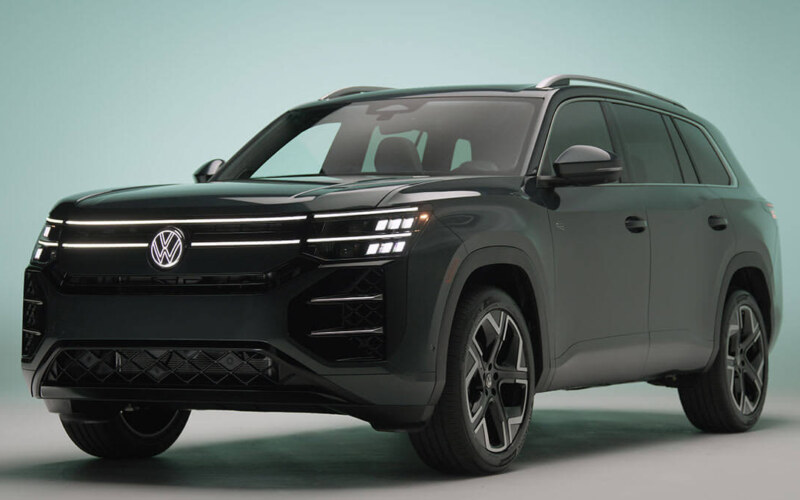
2026 Volkswagen Atlas is Volkswagen’s clearest answer to the American family SUV market, and eight years into its existence, the formula it represents has only gotten more refined. When the original Atlas arrived in 2018, it made one argument loudly and consistently: here is a three-row SUV with more legroom and cargo space than almost anything else at the price, built by people who understand that American families are large, their gear is abundant, and their patience for compromise is limited. The 2026 Volkswagen Atlas makes the same argument — more polished, better equipped, and now earning the IIHS TOP SAFETY PICK+ designation that confirms its safety credentials at the highest independent level. This is not a flashy car. It is a genuinely useful one, and in the three-row family SUV segment, that distinction matters enormously.
Overview: What the 2026 Volkswagen Atlas Is Built For
The 2026 Volkswagen Atlas is a midsize three-row SUV available in five trim levels — SE, SE with Technology, Peak Edition, SEL, and SEL Premium R-Line — all powered by a single turbocharged 2.0-litre four-cylinder engine paired with an eight-speed automatic transmission. It seats up to seven passengers, offers 20.6 cubic feet of cargo space behind the third row expanding to 96.6 cubic feet with all rear seats folded, and can tow up to 5,000 pounds when properly equipped. The 2026 Volkswagen Atlas is assembled at Volkswagen’s Chattanooga, Tennessee, facility — one of the brand’s most important North American production sites — and has been a consistent sales success since its introduction, establishing itself as the brand’s volume family vehicle in a market where three-row SUVs define the mainstream.
The 2026 model year carries forward the significant 2024 redesign without major changes. As Autoweb’s road test noted, the 2026 Volkswagen Atlas is “still among the roomier three-row crossovers you can find,” while VW has “dialed up the SUV’s luxury and technology with an overhauled dashboard” over successive updates. The notable 2026-specific addition is the inclusion of HomeLink garage door control technology in the auto-dimming rearview mirror on SE with Technology and higher trims — a small but welcome addition. More significantly, Volkswagen updated the rear seatbelts with pretensioners and load limiters for 2026 to improve rear occupant protection in frontal crashes, a safety engineering improvement that contributed directly to the IIHS TOP SAFETY PICK+ result.
Expected Price: Competitive Entry, Escalating Ambitions
The 2026 Volkswagen Atlas starts at $39,310 for the base SE in front-wheel drive, including the destination charge, according to Edmunds. All-wheel drive adds $1,900 to the SE and SE with Technology trims; from the Peak Edition upward, 4Motion AWD is standard equipment. The five trim levels span a meaningful price range: the SE with Technology — Edmunds’ recommended trim — adds a hands-free liftgate, remote start, 20-inch wheels, parking sensors, and the 5,000-pound towing capacity that the base SE lacks. The SEL brings genuine leather upholstery, a panoramic sunroof, heated rear seats, and a head-up display. At the top, the SEL Premium R-Line — as tested by U.S. News at $54,630 — adds massaging front seats, a Harman Kardon audio system, 21-inch two-tone alloy wheels, and multicolour ambient lighting.
Autoweb’s week-long real-world test of the 2026 Volkswagen Atlas emphasised that it “costs less than key rivals” while being “packed with standard luxury features that most rivals charge extra for” — a value argument that applies most convincingly at the lower trim levels. As U.S. News observed, “the lower trims of the 2026 Atlas are a good value,” with the caveat that “the more you spend on an Atlas, the more the competition catches up with its feature content.” The sweet spot for most buyers is the SE with Technology at approximately $42,000–$44,000 with AWD — a specification that includes the features families actually use daily without approaching the SEL Premium’s more aggressive pricing.
Release Date: On Sale Now, Built in Tennessee
The 2026 Volkswagen Atlas is on sale now at Volkswagen dealerships across the United States. The model went on sale in the fall of 2025, as CarGurus had projected, and is currently available across all five trim levels. The car is assembled at Volkswagen’s Chattanooga, Tennessee, plant — a facility that has produced the Atlas since the nameplate’s 2018 debut and continues to serve as Volkswagen’s primary large-SUV manufacturing base in North America. Current inventory across dealerships shows good availability, with the SE and SE with Technology trims most commonly stocked and the Peak Edition and SEL Premium R-Line requiring more lead time in some markets.
Looking ahead, Volkswagen has not announced a next-generation Atlas replacement on a defined timeline, but the brand’s broader electrification roadmap — which includes the ID.Buzz as a seven-seat option — suggests that the future of large Volkswagen family vehicles will incorporate electrification in some form. For buyers who want the 2026 Volkswagen Atlas’s combination of three-row space, 5,000-pound towing, and a conventional combustion powertrain they can refuel in minutes anywhere in the country, the current generation remains the definitive expression of that formula.
Engine and Performance: One Engine, All the Trims
The Evo4 2.0 TSI: 269 Horsepower, Eight-Speed Automatic
Every 2026 Volkswagen Atlas trim level is powered by the same engine: the “Evo4” 2.0-litre turbocharged four-cylinder TSI producing 269 horsepower and 273 lb-ft of torque, paired exclusively with an eight-speed automatic transmission. This engine replaced the previous 3.6-litre V6 option in the 2024 redesign and delivers more power — 269 hp versus the V6’s 276 hp — in a smaller, more fuel-efficient package. The turbocharged four-cylinder builds torque quickly from low revs, which helps offset the Atlas’s considerable kerb weight during urban acceleration. Edmunds’ testers noted that the powertrain delivers “enough grunt to get you onto the highway without too much trouble,” though they observed that the engine feels like it’s “working hard” when the cabin is fully loaded. The eight-speed automatic shifts “quickly and smoothly” according to the same evaluation — the transmission is one of the Atlas’s stronger points in real-world use.
Front-wheel drive is standard on the SE and SE with Technology trims, with 4Motion all-wheel drive available as a $1,900 option on those two levels and standard from the Peak Edition upward. The 4Motion system adds an Offroad drive mode to the standard Eco, Sport, Comfort, Custom, and Snow modes available on FWD models — a practical addition for buyers who occasionally venture beyond paved surfaces. All 2026 Volkswagen Atlas models include stop-start technology to reduce fuel consumption at standstill, and all can be equipped with the factory trailer hitch that enables the 5,000-pound tow rating — a figure that compares favourably to several key competitors. Full specifications are available on the official Volkswagen USA Atlas page.
Towing and Practical Performance
The 2026 Volkswagen Atlas is rated to tow up to 5,000 pounds when properly equipped with the factory trailer hitch — standard on SE with Technology and above, available on the base SE. That rating accommodates a mid-size boat, a loaded utility trailer, or a smaller travel trailer, covering the towing needs of most family SUV buyers without requiring a larger, less fuel-efficient vehicle. Volkswagen’s Intelligent Crash Response System is standard on every 2026 Volkswagen Atlas: in the event of a collision, it automatically shuts off the fuel pump, unlocks the doors, and activates the hazard lights — a passive safety feature that operates independently of driver action when it matters most.
Fuel Economy: Honest Numbers for a Large SUV
The EPA rates the FWD 2026 Volkswagen Atlas at 20 mpg city, 27 mpg highway, and 23 mpg combined. AWD models on SE trims return 20/26/22 mpg, while the heavier SEL and Peak Edition AWD variants achieve 19/25/21 mpg — a 1–2 mpg penalty for the added traction hardware and larger wheels. Autoweb’s real-world week of testing with the AWD SEL Premium R-Line confirmed 19 city/25 highway/21 combined, matching the EPA estimate precisely — an honest result for a turbocharged four-cylinder moving nearly two tons of family SUV. Edmunds’ test returned 22.3 mpg on their real-world route, also consistent with official figures. These numbers are average for the midsize three-row segment, and the 2026 Volkswagen Atlas has no hybrid option to improve them — a genuine limitation compared to rivals like the Toyota Grand Highlander Hybrid and Hyundai Palisade Hybrid.
Battery and Electric Drive: Combustion Only, No Hybrid
The 2026 Volkswagen Atlas is a purely combustion-powered vehicle. There is no mild-hybrid assist, no plug-in hybrid variant, and no purely electric version in the Atlas lineup. All models use the same stop-start system to reduce idling consumption, but beyond that concession, the 2026 Volkswagen Atlas remains a straightforward turbocharged petrol vehicle. Edmunds specifically flagged this as a competitive disadvantage, noting that the Toyota Grand Highlander — their recommended alternative — “is also available as a hybrid, which is something Volkswagen doesn’t offer for the Atlas.” For buyers whose priorities include electrified efficiency, that gap is real and the competition addresses it; for buyers who simply want a reliable, refuel-anywhere three-row SUV, it is a non-issue.
Driving Experience: Composed, Comfortable, Competent
Ask the 2026 Volkswagen Atlas to be sporting and it will disappoint you. Ask it to carry your family across 400 miles of varied road in unhurried, well-composed comfort, and it will reward you with every mile. Edmunds put it plainly: “The Volkswagen Atlas isn’t sporty or fun to drive, though it can win you over with how great it is at transporting up to seven people in comfort.” That is an accurate description of the car’s essential character — one that prioritises stability, predictability, and passenger comfort over driver engagement, which is the correct priority for a vehicle of this size and purpose.
U.S. News tested a top-spec SEL Premium R-Line across Washington’s Olympic Peninsula — a region of varied elevation, curves, and surface quality — and confirmed that the 2026 Volkswagen Atlas delivers “agile handling” and a “purposeful design” that remain appealing even at the top of the range. The steering is precise and the brakes work well for smooth stops according to Edmunds’ independent track evaluation. Body roll in corners is significant enough to remind you of the vehicle’s mass, but it is predictable and well-managed rather than alarming. Drive mode selection — including the AWD-specific Offroad mode — allows drivers to tailor the 2026 Volkswagen Atlas to road conditions from motorway cruising to light trail use.
The ride quality across all 2026 Volkswagen Atlas trims is composed rather than plush — firm enough to feel controlled without the harshness that undermines long-distance comfort. On the Olympic Peninsula test, U.S. News found the Atlas comfortable despite the route’s challenges. Autoweb’s week-long real-world assessment concluded with genuine enthusiasm: “We love the spaciousness, driving manners, relative luxury, and overall value of a 2026 Volkswagen Atlas SE.” The key qualifier is “relative” — the Atlas delivers luxury appropriate to its price point, not the opulence of a Cadillac Escalade, and buyers who calibrate their expectations accordingly will find the 2026 Volkswagen Atlas consistently satisfying.
Exterior Design: Upright, Athletic, Distinctively VW
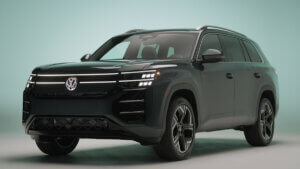
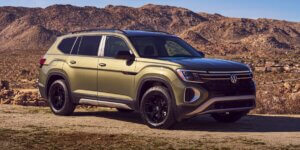
The exterior design of the 2026 Volkswagen Atlas is defined by its upright stance, strong horizontal character lines, and a front fascia that projects presence without resorting to the aggressive corporate grilles that dominate this segment. The 2024 redesign gave the Atlas sharper LED headlights with the Adaptive Front-lighting System (AFS) — swivel-mounted lamps that improve road illumination when cornering — standard across all trim levels. A pair of 900-lumen LED headlights flanks a large grille, with roof rails standard on every trim in either black or silver finish depending on specification. Edmunds described the Atlas’s styling as “distinctive and likable, especially with the R-Line treatments” — the R-Line appearance package adds sportier fascias, darker exterior detailing, and larger wheels that give the 2026 Volkswagen Atlas a more athletic presence.
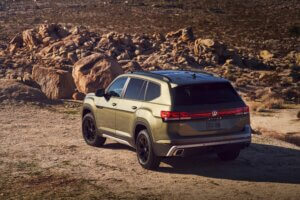
Wheel sizes escalate with trim level: 18-inch alloys on the base SE, 20-inch on the SE with Technology and SEL, and 21-inch two-tone alloys on the SEL Premium R-Line. The Peak Edition takes a different visual direction with a more rugged front fascia and underbody cladding designed for light off-road credibility. Six exterior colours are available — Silver Mist Metallic, Avocado Green Metallic, Mountain Lake Blue Metallic, Opal White, Deep Black Pearl, and Pure Gray — with colour availability varying by trim. At nearly 198 inches long, the 2026 Volkswagen Atlas is genuinely large in profile — a presence that communicates its interior space ambitions before you open a door.
Interior and Technology: Space as the Primary Feature
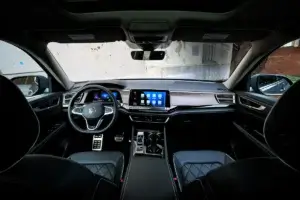
Walk into a 2026 Volkswagen Atlas cabin and the primary impression is one of scale. The third row — which Autoweb describes as among the largest in the midsize segment — provides 33.7 inches of legroom, accommodating adults and teenagers rather than requiring them to fold themselves into a space designed for emergency use only. The second row offers generous legroom and, from the SE with Technology trim upward, the option of second-row captain’s chairs (a $695 option) that create a six-passenger layout with a centre aisle for easier third-row access. Autoweb noted a particularly thoughtful feature: the second-row seat moves forward for third-row access even with a child safety seat still installed — eliminating the frustrating process of removing and reinstalling car seats every time a rear passenger needs to climb through.
The technology centrepiece is a 12-inch floating touchscreen infotainment display paired with a 10.25-inch Digital Cockpit Pro instrument cluster, both standard across all 2026 Volkswagen Atlas trims. Wireless Apple CarPlay and Android Auto are standard, as is wireless charging at 15 watts — a genuine improvement over the slow wired-only charging of previous generations. Six USB-C ports with up to 45 watts of output power cover the charging needs of a fully occupied family. Starting in 2026, Atlas models with a myVW+ subscription gain access to a ChatGPT-powered voice assistant, alongside remote start, remote lock/unlock, and last parked location services. The control layout does present a limitation: as invoice-pricing.com’s review noted, the system “lacks traditional power and tuning knobs, which many people find helpful for using the radio” — a criticism that Edmunds similarly identifies as “a real drawback.”
Upholstery on the 2026 Volkswagen Atlas escalates from leatherette on lower trims to genuine leather on the SEL and above. Heated and ventilated front seats and a heated steering wheel are standard across the range — a specification breadth that Autoweb highlighted as unusual for a base trim. The SEL Premium R-Line adds massaging front seats with four-way lumbar support, a Harman Kardon premium audio system, and multicolour adjustable ambient lighting. Cargo capacity is genuinely impressive: 20.6 cubic feet behind the third row, 55.5 cubic feet with the second row folded, and 96.6 cubic feet with all rear seats down — figures that, as Autoweb confirmed, exceed those of the Honda Pilot, Hyundai Palisade, and Ford Explorer.
Safety Systems: IIHS TOP SAFETY PICK+ — The Highest Available Rating
The 2026 Volkswagen Atlas earned the IIHS TOP SAFETY PICK+ designation — the Insurance Institute for Highway Safety’s highest honour — confirmed in April 2026. To achieve this rating, a vehicle must earn Good results in the IIHS’s updated moderate overlap front, updated side, and small overlap front crash tests, achieve Acceptable or Good headlight ratings across all trims, and earn an Acceptable or Good pedestrian front crash prevention result. The 2026 Volkswagen Atlas achieved Good ratings across every crash test conducted, with the LED Adaptive Front-lighting System rated Good — a notable achievement given how many vehicles fail to reach acceptable headlight standards at their base specification.
The updated rear seatbelt pretensioners and load limiters added for 2026 contributed directly to the TOP SAFETY PICK+ result by improving rear occupant protection in the IIHS’s newest frontal crash evaluation — a proactive safety engineering decision that demonstrates VW’s commitment to the standard rather than waiting for regulations to mandate it. The National Highway Traffic Safety Administration separately awarded the 2026 Volkswagen Atlas an overall five-star safety rating, with five stars in the side impact test. Standard IQ.Drive equipment across all trims includes automatic emergency braking with pedestrian and cyclist detection, blind-spot monitoring, adaptive cruise control with lane-centering, rear cross-traffic alert, and post-collision automatic braking. Available upgrades include a 360-degree surround-view camera system, parking sensors, a head-up display, and road sign recognition — a comprehensive menu that covers both active and passive safety needs.
Pros and Cons
✅ Pros
- IIHS TOP SAFETY PICK+ — highest available safety designation
- Five-star NHTSA overall safety rating
- 96.6 cubic feet of total cargo space — more than Honda Pilot, Hyundai Palisade, Ford Explorer
- Genuine adult-sized third row with 33.7 inches of legroom
- 5,000-pound tow rating standard from SE with Technology upward
- Heated and ventilated front seats standard across all trims
- 12-inch touchscreen and 10.25-inch digital cluster standard on every model
- 15W wireless charging and six USB-C ports standard
- Assembled in Chattanooga, Tennessee — strong North American supply chain
❌ Cons
- No hybrid option — Toyota Grand Highlander and Hyundai Palisade offer one
- 22–23 mpg combined is average for the class, not class-leading
- Infotainment lacks physical volume and tuning knobs — touch-only controls
- Engine feels strained with a full cabin and luggage
- Body roll in corners is noticeable — this is not a sporty driver
- SEL Premium R-Line at $54,630 pushes into luxury SUV territory
- LATCH child seat lower anchors rated Marginal by IIHS for ease of use
- J.D. Power predicted reliability score of 71 — rated Average, not above
Competitors: A Segment Where Every Rival Has Something to Offer
The midsize three-row SUV segment is the most competitive in the American automotive market, and the 2026 Volkswagen Atlas faces rivals that cover nearly every angle of the space, comfort, and value argument. The Toyota Grand Highlander is Edmunds’ top-rated alternative — praised for its hybrid powertrain option, strong reliability reputation, and broad model range. The Toyota doesn’t match the Atlas’s cargo volume but offers significantly better fuel economy in hybrid form. The Hyundai Palisade has been fully redesigned with a dramatically improved interior and standard hybrid availability, making it a compelling value argument against the 2026 Volkswagen Atlas at similar price points.
The Kia Telluride remains the segment’s most frequently praised vehicle for interior quality and value at its price point — consistently ranked above the 2026 Volkswagen Atlas in consumer satisfaction surveys, though the Atlas counters with more cargo space and a more European driving character. The Ford Explorer offers more powertrain variety and a sportier feel, though less interior space. The Honda Pilot brings user-friendly technology and strong long-term reliability but less cargo volume. The Chevrolet Traverse offers minivan-matching space in an SUV body but a noisier cabin at highway speeds. Against all of them, the 2026 Volkswagen Atlas’s strongest arguments remain consistent: maximum interior volume, a compelling lower-trim value equation, and — now with the IIHS TOP SAFETY PICK+ — class-competitive safety credentials.
Final Verdict: The 2026 Volkswagen Atlas Delivers on Its Promise
The 2026 Volkswagen Atlas has always known what it is: a large, practical, well-equipped family SUV built for buyers who prioritise interior space and usability over driving excitement or brand prestige. Eight model years in, that clarity of purpose has become a genuine strength. The car does not try to be something it isn’t — it does not pretend to be sporty, does not promise fuel economy it cannot deliver, and does not require you to spec aggressively to get a useful vehicle. The base SE at $39,310 comes with heated and ventilated front seats, a 12-inch touchscreen, wireless charging, and IQ.Drive safety technology as standard equipment — a specification that would cost meaningfully more on most competitors at the same price point.
The criticisms that follow the 2026 Volkswagen Atlas are the same ones that have followed it throughout its life: the engine is adequate but not inspiring under load, the infotainment would benefit from physical controls, the fuel economy trails hybrid competitors, and the upper trim pricing becomes harder to defend against a fully loaded Telluride or Palisade. These are real limitations, not minor quibbles, and buyers who find them decisive should follow Edmunds’ recommendation toward the Toyota Grand Highlander or Kia Telluride without guilt.
But for the buyer who wants maximum interior volume, a proper adult third row, 5,000-pound tow capability, and an IIHS TOP SAFETY PICK+ rating at an entry price of $39,310 — built in Tennessee by a brand with a clear long-term commitment to the North American market — the 2026 Volkswagen Atlas makes a case that is difficult to argue against. Autoweb’s final word captures it accurately: “the huge cargo hold, agile handling, and purposeful design remain appealing at any price.” The 2026 Volkswagen Atlas earns its place in a crowded segment by doing the fundamental things exceptionally well.
2026 Volkswagen Atlas Images
Specifications
Specifications
| Production year | 2026 |
| Body type & seats | Mid-Size SUV, 7 Seats |
| Dimensions | Length 5,097 mm × Width 1,990 mm × Height 1,781 mm; Wheelbase 2,979 mm |
| Weight | 2,018 kg (Curb Weight) |
| Engine type | 2.0L TSI Turbocharged Petrol Engine |
| Engine size & cylinders | 1,984 cc, Inline 4-Cylinder |
| Aspiration | Turbocharged Direct Injection with Intercooler |
| Power | 269 hp (200 kW) |
| Torque | 370 Nm |
| Transmission | 8-Speed Automatic |
| Drivetrain | Front-Wheel Drive (FWD) / 4Motion All-Wheel Drive (AWD) |
| Acceleration (0-100 km/h) | 7.0 Seconds (AWD) |
| Top speed | 209 km/h |
| Fuel type | Premium Unleaded Petrol (Gasoline) |
| Fuel consumption | 9.8 L/100 km (Combined) |
| Fuel tank capacity | 70 Liters |
| Brakes | Ventilated Disc Brakes (Front & Rear) |
| Steering | Electromechanical Power Steering |
| Infotainment | 12.0-inch Touchscreen Infotainment System, 10.25-inch Digital Cockpit Pro, Navigation, Voice Assistant, Harman Kardon Premium Audio (Available) |
| Connectivity | Wireless Apple CarPlay, Wireless Android Auto, Bluetooth, USB-C Ports, Wireless Phone Charging, Volkswagen Car-Net, Over-the-Air (OTA) Updates |
| Safety | Adaptive Cruise Control, Front Assist, Lane Assist, Travel Assist, Blind Spot Monitor, Rear Traffic Alert, Automatic Emergency Braking, Park Assist Plus, 360-Degree Camera, Driver Attention Monitor, Multiple Airbags |
2026 Volkswagen Atlas Price
 Price in USD
|
40,000 USD |
 Price in European Union
|
34,000 EUR |
 Price in United Kingdom
|
29,600 GBP |
 Price in Australia
|
61,200 AUD |
 Price in Canada
|
55,200 CAD |
 Price in India
|
3,492,000 INR |
 Price in China
|
287,200 CNY |
 Price in Indonesia
|
648,000,000 IDR |
 Price in Philippines
|
2,280,000 PHP |
 Price in Malaysia
|
168,800 MYR |
 Price in Nigeria
|
61,400,000 NGN |
 Price in Russia
|
3,218,400 RUB |
 Price in Pakistan
|
11,320,000 PKR |
 Price in Saudi Arabia
|
150,000 SAR |
 Price in Japan
|
5,880,000 JPY |
 Price in South Africa
|
705,600 ZAR |
 Price in Brazil
|
217,200 BRL |
 Price in Bangladesh
|
4,840,000 BDT |
 Price in Mexico
|
750,800 MXN |
More Products from Volkswagen

BrandsView All
Show More Brands