The overall rating is based on review by our experts
8.0
Rating8 / 10
2028 Volkswagen Tiguan is shaping up to be the most important update the nameplate has seen in years. Volkswagen’s Works Council officially confirmed in early 2026 that the Tiguan is scheduled for two extensive product upgrades — the first in 2028 and a second in 2031 — locking in a production lifecycle that runs to at least 2035.
That 2028 facelift is far more than revised bumpers and fresh paint. It brings updated interior technology, a stronger electrification push, and — critically — the arrival of a full hybrid powertrain for the North American market for the very first time. For the world’s best-selling Volkswagen, 2028 is the year the third generation steps fully into its own.
2028 Volkswagen Tiguan: Overview
The Volkswagen Tiguan has been the brand’s best-selling nameplate globally for years — not just its most popular SUV, but its single most popular model, with annual production consistently exceeding half a million units across more than 170 markets.
The third generation launched for 2025 on the MQB Evo platform with a redesigned interior, more powerful engines, and a dramatic 170-pound weight reduction over the previous generation. It set a strong foundation. The 2028 Volkswagen Tiguan facelift is now tasked with building on that foundation — addressing software and interface shortcomings, introducing hybrid power to new markets, and keeping the lineup competitive through the early 2030s.
2028 Volkswagen Tiguan Release Date and What’s Confirmed
The 2028 Volkswagen Tiguan facelift is expected in the second half of 2028, following Volkswagen’s established product cycle of major updates at roughly four-year intervals. The third generation debuted in late 2023 for European markets and 2025 for North America, making the timing precise.
The most significant confirmation came from Volkswagen of America CEO Dr. Kjell Gruner, who told reporters that a Tiguan Hybrid for the US market is “part of the plan.” According to Top Electric SUV, the launch is expected “as part of the model’s mid-cycle refresh, likely in the second half of 2028.”
That single confirmation transforms the 2028 Tiguan from a routine update into a strategic milestone for Volkswagen’s North American electrification strategy.
2028 Volkswagen Tiguan Price: What to Expect
The current 2027 Volkswagen Tiguan ranges from $32,280 to $45,410 in the United States. The 2028 facelift will carry a modest premium reflecting new technology and the hybrid powertrain addition — expect the base model to start in the low-to-mid $33,000 range.
The hybrid variant will likely add $3,000–$5,000 over an equivalent combustion trim, in line with how Volkswagen prices the eHybrid in European markets. In Europe, the current Tiguan starts from approximately €36,600, with the eHybrid 204 PS beginning from €48,655.
Engine and Performance of the 2028 Volkswagen Tiguan
2028 Volkswagen Tiguan Standard Combustion Engines
The 2028 Volkswagen Tiguan continues with the EA888 evo5 2.0-litre turbocharged four-cylinder — the same engine family that powers the third generation today. The standard engine produces 201 horsepower and 207 lb-ft of torque, paired with an eight-speed automatic transmission.
The range-topping SEL R-Line Turbo steps up to 268 horsepower and 258 lb-ft — a 67-horsepower premium introduced for the 2026 model year that is expected to remain on the facelifted lineup. In European markets, mild-hybrid eTSI petrol options (130 PS and 150 PS) and a 150 PS TDI diesel with 4Motion AWD and 2,300kg towing capacity remain part of the lineup.
2028 Volkswagen Tiguan Hybrid: The Key New Addition
The headline powertrain story for the 2028 Volkswagen Tiguan in North America is the confirmed hybrid system — a full hybrid (non-plug-in) setup comparable to what Toyota and Honda offer in the RAV4 Hybrid and CR-V Hybrid.
Volkswagen of America’s leadership has specifically indicated a preference for a self-charging full hybrid rather than a plug-in, citing cost and weight advantages for the US market. The system is expected to be based on Volkswagen’s new full-hybrid architecture debuting in the second-generation T-Roc in Europe, using a 1.5-litre turbocharged petrol engine as its combustion base.
For Europe, the existing eHybrid plug-in system — currently one of the longest-range PHEVs in the compact SUV segment — continues with its 204 PS and 272 PS output options.
Horsepower and Acceleration Figures
The 201 PS standard 2028 Volkswagen Tiguan covers 0–100 km/h in approximately 7.5 seconds. The 268 PS SEL R-Line Turbo is noticeably quicker in real-world driving, while the European eHybrid 272 PS variant achieves 0–100 km/h in 7.0 seconds flat — combining petrol and electric outputs for a performance-to-efficiency ratio no combustion-only Tiguan can replicate.
Fuel Consumption of the 2028 Volkswagen Tiguan
The 201 PS combustion 2028 Volkswagen Tiguan achieves EPA-estimated fuel economy of approximately 25 city / 32 highway / 28 combined MPG in front-wheel-drive specification — a result that benefits directly from the third generation’s weight reduction and the EA888 evo5’s improved thermal efficiency.
With 4Motion all-wheel drive, combined economy drops marginally to the 23–26 MPG range in real-world mixed driving — still competitive for a compact SUV with this level of performance on offer.
The European eHybrid variants tell a far more efficient story. Parkers’ real-world testing returned mid-50s MPG in mixed driving with regular charging on the 204 PS variant — and the 73-mile WLTP electric range means most daily commuters can complete a full working week on electricity before needing fuel.
Battery and Electric Range of the 2028 Volkswagen Tiguan eHybrid
The European 2028 Volkswagen Tiguan eHybrid uses a 19.7kWh lithium-ion battery — nearly double the previous generation’s 10.6kWh — powering an 85kW electric motor alongside a 1.5-litre TSI petrol engine.
The result is a WLTP-certified all-electric range of up to 120 kilometers (approximately 75 miles). Volkswagen positions this as sufficient to cover 99% of typical daily journeys on electricity alone — a meaningful claim backed by independent testing.
Charging has also been significantly upgraded over the previous generation. The eHybrid now accepts up to 11kW from an AC wallbox and up to 50kW at DC fast-charging stations — compared to just 3.6kW AC on the outgoing model. A full charge from a 7.4kW wallbox takes approximately three and a half hours.
Driving the 2028 Volkswagen Tiguan: On-Road Experience
The 2028 Volkswagen Tiguan builds on the third generation’s already-strong driving character. The MQB Evo platform’s revised suspension geometry, aluminum components, and high-strength steel body structure produce a vehicle that feels genuinely more composed than its predecessor — tighter in corners, better controlled over broken surfaces, and quieter at motorway speeds.
Available DCC Pro adaptive dampers on European higher specifications allow meaningful adjustment between comfortable everyday riding and a more dynamic mode with reduced body roll. Parkers found the result moved the Tiguan closer to the Ford Kuga’s handling sharpness than most buyers would expect from a family-focused compact SUV.
The eHybrid always launches in electric mode and transitions to hybrid power seamlessly under heavier acceleration. The powertrain isn’t quite as imperceptibly smooth as the Toyota RAV4 Hybrid’s CVT-based system, but it’s efficient, responsive, and well-suited to the Tiguan’s composed everyday character.
Exterior Design of the 2028 Volkswagen Tiguan Facelift
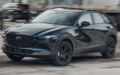
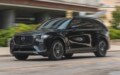
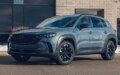
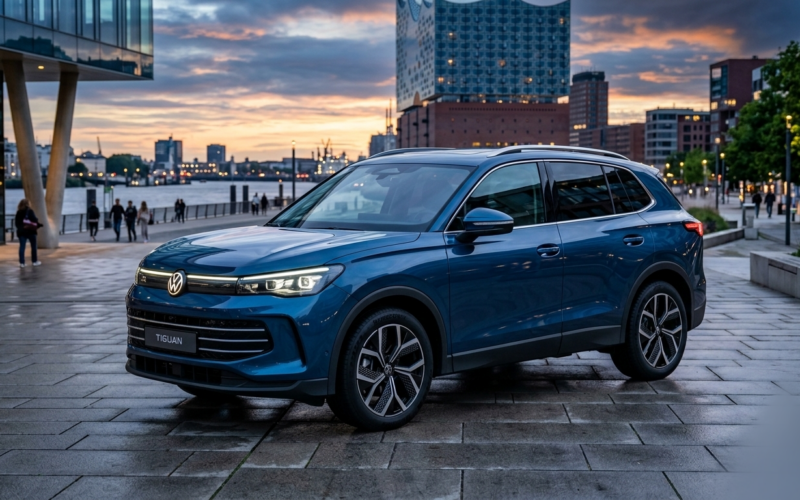
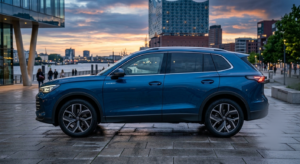
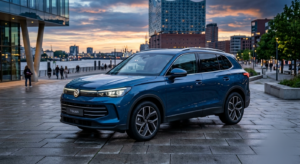
The exterior updates for the 2028 Volkswagen Tiguan are expected to be measured rather than dramatic. Based on Volkswagen’s confirmed product planning, expect revised front and rear bumpers, updated LED lighting signatures aligned with the brand’s 2028 design direction, new color options, and revised wheel designs across the trim levels.
The IQ.LIGHT HD Matrix headlights currently available on top-spec Tiguan models are expected to carry forward — and potentially expand to more trim levels as costs fall. The full-width rear LED light bar and illuminated VW logo that define the current Tiguan’s visual signature will continue as brand anchors through the facelift.
The current design is genuinely strong. The 2028 facelift’s role is to keep it current against rivals who will have updated in the intervening years — not to replace what is already working well.
Interior and Technology Inside the 2028 Volkswagen Tiguan
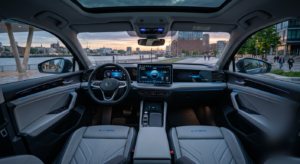
The interior is where the 2028 Volkswagen Tiguan facelift is expected to make its biggest impression. Carscoops’ confirmed reporting on the 2028 update specifically mentions bringing the Tiguan’s tech “up to speed with Volkswagen’s newer models” — with an explicit renewed focus on physical controls to address one of the third generation’s most consistent criticisms.
The standard 12.9-inch touchscreen, 10.25-inch Digital Cockpit Pro, wireless Apple CarPlay and Android Auto, and the Atmospheres ambient lighting system all carry forward. The 15-inch floating display currently exclusive to the SEL R-Line Turbo is expected to become more widely available across the facelifted lineup.
Top-spec models continue with the 12-speaker Harman Kardon audio system, three-zone Climatronic Touch climate control, heated and ventilated massaging front seats, and the Park Assist system that enables fully automated parking up to 50 meters via smartphone. Over-the-air update capability allows software improvements without dealer visits — a feature that will keep the 2028 Tiguan current long after purchase.
Safety Systems in the 2028 Volkswagen Tiguan
The 2028 Volkswagen Tiguan continues with Volkswagen’s IQ.DRIVE Level 2 driver assistance suite as standard across all trim levels — one of the most comprehensive standard-equipment safety packages in the compact SUV segment.
Standard across every trim: Travel Assist semi-automated highway driving, autonomous emergency braking, lane-keeping assist, rear cross-traffic alert, blind-spot monitoring, adaptive cruise control with stop-and-go, automatic high-beam assist, and front and rear parking sensors.
The third generation introduced ten airbags total — adding driver knee, center, and rear side airbags over the previous model. Higher European specifications offer the IQ.LIGHT HD Matrix headlights derived from the Touareg, bringing individually controlled beam management that meaningfully improves visibility on unlit rural roads.
Pros and Cons of the 2028 Volkswagen Tiguan
✅ Pros
❌ Cons
Confirmed facelift with lifecycle extended to at least 2035
Exterior facelift changes expected to be restrained — no dramatic visual reinvention
First-ever full hybrid powertrain for the North American Tiguan
US hybrid will be full hybrid only — PHEV remains Europe-exclusive
European eHybrid offers up to 120km electric range and 50kW DC fast charging
eHybrid battery reduces boot space from 652 to 490 litres
eHybrid hybrid transitions not as smooth as Toyota RAV4 Hybrid
IQ.DRIVE Level 2 safety suite standard across all trims
No AWD option for the eHybrid — front-wheel drive only on PHEV variants
268 PS SEL R-Line Turbo delivers genuine performance in a family SUV package
Top-trim pricing approaches Audi Q3 territory, challenging value proposition
2028 Volkswagen Tiguan vs. The Competition
The 2028 Volkswagen Tiguan competes in one of the most crowded segments in global automotive — and its rivals have been sharpening their offers consistently.
The Toyota RAV4 Hybrid remains the benchmark for full-hybrid refinement in this class. Its conventional hybrid system is smoother, more efficient in real-world use, and priced competitively. For the US-market 2028 Tiguan Hybrid, outperforming the RAV4 on interior quality while matching it on efficiency is the core challenge.
The Honda CR-V Hybrid combines strong efficiency with genuinely generous interior packaging. The Ford Kuga PHEV and Hyundai Tucson PHEV compete directly with the European eHybrid — though the Tiguan’s 120km WLTP range sets a benchmark neither currently matches. Against the Kia Sportage PHEV, the Tiguan’s stronger residuals and more premium interior positioning are meaningful differentiators.
Within the Volkswagen Group itself, the Skoda Kodiaq iV shares the Tiguan’s platform and eHybrid system but offers more interior space at a lower price — an honest internal competitor. The Audi Q3 sits above on perceived prestige but shares enough platform DNA that serious buyers regularly cross-shop both. The 2028 facelift’s technology upgrade is designed specifically to close that gap.
Final Verdict: Is the 2028 Volkswagen Tiguan Worth Buying?
The 2028 Volkswagen Tiguan makes a compelling case at every level of the lineup. For North American buyers who have been waiting for an electrified Tiguan, the 2028 model year finally delivers — in a full-hybrid form well-suited to American driving habits.
For European buyers, the eHybrid with its 120km electric range and 50kW DC charging is already one of the strongest plug-in hybrid family SUVs on sale. The facelift’s technology updates address the one area where the third generation has faced consistent criticism — and that matters for a vehicle expected to stay in production until 2035.
The combustion variants — especially the 268 PS SEL R-Line Turbo — remain thoroughly capable choices. The lightweight MQB Evo platform, the efficient EA888 evo5 engine, and the standard Level 2 safety suite combine to make the combustion 2028 Volkswagen Tiguan one of the most complete compact SUVs in the class, without requiring a single electrification compromise.
With a lifecycle confirmed to 2035 and two planned upgrades, buying the 2028 Volkswagen Tiguan means investing in a model Volkswagen is actively committed to keeping current. That long-term product confidence is something most rivals simply cannot offer — and it’s one of the most underrated reasons to choose it.
Specifications and production planning details sourced from Carscoops, Top Electric SUV, Volkswagen Newsroom, Parkers, RAC Drive, Electrifying, and Business Car. US-market Tiguan Hybrid specifications based on confirmed Volkswagen executive statements; final specs to be announced closer to launch. European eHybrid figures reflect current third-generation models expected to carry forward to the 2028 facelift.
2028 Volkswagen Tiguan Images
Specifications
Specifications
Production year
2028
Body type & seats
Compact SUV, 5 Seats
Dimensions
Length 4,539 mm × Width 1,859 mm × Height 1,658 mm; Wheelbase 2,680 mm

 Price in USD
 Price in European Union
 Price in United Kingdom
 Price in Australia
 Price in Canada
 Price in India
 Price in China
 Price in Indonesia
 Price in Philippines
 Price in Malaysia
 Price in Nigeria
 Price in Russia
 Price in Pakistan
 Price in Saudi Arabia
 Price in Japan
 Price in South Africa
 Price in Brazil
 Price in Bangladesh
 Price in Mexico