2026 Toyota Hilux: Price, Engine, Specs, Towing Capacity, and Review
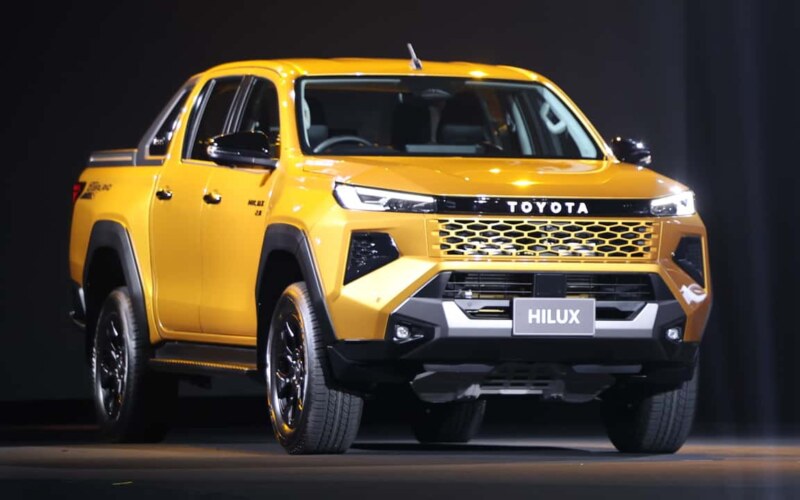
2026 Toyota Hilux is not just an update — it is a full generational reinvention. The ninth-generation Hilux made its world premiere on November 10, 2025 in Bangkok, Thailand. After more than a decade on the same basic platform, Toyota has thrown everything at it: a bold new “Cyber Sumo” design, a completely redesigned interior inspired by the Land Cruiser, and for the first time in the model’s 58-year history, a fully electric powertrain. The 2026 Hilux now offers more powertrain choices than any other Toyota currently on the market — diesel, mild-hybrid diesel, full BEV, and a hydrogen fuel cell version coming in 2028. Starting from AUD $33,990 in Australia, this is the most ambitious Hilux ever built.
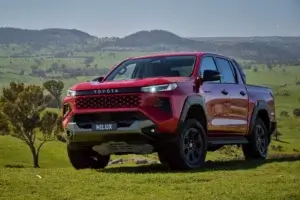
2026 Toyota Hilux Overview: A New Generation Arrives
The Toyota Hilux has been one of the world’s most iconic trucks since 1968. With more than 27 million units sold across over 180 countries, it has built a reputation for toughness that no marketing campaign could manufacture. The fifth season of Top Gear famously tried to destroy one — it survived everything they threw at it.
But the eighth-generation Hilux was showing its age. Its core architecture dated back to 2015. Rivals had caught up on technology, interior quality, and efficiency. Toyota knew it needed a wholesale reinvention — not another facelift.
The 2026 Toyota Hilux delivers exactly that. According to CarExpert, the ninth generation introduces “a refreshed exterior, new cabin design and now only one diesel powertrain” for key markets — the 2.4-litre has been retired in favour of an improved 2.8-litre across the board. The overall result is the most technologically advanced and best-equipped Hilux ever offered to buyers around the world.
2026 Toyota Hilux Release Date and Availability
The 2026 Toyota Hilux officially went on sale on December 9, 2025 in Australia. It is built in Thailand and sold across markets including Australia, Europe, the Middle East, Asia, New Zealand, South Africa, and Latin America. The Hilux is not sold in the United States, where the Toyota Tacoma serves that market.
The rollout is staggered by powertrain and region. Diesel models launched first in Australia in December 2025. The 48V mild-hybrid diesel variants for Europe entered production in spring 2026, with deliveries from April through July 2026. The BEV electric model began rolling out in select markets from December 2025, with Australian BEV deliveries expected between January and March 2026. Japan diesel models arrive mid-2026. The hydrogen FCEV is confirmed for 2028.
2026 Toyota Hilux Price
In Australia, the 2026 Toyota Hilux starts at AUD $33,990 before on-road costs for the WorkMate 4×2 manual cab-chassis — up from the previous entry price but reflecting the deletion of the older 2.4-litre diesel and the upgrade to a full 2.8-litre across the range. The lineup then climbs through the SR, SR5, Rogue, and — returning after being dropped in 2022 — the Rugged X, which tops out at $71,990 before on-roads.
BEV pricing has not been confirmed in Australia at time of writing but is expected to land below $100,000. Toyota has been clear that the electric Hilux is “largely aimed at fleet customers” — businesses with charging infrastructure in place and sustainability targets to meet.
Globally, the 2026 Toyota Hilux pricing ranges from approximately $35,000 to $55,000 USD equivalent depending on market, powertrain, and specification. In Europe, the Hybrid 48V lineup spans Entry, Mid, High, and Invincible grades. The BEV offers Entry, Mid, and High at launch. Against its rivals, the Hilux now undercuts the Ford Ranger’s base price in Australia — a deliberate positioning move to reclaim segment leadership.
2026 Toyota Hilux Engine and Performance
2026 Toyota Hilux Diesel: 2.8L Turbo with 48V Mild Hybrid
The volume-seller powertrain in the 2026 Toyota Hilux is the upgraded 2.8-litre turbocharged diesel. Toyota has retired both the old 2.4-litre diesel and the 2.7-litre petrol in most key markets. The 2.8-litre diesel produces 201 horsepower and up to 500Nm of torque — well-suited for towing heavy loads and handling demanding terrain.
On higher grades in Australia and Europe, this engine is paired with a 48V mild-hybrid system. The mild-hybrid adds 8.5kW and 65Nm of additional torque, improves fuel efficiency to between 7.1 and 7.6L/100km combined, and significantly reduces diesel clatter and vibration. It is paired with a six-speed automatic transmission across most grades, with a six-speed manual available on entry WorkMate configurations.
2026 Toyota Hilux BEV: The First Electric Hilux
The 2026 Toyota Hilux BEV is historic — the first fully electric body-on-frame pickup Toyota has ever built. It uses a dual-motor all-wheel-drive setup drawing from a 59.2kWh lithium-ion battery. The front motor produces 205Nm of torque, the rear motor delivers 269Nm, for a combined output that gives the electric Hilux genuine off-road and towing capability.
The electric Hilux is available in Australia in SR and SR5 grades as a double-cab 4×4 only. It supports fast charging and is designed to be fully off-road capable despite its electric powertrain — maintaining the Hilux’s core identity even without a combustion engine underneath.
2026 Toyota Hilux Towing Capacity and Payload
The diesel 2026 Toyota Hilux can tow up to 3,500kg braked and carry a payload of up to 1,000kg — numbers that make it one of the most capable one-tonne utes on the market. These figures put it on par with or ahead of the Ford Ranger in towing and strongly ahead of the electric variant, which is rated for 1,600kg towing and 715kg payload.
The payload gap between diesel and BEV is significant. For buyers who genuinely load their truck to capacity with tools, equipment, or materials, the diesel remains the right choice. The electric Hilux serves fleet buyers and those whose payloads are lighter but whose sustainability requirements are non-negotiable.
2026 Toyota Hilux Fuel Consumption
The 2026 Toyota Hilux 2.8-litre diesel with the 48V mild-hybrid system returns between 7.1 and 7.6L/100km in combined driving. That is a meaningful improvement over the previous generation’s diesel consumption, and it comes without the complexity or cost of a plug-in hybrid system.
Non-hybrid diesel variants — offered in select markets including Eastern Europe — consume slightly more, typically in the 8.0–9.0L/100km range depending on configuration and driving style. These figures are competitive for a body-on-frame one-tonne ute of this capability and size.
2026 Toyota Hilux BEV Battery and Electric Range
The 2026 Toyota Hilux BEV uses a 59.2kWh lithium-ion battery pack powering two electric motors through eAxles at both front and rear. WLTP-rated range is approximately 240 kilometers — or over 300 kilometers under the less stringent NEDC test cycle. Fast-charging capability is standard.
The 240km WLTP range is honest and practical for the use cases Toyota is targeting: urban fleet operations, short regional runs, and worksites with overnight charging. It is not designed to replace a diesel Hilux on a remote outback station or a 1,000km highway run. Toyota is clear about this — the BEV and diesel exist for different buyers with different needs, and the 2026 lineup is designed so neither compromises the other.
A hydrogen fuel cell Hilux (FCEV) is confirmed for 2028. It will use Toyota’s fuel cell system — similar to that in the Mirai sedan — to produce electricity from hydrogen, emitting only water. It will offer longer range and faster refuelling than the BEV, targeting markets with established hydrogen infrastructure.
Driving the 2026 Toyota Hilux
The 2026 Toyota Hilux rides on the same proven ladder-frame chassis as its predecessor — not the newer TNGA-F platform used by the Land Cruiser Prado and Sequoia. Toyota made this decision deliberately. The existing chassis has earned its reputation for durability in the harshest conditions on earth. Changing it without proven reason would be a risk no Hilux buyer asked for.
What has changed is the suspension tuning. Toyota Australia’s Altona-based team guided the chassis setup — local engineers tuning the ride and handling for Australian conditions, which include some of the most demanding road surfaces in the world. The result is a Hilux that rides more smoothly than the previous generation without sacrificing the firmness needed for heavy payloads.
The 700mm wading depth carries over from the eighth generation — enough to cross most water obstacles a working truck would encounter. Multi-Terrain Select and Multi-Terrain Monitor are available on higher grades, giving drivers control over power delivery on mud, sand, rock, and dirt. The locking rear differential is available on 4×4 models and remains one of the most useful off-road tools in the segment.
The electric Hilux BEV adds instant torque delivery from its dual-motor setup — a different kind of off-road capability that suits smooth rock-crawling and precise low-speed maneuvers. The permanent AWD system on the BEV requires no driver input to split torque between axles. In some off-road scenarios, that automation is an advantage over the part-time 4WD systems on diesel variants.
2026 Toyota Hilux Exterior Design
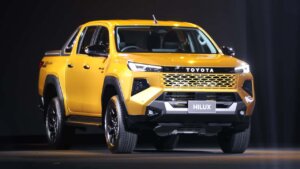
The 2026 Toyota Hilux wears a completely new design called “Cyber Sumo” — a blend of sharp angles, geometric shapes, and muscular proportions that is unlike any previous generation of the nameplate. The front end features slim LED headlights connected by a central bar carrying the TOYOTA name in full lettering. There is no traditional grille on the BEV — a smooth, aerodynamically efficient panel replaces it. Diesel and hybrid variants carry a wide hexagonal mesh grille in body colour.
The wheel arches are wider and more pronounced. New side steps are wider than before. A revised rear step makes accessing the load bed easier. The tailgate carries integrated TOYOTA branding. Two new exterior colors — Ash Slate and Sunglow — join the existing palette for 2026. The Rugged X adds unique exterior details including a snorkel, raised suspension, and underbody protection that signal its extreme off-road positioning clearly.
The overall dimensions are unchanged from the eighth generation. The wheelbase remains 3,085mm. The BEV prototype measures 5,320mm in length, 1,855mm wide, and 1,800mm tall — keeping the Hilux in its traditional size category rather than growing upward as some Chinese rivals have done. Toyota and Australia’s design team started the Cyber Sumo concept in 2021 — four years of development that shows in how cohesively the design language works across all powertrains.
2026 Toyota Hilux Interior and Technology
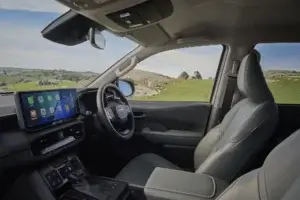
The cabin of the 2026 Toyota Hilux has been completely redesigned — the most significant interior overhaul in the model’s modern history. The inspiration is the Land Cruiser 300 Series. The dashboard uses a three-tiered horizontal layout with a 12.3-inch digital instrument cluster and a 12.3-inch central touchscreen. Physical buttons for climate control and 4×4 functions are grouped centrally and easily accessible during off-road driving.
Wireless charging is standard on mid and upper grades. Rear USB ports are included. The layout prioritizes function over flair — exactly what Hilux buyers have always asked for. The most frequently used controls are within a button press, not buried in touchscreen menus. Motor1 noted this is “a functional, straightforward layout, which is exactly what you’d expect from a no-nonsense truck.”
An optional premium interior pack is available on SR5 and above grades in Australia for $2,500. It adds black leather upholstery, an eight-way power-adjustable driver’s seat with lumbar support, and a nine-speaker JBL audio system. The Rogue and Rugged X come standard with Mineral-coloured upholstery that distinguishes the top-tier cabin from lower grades. Over-the-air software updates keep both the infotainment system and safety technology current throughout the vehicle’s life.
2026 Toyota Hilux Safety Systems
The 2026 Toyota Hilux comes with an expanded Toyota Safety Sense suite — called T-Mate in some markets. Standard across all grades is autonomous emergency braking with pedestrian detection, adaptive cruise control, lane trace assist, road sign recognition, and automatic high beams. Blind-spot monitoring is now standard from WorkMate grade upward — a meaningful improvement over the previous generation.
New for this generation is a driver monitor camera that detects signs of driver inattention or fatigue. A cabin detection alert warns if a passenger — including a child — is left in the rear cabin after the driver exits. Emergency Driving Stop System can bring the vehicle to a controlled stop if the driver becomes incapacitated. Over-the-air updates allow Toyota to deploy safety system improvements without requiring a dealer visit.
Toyota covers the 2026 Hilux in Australia with a five-year unlimited-kilometre warranty covering all Toyota-produced parts, panels, and accessories. The powertrain warranty extends to seven years if the vehicle is serviced on schedule. Seven years of emergency roadside assistance is also included — one of the strongest warranty packages in the ute segment.
2026 Toyota Hilux Pros and Cons
| ✅ Pros | ❌ Cons |
|---|---|
| First-ever Hilux BEV — 59.2kWh dual-motor AWD, 240km WLTP range | BEV rated for only 1,600kg towing — far below the diesel’s 3,500kg |
| 48V mild-hybrid diesel: 7.1–7.6L/100km combined — best Hilux efficiency ever | Price increase of ~$6,000+ over previous entry point in Australia |
| Dual 12.3-inch screens with physical controls — Land Cruiser-inspired interior | Not available in the United States — Tacoma remains the US alternative |
| 3,500kg braked towing (diesel) — competitive with Ford Ranger and Amarok | BEV pricing not yet confirmed — expected under $100,000 AUD but targeting fleets |
| Rugged X returns — factory-ready extreme off-road model back after 2022 hiatus | No GR Sport or Raptor-equivalent confirmed yet for performance off-road niche |
| Five-year unlimited-km warranty + seven years roadside assistance in Australia | Service intervals every 6 months / 10,000km — shorter than most rivals’ schedules |
2026 Toyota Hilux vs The Competition
The 2026 Toyota Hilux competes in the global one-tonne ute segment — one of the most fiercely contested vehicle categories in markets like Australia, South Africa, Europe, and the Middle East. Its primary rival is the Ford Ranger. The Ranger reclaimed Australia’s best-selling vehicle crown from the Hilux in 2022 — and the ninth-generation Hilux is Toyota’s direct response. The Ranger’s plug-in hybrid variant offers more electric range than the Hilux BEV’s 240km, but the Hilux diesel’s 3,500kg towing matches the Ranger’s maximum and comes with a longer reliability track record in demanding conditions.
The Volkswagen Amarok W600 is the handling-focused rival — better on sealed roads but not as proven in extreme conditions. The Isuzu D-Max is the reliability benchmark alternative, with a loyal following in Australia and Africa built on decades of diesel durability. The D-Max lacks the Hilux’s new interior technology but offers a strong warranty and a lower entry price on equivalent grades.
The Mitsubishi Triton and Nissan Navara compete at lower price points with more conservative feature sets. Neither yet offers a comparable electric or mild-hybrid powertrain at the Hilux’s scale. The BYD Shark 6 and GWM Cannon Alpha PHEV represent the emerging Chinese competition — plug-in hybrid pickup trucks with higher electric range than the Hilux BEV, but without the Hilux’s 58-year reliability reputation or established dealer and service networks in most markets.
2026 Toyota Hilux Final Verdict
The 2026 Toyota Hilux is the most important Hilux in a generation. After more than a decade on an aging platform, Toyota has delivered a truck that looks genuinely modern, offers genuinely modern technology, and covers genuinely modern powertrain expectations — without abandoning the core qualities that made the nameplate a global legend in the first place.
The 48V mild-hybrid diesel is the choice for most buyers. At 7.1–7.6L/100km combined with 3,500kg towing capacity, it does everything a working truck needs to do — more efficiently than before and with a far better interior to spend time in. The BEV is a genuine statement of intent for fleet buyers and sustainability-focused operators, even if its 240km range and 1,600kg towing limit make it a specialist choice rather than a universal one.
The price increase over the previous generation is real and noticeable. But what you get for the extra money — dual 12.3-inch screens, 48V mild-hybrid efficiency, blind-spot monitoring as standard, the Cyber Sumo design, and the returning Rugged X — justifies the step up. The 2026 Toyota Hilux is back where it belongs: at the top of the global ute conversation, with more powertrain choices, more technology, and more ambition than any Hilux that came before it.
Specifications and pricing sourced from CarExpert, RACV, Motor1, Toyota Global Newsroom, CarsFrenzy, and Toyota Australia official documentation. Australian pricing confirmed at December 2025 launch. BEV range figures reflect WLTP test cycle. FCEV confirmed for 2028 launch via Toyota Global Newsroom. Service intervals and warranty details per Toyota Australia dealer documentation.
2026 Toyota Hilux Images
Specifications
Specifications
| Production year | 2026 |
| Body type & seats | Mid-Size Pickup Truck, 5 Seats |
| Dimensions | Length: 5,325 mm • Width: 1,900 mm • Height: 1,865 mm • Wheelbase: 3,085 mm |
| Weight | 2,020–2,140 kg |
| Engine type | Turbocharged Petrol Engine |
| Engine size & cylinders | 2.7-liter (2,694 cc) Inline-4 |
| Aspiration | Naturally Aspirated |
| Power | 166 hp (122 kW) |
| Torque | 245 Nm (181 lb-ft) |
| Transmission | 6-Speed Automatic or 5-Speed Manual |
| Drivetrain | Rear-Wheel Drive (RWD) or Part-Time 4WD |
| Acceleration (0-100 km/h) | 12.5 sec (approx.) |
| Top speed | 175 km/h (approx.) |
| Fuel type | Regular Unleaded Gasoline |
| Fuel consumption | 10.7 L/100 km (combined) |
| Fuel tank capacity | 80 Liters |
| Brakes | Ventilated Front Disc, Rear Drum, ABS, EBD, Brake Assist |
| Steering | Hydraulic Power Steering or Electric Power Steering (market dependent) |
| Infotainment | 8-inch or 9-inch Touchscreen, Toyota Smart Connect |
| Connectivity | Wireless Apple CarPlay, Android Auto, Bluetooth, USB-C |
| Safety | Toyota Safety Sense, Pre-Collision System, Lane Departure Alert, Adaptive Cruise Control (selected trims), Blind Spot Monitor, Rear Cross Traffic Alert, Vehicle Stability Control, Hill-Start Assist, Downhill Assist Control, Rear Camera, 7 Airbags, TPMS. |
2026 Toyota Hilux Price
 Price in USD
|
34,000 USD |
 Price in European Union
|
28,900 EUR |
 Price in United Kingdom
|
25,160 GBP |
 Price in Australia
|
52,020 AUD |
 Price in Canada
|
46,920 CAD |
 Price in India
|
2,968,200 INR |
 Price in China
|
244,120 CNY |
 Price in Indonesia
|
550,800,000 IDR |
 Price in Philippines
|
1,938,000 PHP |
 Price in Malaysia
|
143,480 MYR |
 Price in Nigeria
|
52,190,000 NGN |
 Price in Russia
|
2,735,640 RUB |
 Price in Pakistan
|
9,622,000 PKR |
 Price in Saudi Arabia
|
127,500 SAR |
 Price in Japan
|
4,998,000 JPY |
 Price in South Africa
|
599,760 ZAR |
 Price in Brazil
|
184,620 BRL |
 Price in Bangladesh
|
4,114,000 BDT |
 Price in Mexico
|
638,180 MXN |
More Products from Toyota


BrandsView All
Show More Brands