2027 Audi RS 7 : Price, Horsepower & Specs
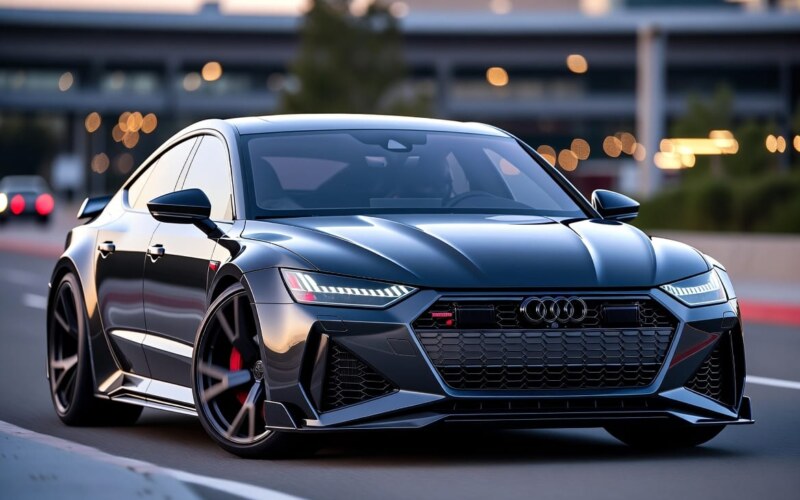
2027 Audi RS 7 is the five-door sports car that continues to define what a luxury performance Sportback can be. Carrying forward the exceptional RS 7 Performance specification with 621 horsepower, a 3.3-second 0–60 mph time, quattro all-wheel drive, and adaptive air suspension, the 2027 Audi RS 7 remains the most powerful and most versatile halo model in the A7 lineup. Starting from approximately $143,000, it offers a combination of daily usability, grand touring capability, and supercar-rivalling acceleration that no direct competitor in its class can fully replicate. The 2027 RS 7 is the rare car that genuinely earns every dollar of its asking price.
2027 Audi RS 7: Overview
The Audi RS 7 has been one of the most compelling arguments in the luxury performance sedan segment since it first launched in 2013. The second generation, which arrived for the 2021 model year, raised the standard significantly — bringing a new 48-volt mild hybrid system, more power, sharper handling, and a technology suite that finally matched the RS 7’s dynamic ambitions.
The RS 7 Performance variant — introduced for 2024 — is the highest expression of this generation. It strips over 17 pounds of acoustic damping material, adds 30 horsepower over the standard RS 7, and cuts the 0–60 mph time by two-tenths of a second to 3.3 seconds flat. The 2027 Audi RS 7 continues this Performance specification as the sole RS 7 configuration available in the United States.
According to Cars.com, the RS 7 Performance is “equipped the way you’d expect a 621-hp flagship luxury model to be” — riding on 21-inch wheels with summer performance tires, adaptive air suspension, a sport rear differential, and rear-wheel steering as standard. The 2027 Audi RS 7 carries all of that forward without compromise.
2027 Audi RS 7: Release Date and Availability
The 2027 Audi RS 7 continues from the current generation launched in 2021 and refined with the Performance upgrade in 2024. It is on sale now at Audi dealers across the United States, Europe, the Middle East, and key international markets. No significant changes are confirmed for the 2027 model year — it is a carryover of the RS 7 Performance specification.
The 2027 Audi RS 7 is built at Audi’s Neckarsulm plant in Germany — the same facility responsible for the R8 supercar and the full RS lineup. A next-generation A7 is expected to arrive in the coming years, which would eventually spawn a new RS 7 generation. Until then, the current RS 7 Performance remains the definitive form of this generation.
2027 Audi RS 7: Price
The 2027 Audi RS 7 starts from approximately $143,000–$151,000 MSRP in the United States, depending on configuration and options. KBB confirms current RS 7 Performance listings from $142,117 to $151,390 — making it the most accessible entry point to a 621-horsepower luxury grand tourer in Audi’s lineup.
Options on the 2027 RS 7 can add meaningfully to that base price. Carbon-ceramic brakes, the optional sport exhaust, carbon-fiber interior inlays, the RS Dynamic Package, and the optional forged/milled 22-inch lightweight wheels — which save approximately 11 pounds of unsprung mass per corner — all add to the final figure. A well-specified 2027 Audi RS 7 approaches $175,000 before tax and destination.
Against its primary rivals, the 2027 RS 7 is positioned competitively. The BMW M8 Gran Coupe starts at approximately $145,000 with similar performance credentials. The Mercedes-AMG GT 63 starts above $160,000. The Porsche Panamera Turbo starts around $175,000. The 2027 Audi RS 7 undercuts each of those at its base price while matching or exceeding them on practicality.
2027 Audi RS 7: Engine and Performance
2027 Audi RS 7: 4.0L Twin-Turbo V8 with 48V MHEV
The 2027 Audi RS 7 is powered by Audi’s 4.0-litre twin-turbocharged TFSI V8 engine producing 621 horsepower at 6,000 RPM and 627 lb-ft of torque at 2,300–4,500 RPM. A 48-volt mild-hybrid system integrates with the engine to provide additional torque fill at low RPM and to enable smoother engine stop-start functionality.
The V8 uses a bank-firing cylinder deactivation system — shutting down four cylinders under light load at highway speeds to improve fuel efficiency. The transition between four- and eight-cylinder operation is designed to be imperceptible to driver and passengers. In practice, it works — highway cruising in the 2027 RS 7 reveals neither the mechanical drama of a V8 working hard nor the flatness of four cylinders struggling.
The eight-speed Tiptronic automatic transmission is the only gearbox option on the 2027 Audi RS 7. It drives all four wheels through Audi’s quattro permanent AWD system with a sport rear differential that distributes torque between the rear wheels for improved cornering dynamics. No manual transmission option exists or has been offered on the RS 7 in any generation.
2027 Audi RS 7: Chassis and Dynamic Systems
The 2027 Audi RS 7 rides on RS-specific adaptive air suspension — adjustable across five ride height settings and with continuously variable damping. Rear-wheel steering is standard, reducing the effective turning radius at low speeds for easier parking and increasing stability at high speeds by steering the rear wheels in phase with the fronts.
The sport rear differential is one of the RS 7’s most significant dynamic assets. It can shift torque biases between 0% and 100% to either rear wheel within milliseconds — enabling the car to rotate more willingly into corners and drive out more cleanly than a fixed differential allows. Combined with the rear-wheel steering, the result is a 5,000-pound grand tourer that handles with a precision and agility its weight suggests should be impossible.
2027 Audi RS 7: Horsepower, Acceleration, and Top Speed
The 2027 Audi RS 7 accelerates from 0–60 mph in 3.3 seconds — confirmed by Audi as standard for the RS 7 Performance. That figure matches or betters the BMW M8 Gran Coupe and trails only the AMG GT 63 S E Performance PHEV in this segment. Top speed is electronically limited to 155 mph (250 km/h) as standard, with the optional RS Dynamic Package raising that to 174 mph and the RS Dynamic Package Plus raising it to 190 mph.
Quarter-mile time is approximately 11.4–11.6 seconds based on independent testing of the RS 7 Performance specification — consistent with a 3.3-second 0–60 mph time in a car of this weight. Braking from 60 mph occurs in approximately 104 feet with the standard steel brakes. The optional carbon-ceramic brakes reduce brake fade under repeated hard stops and improve cold-weather modulation compared to carbon units.
2027 Audi RS 7: Fuel Consumption
The 2027 Audi RS 7 is EPA-rated at 14 city / 21 highway / 17 combined MPG — confirmed by Cars.com for the RS 7 Performance specification. These numbers reflect the twin-turbo V8’s appetite for fuel when driven with appropriate enthusiasm, and they are honest rather than surprising for a 621-horsepower luxury grand tourer.
The cylinder deactivation system partially compensates in light-load highway driving, where the 2027 RS 7 can return closer to 22–24 MPG in real-world conditions. The 48V mild-hybrid system does not provide a meaningful efficiency improvement under performance driving — it is most effective at smoothing the start-stop system and providing torque fill at low RPM rather than delivering measurable fuel economy gains.
The 2027 Audi RS 7 requires premium 91+ octane fuel. For buyers who cover primarily urban miles, the 14 MPG city figure and premium fuel requirement add up to meaningful ongoing costs. For buyers who use the RS 7 for what it was built for — long-distance grand touring at speed — the highway figure is acceptable and the driving experience justifies the cost.
2027 Audi RS 7: Mild Hybrid System Details
The 2027 Audi RS 7 uses a 48-volt mild-hybrid (MHEV) system — not a plug-in hybrid. There is no external charging port and no pure electric driving range. The 48V belt-alternator-starter (BAS) connects to the crankshaft, recovering energy under braking and storing it in a lithium-ion battery, then deploying it to assist the engine during acceleration and to power the start-stop system.
The 48V system enables a coast-and-glide function — at speeds between 34 and 99 mph, the engine can shut down completely while the car coasts, restarting seamlessly when the driver applies throttle. This contributes to real-world fuel savings on motorway driving that the EPA cycle does not fully capture. The system adds neither significant weight nor complexity relative to a conventional mild-hybrid setup.
A fully plug-in hybrid RS 7 is widely anticipated for the next generation, which is expected to arrive in the coming years on the Volkswagen Group’s PPC (Premium Platform Combustion) architecture. That future model would pair a V8 or V6 with a larger battery for genuine EV range alongside performance output exceeding the current model’s 621 horsepower. For the 2027 Audi RS 7, however, the mild-hybrid system is the only electrification present.
Driving the 2027 Audi RS 7
The 2027 Audi RS 7 drives with a composure and precision that belies the numbers on its spec sheet. At 5,000 pounds, it has no right to feel as agile as it does. The adaptive air suspension keeps body movement controlled without transmitting harshness. The rear-wheel steering sharpens the front end’s response in a way that removes a half-metre from the car’s subjective size in tight situations.
In Comfort mode, the 2027 RS 7 is a refined, quiet grand tourer — the Sportback body allows it to absorb motorway surfaces without fatigue, and the air suspension’s lowest setting smooths out imperfections with genuine luxury. Switching to RS Dynamic or RS Performance mode firms the suspension, sharpens the throttle, and makes the transmission hold gears longer — transforming the RS 7 into a genuinely focused performance car in seconds.
The sport rear differential’s torque vectoring is the dynamic element that most separates the 2027 Audi RS 7 from less sophisticated rivals. In hard cornering, the outside rear wheel receives more torque for neutral balance. In controlled oversteer, the inside rear can receive more to rotate the car. It is adjustable through the drive mode selector — more active in RS Dynamic, more conservative in Comfort. The result is a car that rewards commitment with precise, predictable responses across a broad spectrum of driving conditions.
2027 Audi RS 7: Exterior Design
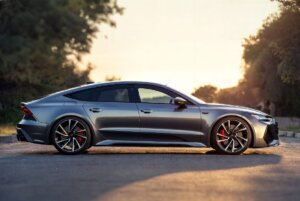
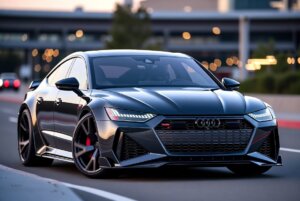
The 2027 Audi RS 7 wears one of the most successful designs in the modern German luxury segment — the four-door fastback Sportback body that gives it a roofline and proportions closer to a coupe than a traditional sedan. The wide RS-specific body kit — flared wheel arches, a more aggressive front bumper with larger air intakes, and a fixed rear spoiler — distinguishes the RS 7 clearly from the A7 and S7 without resorting to vulgarity.
Standard 21-inch wheels with summer performance tires fill the arches with appropriate presence. The optional forged and milled 22-inch lightweight wheels — which reduce approximately 11 pounds of unsprung mass per corner compared to the standard cast units — add visual drama while delivering a measurable dynamic improvement. LED headlights with Audi’s matrix beam technology are standard, providing one of the best adaptive lighting systems available at this price point.
The RS 7’s rear end — a wide, flat deck with the Sportback’s sloping hatchback liftgate and a full-width LED light bar — is one of the most recognisable silhouettes in the segment. Available colors include a range of Audi’s standard palette alongside RS-specific options. The Nardo Gray matte paint and Daytona Gray Pearl Effect both remain popular choices that complement the RS 7’s athletic but restrained visual character.
2027 Audi RS 7: Interior and Technology
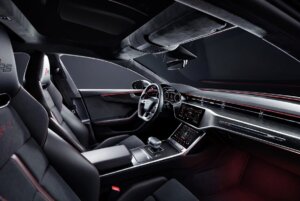
The 2027 Audi RS 7 interior is among the finest in any performance car at this price — and it earns that description on substance rather than on the strength of its badge alone. The MMI touch display system uses two stacked screens — a 10.1-inch upper display for infotainment and a 8.6-inch lower display for climate and comfort controls — reducing button clutter while maintaining accessibility. Both respond well to touch inputs with minimal lag.
The 12.3-inch virtual cockpit digital instrument cluster is customisable across multiple display configurations — including a full RS performance display showing lap timer, G-force meter, and powertrain data. Wireless Apple CarPlay and Android Auto are standard. A Bang & Olufsen 3D Advanced Sound System with up to 23 speakers is available — one of the best factory audio installations in any car at any price.
Four-zone automatic climate control, heated and ventilated front seats with massage function, a heated steering wheel, and RS sport seats with side bolsters that activate under hard cornering are all standard on the 2027 Audi RS 7. The Sportback body provides a genuine advantage over traditional sedans: the rear seats fold flat under the liftgate, opening 59.3 cubic feet of cargo space — transforming the RS 7 from a five-seat luxury performance car into a practical load carrier when needed.
2027 Audi RS 7: Safety Systems
The 2027 Audi RS 7 comes standard with forward collision warning, automatic emergency braking with pedestrian detection, lane departure warning, and a 360-degree camera system — the latter being particularly useful given the RS 7’s width and the difficulty of judging rear clearances from the low driving position. Cars.com notes that the current generation is “fairly light on standard safety tech” given the platform’s age — a fair observation that the available options address comprehensively.
Available safety technology on the 2027 RS 7 includes adaptive cruise control with stop-and-go, blind-spot monitoring, lane-centering steering, front and rear cross-traffic alert, automated parking, and a night vision system with animal and pedestrian detection. The available Pre Sense 360 system monitors multiple threat vectors simultaneously and can pre-tension seatbelts before an imminent collision.
The 2027 Audi RS 7 has not been separately crash-tested by IIHS or NHTSA in its Performance specification. Audi covers the RS 7 with a four-year / 50,000-mile basic warranty and a four-year / 50,000-mile powertrain warranty — more generous terms than most German competitors offer, which typically provide three-year coverage. Complementary scheduled maintenance is included for the first year.
2027 Audi RS 7: What We Love and What We Don’t
✅ 621 hp / 627 lb-ft / 3.3s 0–60 mph — supercar acceleration in a five-door grand tourer that comfortably seats five adults
❌ 14 MPG city / 17 MPG combined + premium fuel required — the running costs of a V8 at this output level are significant in urban use
✅ Sport rear differential + rear-wheel steering standard — dynamic systems that transform what a 5,000-pound car feels like at the limit
❌ Standard safety tech is limited for the price — adaptive cruise, blind-spot monitoring, and lane-centering are available but not standard, despite being standard on rivals at lower price points
✅ Sportback liftgate with 59.3 cu-ft of cargo space folded — the practicality of a hatchback in the body of a performance flagship
❌ Current generation dates from 2021 — the platform and core architecture are now six years old, with a next-generation A7 expected in the coming years
✅ Available B&O 3D Advanced Sound System with up to 23 speakers — one of the finest factory audio installations available in any vehicle at any price
❌ Dual-screen MMI interface requires adaptation time — the lower climate control screen is less intuitive than traditional physical knobs, particularly under dynamic driving
✅ Four-year / 50,000-mile warranty — more generous than Mercedes-AMG and BMW M’s typical three-year coverage at this performance tier
❌ No manual gearbox — eight-speed automatic only — the RS 7 has never offered a manual, and driving purists will find no compromise available
2027 Audi RS 7 vs The Competition
The 2027 Audi RS 7 competes in one of the most exclusive performance segments in the automotive world. The BMW M8 Gran Coupe at approximately $145,000 is the most direct rival — a four-door fastback producing 617 horsepower with xDrive AWD and a dual-clutch gearbox. The M8 Gran Coupe is more driver-focused and more dynamically exciting at the absolute limit. The RS 7 is more practical, better packaged, and broader in its daily usability. Both are outstanding; the choice is one of character rather than capability.
The Mercedes-AMG GT 63 starts above $160,000 and uses a turbocharged inline-four paired with an electric motor in its GT 63 E Performance specification — producing 831 horsepower. It is faster in outright acceleration and more technologically complex. But the AMG’s rear-biased platform is less composed at everyday speeds than the RS 7’s quattro system, and its interior cannot match the RS 7’s packaging efficiency. The AMG is the choice for maximum performance theatre. The RS 7 is the choice for sustained excellence.
The Porsche Panamera Turbo starts around $175,000 and is widely considered the dynamic benchmark in this segment — superior handling, more driver feedback, and a longer list of available performance options. It is also significantly more expensive at comparable specification levels. The 2027 Audi RS 7 undercuts the Panamera Turbo by $25,000–$40,000 at base pricing while coming very close on straight-line performance. For buyers who prioritise value within the segment, that gap is compelling.
2027 Audi RS 7: Final Verdict
The 2027 Audi RS 7 is the most complete expression of what a luxury performance grand tourer should be. It accelerates like a supercar. It carries five people in genuine comfort. It folds its rear seats flat for a long weekend’s worth of luggage. It costs less than the Panamera Turbo and matches it for straight-line performance. And it does all of this on a platform that, at six years old, still sets the benchmark for refinement and dynamic sophistication in its class.
The standard safety technology shortfall is the one legitimate criticism that stands against it in 2027. Buyers spending this much money expect adaptive cruise, blind-spot monitoring, and lane-centering steering as standard — and the RS 7 makes them options. That is a valid frustration. But it does not undermine what the 2027 RS 7 fundamentally is: the right car, at the right price, with the right combination of performance and practicality.
With a next-generation A7 and RS 7 anticipated in the coming years — likely on an updated platform with plug-in hybrid power — the 2027 Audi RS 7 may represent the final expression of the pure twin-turbo V8 RS 7 before electrification arrives. For buyers who want the best version of a formula that has been refined over two generations, the 2027 RS 7 is the answer. Buy it now, before it changes.
Specifications and pricing sourced from Cars.com, KBB, Audi USA Newsroom (media.audiusa.com), CarMax RS 7 generation history, JD Power model year data, and Audi official product documentation. Performance figures from Audi official specifications confirmed for the RS 7 Performance model year 2024–2027. Fuel economy from EPA official ratings as published by Cars.com. Warranty details from Audi USA official coverage documentation.
2027 Audi RS 7 Images
Specifications
Specifications
| Production year | 2027 |
| Body type & seats | High-Performance Sportback, 5 Seats |
| Dimensions | Length: 5,010 mm • Width: 1,950 mm • Height: 1,425 mm • Wheelbase: 2,930 mm |
| Weight | 2,065–2,150 kg |
| Engine type | Twin-Turbocharged TFSI Petrol Engine |
| Engine size & cylinders | 4.0-liter (3,996 cc) V8 |
| Aspiration | Twin Turbocharged |
| Power | 630 hp (470 kW) (expected) |
| Torque | 850 Nm (627 lb-ft) (expected) |
| Transmission | 8-Speed Tiptronic Automatic |
| Drivetrain | quattro Permanent All-Wheel Drive (AWD) |
| Acceleration (0-100 km/h) | 3.4 sec (expected) |
| Top speed | 250 km/h (electronically limited) • 280 km/h (with Dynamic Package) • 305 km/h (with RS Dynamic Package Plus) |
| Fuel type | Premium Unleaded Gasoline |
| Fuel consumption | 11.8–12.5 L/100 km (combined, estimated) |
| Fuel tank capacity | 73 Liters |
| Brakes | Ventilated Front & Rear Disc Brakes, Optional Carbon-Ceramic Brakes, ABS, EBD, Brake Assist |
| Steering | Progressive Electromechanical Power Steering with Optional Dynamic All-Wheel Steering |
| Infotainment | 12.3-inch Audi Virtual Cockpit Plus, 10.1-inch MMI Touch Display, 8.6-inch Lower Touchscreen, Bang & Olufsen 3D Premium Audio |
| Connectivity | Wireless Apple CarPlay, Android Auto, Bluetooth, USB-C, Wireless Charging, Audi Connect, Wi-Fi Hotspot |
| Safety | Audi Pre Sense Front & Rear, Adaptive Cruise Assist, Lane Departure Warning, Lane Change Assist, Intersection Assist, 360-Degree Camera, Park Assist Plus, Traffic Sign Recognition, Night Vision Assist (available), Multiple Airbags, TPMS. |
2027 Audi RS 7 Price
 Price in USD
|
135,000 USD |
 Price in European Union
|
114,750 EUR |
 Price in United Kingdom
|
99,900 GBP |
 Price in Australia
|
206,550 AUD |
 Price in Canada
|
186,300 CAD |
 Price in India
|
11,785,500 INR |
 Price in China
|
969,300 CNY |
 Price in Indonesia
|
2,187,000,000 IDR |
 Price in Philippines
|
7,695,000 PHP |
 Price in Malaysia
|
569,700 MYR |
 Price in Nigeria
|
207,225,000 NGN |
 Price in Russia
|
10,862,100 RUB |
 Price in Pakistan
|
38,205,000 PKR |
 Price in Saudi Arabia
|
506,250 SAR |
 Price in Japan
|
19,845,000 JPY |
 Price in South Africa
|
2,381,400 ZAR |
 Price in Brazil
|
733,050 BRL |
 Price in Bangladesh
|
16,335,000 BDT |
 Price in Mexico
|
2,533,950 MXN |
More Products from Audi