2028 Honda Civic Review : Price, Specs & Release Date
2028 Honda Civic Review arrives at the most exciting moment in this nameplate’s history. The 12th-generation Civic is a ground-up reinvention — 188 pounds lighter than the car it replaces, more structurally rigid, sharper handling, and powered by a new e:HEV hybrid system that Honda promises will improve fuel efficiency by 30 percent. This 2028 Honda Civic Review covers everything confirmed so far: the new platform, the hybrid-forward powertrain strategy, the S+ Shift simulation system, and what all of it means for the buyer who has trusted the Civic for decades. The official debut is expected in late 2027, with the 2028 model going on sale shortly after.
2028 Honda Civic Review: Overview of the 12th Generation
This 2028 Honda Civic Review begins with a simple observation: Honda is not playing it safe this time. The 11th-generation Civic was already one of the best compact cars in the world — a car that won awards, led sales charts, and earned genuine praise from automotive journalists. Honda could have refreshed it and called it a day.
Instead, Honda built a new platform, cut 90kg of weight, added a new hybrid system, introduced new chassis technology, and is preparing to launch the 12th-generation Civic as either a 2027 or 2028 model year. According to Carscoops, this 2028 Honda Civic is “already taking shape, with early details pointing to a lighter platform, improved hybrid tech, and sharper handling.”
In this 2028 Honda Civic Review, the theme is evolution done seriously. This is not an update to existing bones. The new Civic shares approximately 60% of its parts with the HR-V, CR-V, and Accord — a platform-sharing strategy that reduces production costs while maintaining the engineering quality Honda buyers expect.
2028 Honda Civic Review: Release Date and Availability
The 12th-generation Honda Civic is expected to be officially unveiled in late 2026 or early 2027. The on-sale date for the United States is targeted as a 2027 or 2028 model year — Honda has not confirmed which designation the first production cars will carry at time of writing.
This 2028 Honda Civic Review reflects the most likely designation based on the debut timing. The Civic will be sold in the United States, Canada, Japan, Europe, the Middle East, and over 170 other markets globally. The Civic is built at Honda’s Greensburg, Indiana plant for the North American market.
Honda has already publicly shown a heavily camouflaged development mule testing on public roads. That level of development activity — combined with the confirmed platform and powertrain details — puts the launch timeline on solid ground. Buyers who are considering a current 11th-generation Civic should factor this upcoming generation into their decision.
2028 Honda Civic Review: Price
Honda has not confirmed official pricing for the 2028 Honda Civic at time of writing. The current 2026 Civic starts at approximately $24,250 before destination for the base LX trim. The 2026 Civic Hybrid starts at $28,950 — a $4,700 premium over the base Civic.
For the 2028 Honda Civic, a moderate price increase over current figures is expected. The new platform, more advanced hybrid system, and upgraded technology all carry real engineering costs. Industry analysts project the 2028 Civic LX to start from approximately $25,000–$26,500 and the Hybrid to start from $29,500–$31,000 depending on trim structure.
In every 2028 Honda Civic Review discussion, value is a central consideration. The Civic has always been priced competitively against the Toyota Corolla, Mazda3, and Hyundai Elantra. That competitive positioning is expected to continue — the 2028 Civic will not suddenly become a premium product, but it will deliver more engineering for the money than ever before.
2028 Honda Civic Review: Engine and Performance
2028 Honda Civic Review: New Platform and Weight Reduction
The most confirmed and most significant technical detail in this 2028 Honda Civic Review is the new platform. Honda has officially confirmed the 12th-generation Civic will be 188 pounds (90kg) lighter than the current model. That is a dramatic reduction for a compact sedan — equivalent to removing an entire adult passenger from the vehicle’s kerb weight.
The new architecture also increases structural rigidity. A stiffer body with less mass is the ideal combination for both driving dynamics and efficiency. Honda specifically mentions “sharper steering response and more composed handling” as direct outcomes of the platform change. The front and rear tracks are both wider than the current model.
Honda is also introducing a new Motion Management System paired with an upgraded version of Agile Handling Assist. These are software-based systems that manage brake force at individual wheels to improve stability and cornering balance — technology previously seen only in more expensive Honda and Acura models, now filtering down to the 2028 Civic.
2028 Honda Civic Review: e:HEV Hybrid Powertrain
The 2028 Honda Civic Review powertrain story is dominated by the new e:HEV hybrid system. Honda has confirmed the 12th-generation Civic will use a self-charging hybrid setup built around a 2.0-litre four-cylinder engine paired with two electric motors. This is an evolution of the hybrid system currently used in the Accord and CR-V — optimised and refined for the lighter, more agile Civic.
Honda officially promises a 30 percent improvement in fuel efficiency over the current model. For reference, the current 2026 Civic Hybrid returns approximately 48 city / 47 highway / 48 combined MPG. A 30 percent improvement on that baseline would push combined fuel economy toward 60 MPG or above — a genuinely remarkable figure for a compact sedan with no plug-in capability required.
A turbocharged non-hybrid petrol engine is expected to continue for entry-level trims in markets where price sensitivity makes hybrid pricing difficult. However, Honda’s clear direction in this 2028 Honda Civic Review is toward hybrid as the primary powertrain — not as a premium option but as the mainstream choice.
2028 Honda Civic Review: Honda S+ Shift System
One of the most interesting confirmed features in the 2028 Honda Civic Review is the Honda S+ Shift system. This is a software-based technology — first seen in the new Prelude coupe — that simulates gear changes without a traditional mechanical gearbox.
S+ Shift modulates engine sound and torque delivery to mimic the sensation of a stepped automatic gearbox — giving the driver a sense of engagement and feedback that CVT-based hybrids typically cannot replicate. It is not a physical transmission. It is acoustic and torque engineering working together to create an emotional connection between driver and car that has been missing from many hybrid vehicles.
In a 2028 Honda Civic Review context, S+ Shift is significant because it directly addresses the criticism that hybrid drivetrains feel disconnected and soulless. Honda is trying to give the 2028 Civic the efficiency of a hybrid with the driver engagement of a more traditional powertrain. Whether it fully succeeds will be confirmed when journalists drive the final production car.
2028 Honda Civic Review: Fuel Consumption
Honda’s confirmed 30 percent fuel economy improvement is the headline efficiency claim in this 2028 Honda Civic Review. Applied to the current Hybrid’s 48 MPG combined figure, that improvement projects to approximately 62 MPG combined — which would make the 2028 Civic Hybrid one of the most fuel-efficient non-plug-in vehicles on the market.
The 188-pound weight reduction alone contributes meaningfully to this improvement. Less mass requires less energy to accelerate, decelerate, and maintain speed. Combined with the more advanced e:HEV system’s improved energy recovery and management, the efficiency gains are well-founded in engineering rather than optimistic marketing.
Non-hybrid petrol variants of the 2028 Honda Civic are expected to return approximately 30–35 MPG combined — similar to the current turbocharged engine’s figures, with marginal improvement from the platform weight reduction and possible mild-hybrid assist on some configurations.
2028 Honda Civic Review: Battery and Hybrid Technology
The 2028 Honda Civic e:HEV is a self-charging hybrid. The battery charges through regenerative braking and engine operation. There is no external charging port and no pure electric driving range — unlike a plug-in hybrid. This keeps the ownership experience simple and accessible for buyers who have no charging infrastructure.
The dual-motor setup allows the Civic to operate in electric-only mode at low speeds, switch to series hybrid mode during moderate driving, and use the engine directly at higher speeds — the system continuously selects the most efficient operating mode without driver input. Honda has refined this architecture across multiple generations in the CR-V and Accord.
A fully electric Civic — separate from the e:HEV — is not ruled out for later in the 12th generation’s lifecycle. Honda has positioned the electric Honda e:Ny1 in some markets already. Whether a full EV Civic arrives before 2030 depends on market demand and battery cost trajectories that Honda has not publicly committed to at time of writing.
2028 Honda Civic Review: Driving Experience
Every 2028 Honda Civic Review must acknowledge that no journalist has yet driven the production 12th-generation model. What Honda has confirmed — 188 pounds less weight, wider tracks, a stiffer body, Motion Management System, and Agile Handling Assist — points consistently toward a more engaging, more composed driving experience than the current 11th generation.
The current Civic is already praised for its handling balance and steering feel. Carscoops notes the new platform promises “sharper handling” — and a 188-pound reduction on a car that already weighs under 3,000 pounds is a meaningful change. Less weight means faster direction changes, more responsive turn-in, and better braking distances.
The S+ Shift system adds a layer of involvement that the current e:HEV hybrid’s CVT-based setup cannot deliver. For buyers who enjoyed the Civic Si’s manual gearbox but want the efficiency of a hybrid, S+ Shift may bridge that gap more convincingly than any previous Honda hybrid transmission attempt.
2028 Honda Civic Review: Exterior Design
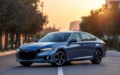
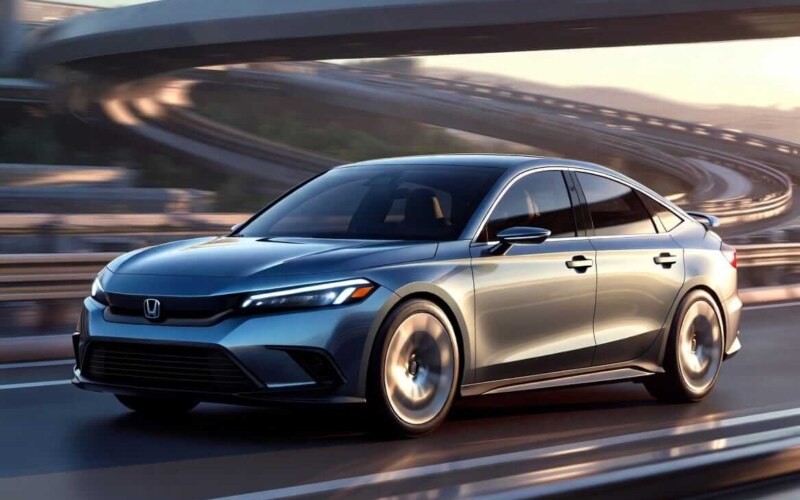
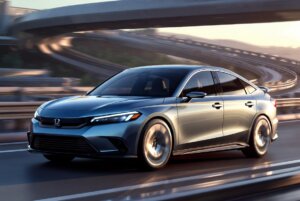
No official exterior images of the 12th-generation 2028 Honda Civic have been released. The camouflaged development mule reveals only body proportions — suggesting a profile broadly similar to the current generation but with wider tracks and potentially sharper surfacing influenced by Honda’s latest design language seen in the Prelude and new CR-V.
Independent rendering artist Theophilus Chin imagined the production car using Honda’s current design cues. His render suggests a sharper front end with a wider grille, more pronounced hood character lines, and rear taillights that span the full width of the tailgate. Carscoops described the rendering as reading “convincingly as a Honda” despite some speculative elements.
Honda’s current design language — seen most clearly in the 2025 Prelude, new Pilot, and revised CR-V — favours clean surfaces, integrated lighting signatures, and a restrained sophistication that differentiates it from more dramatic rivals. The 2028 Honda Civic is expected to follow this direction while introducing its own generation-defining details at the official reveal.
2028 Honda Civic Review: Interior and Technology
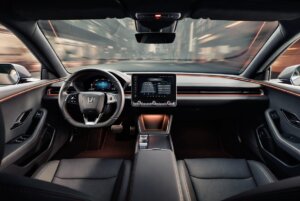
Honda has not released interior images of the 12th-generation 2028 Civic at time of writing. Based on the direction visible in the current 11th generation and Honda’s stated goals for the new model, this 2028 Honda Civic Review expects a larger central touchscreen — likely 10 to 11 inches — with a higher-resolution display and improved processing speed over the current 9-inch unit.
Wireless Apple CarPlay and Android Auto are expected as standard across the lineup. Google Built-In — integrated in the 2026 Civic Si and Type R — is expected to continue on the 2028 Civic’s upper trims. Over-the-air software updates are expected as part of Honda’s connected car strategy for this generation.
Interior space should benefit from the new platform’s longer wheelbase if Honda chooses to stretch it — a detail not yet confirmed. The current Civic’s 41.3 inches of rear legroom is already class-competitive. Honda’s 60% parts-sharing strategy with the CR-V and Accord means cabin components and quality standards will be anchored to those well-regarded products.
2028 Honda Civic Review: Safety Systems
The 2028 Honda Civic is expected to launch with the latest generation of Honda Sensing as standard across all trims. Honda Sensing on the current 11th generation already covers adaptive cruise control with low-speed follow, forward collision warning with automatic emergency braking, lane-centering assist, road departure mitigation, and traffic-sign recognition.
For the 12th generation, Honda is expected to add intersection collision mitigation and more advanced pedestrian and cyclist detection. The new Motion Management System — which modulates individual wheel braking for stability — will also contribute to active safety performance in emergency maneuvers. Honda’s Honda Sensing 360 technology, previewed in the Honda Legend in Japan, may trickle down to the 2028 Civic in some markets.
The current 11th-generation Civic earned a five-star NHTSA overall safety rating and IIHS Top Safety Pick+ designation. The new 12th-generation platform — with its greater structural rigidity and wider tracks — is designed to maintain or improve on those results. Honda covers the current Civic with a three-year / 36,000-mile basic warranty and five-year / 60,000-mile powertrain warranty.
2028 Honda Civic Review: Pros and Cons
| ✅ Pros | ❌ Cons |
|---|---|
| 188 lbs lighter than current model — biggest weight cut in Civic history | Full specifications and pricing not yet officially confirmed by Honda |
| 30% fuel economy improvement confirmed — e:HEV hybrid could exceed 60 MPG combined | No plug-in hybrid option at launch — self-charging only, no EV range |
| S+ Shift simulation — hybrid engagement that mimics a traditional gearbox | S+ Shift is software-based — purists may still prefer a real manual transmission |
| New Motion Management System — individual wheel braking for sharper handling | Exterior design not yet officially revealed — renders are speculative |
| Stiffer body + wider tracks — confirmed improvement in chassis rigidity and dynamics | Price increase expected over current generation to reflect new platform costs |
| 60% parts-sharing with CR-V and Accord — proven component quality standards | Model year designation (2027 vs 2028) not yet officially confirmed by Honda |
2028 Honda Civic Review: vs The Competition
Every 2028 Honda Civic Review must address the Toyota Corolla — the most direct long-standing rival. The Corolla is expected to receive its own update around the same window. The current Corolla Hybrid returns 52 MPG combined — strong, but potentially outpaced by the 2028 Civic e:HEV’s projected 60+ MPG figure. Honda’s platform weight reduction may also give the Civic a dynamics edge over the Corolla’s inherently heavier construction.
The Mazda3 is the driving dynamics benchmark in the compact segment — refined, well-built, and genuinely engaging. The 2028 Civic’s wider tracks, stiffer body, and Motion Management System are clearly aimed at closing the gap that Mazda3 buyers cite when justifying their choice. If the 2028 Civic drives as sharply as Honda’s technical data suggests, this is the comparison that will define the car’s reputation.
The Hyundai Elantra and Kia K4 compete aggressively on features and value. Both have added strong hybrid options and generous standard equipment. Honda names both specifically as targets for the 12th-generation Civic. The S+ Shift system and the 30% efficiency improvement are direct responses to the Elantra Hybrid’s strong fuel economy credentials.
Against the Volkswagen Golf, the 2028 Civic will compete on value and efficiency rather than refinement. The Golf remains the premium European benchmark in the compact segment — better built, more sophisticated, and more expensive. The Civic has always chosen breadth over depth in this comparison, and the 12th generation will continue that strategy.
2028 Honda Civic Review: Final Verdict
This 2028 Honda Civic Review concludes with genuine anticipation — which is not something that can be said about every pre-launch review of a compact sedan. Honda has confirmed enough specific, meaningful technical details to make the case that the 12th-generation Civic is a serious reinvention rather than a routine update.
The 188-pound weight reduction, the 30% fuel economy improvement, the S+ Shift engagement system, the new Motion Management System, and the wider, stiffer platform all point toward a Civic that will be faster, more efficient, more engaging, and more refined than the car it replaces. The current 11th-generation Civic is already one of the best compact cars in the world. The 2028 Honda Civic appears to be genuinely better in every measurable dimension Honda has confirmed so far.
This 2028 Honda Civic Review will be updated when the official reveal takes place and when production specifications are confirmed. Until then, if you are currently in the market for a compact sedan, the question is simple: do you buy the excellent current Civic now, or wait for what appears to be the best version of this car in its 58-year history? Based on everything in this 2028 Honda Civic Review, the wait looks worth it.
This 2028 Honda Civic Review is based on confirmed Honda official statements, Carscoops’ March 2026 preview, HighMotor’s March 2026 report, and CarsDirect buyer’s guide research. The 12th-generation Honda Civic has not yet been officially revealed. All design details beyond confirmed platform and powertrain information are based on independent industry renderings and analysis. Final specifications, pricing, and model year designation will be confirmed by Honda at the official launch.
2028 Honda Civic Review Images
Specifications
Specifications
| Production year | 2028 |
| Body type & seats | Compact Hatchback, 5 Seats |
| Dimensions | Length: 4,570 mm (estimated) • Width: 1,810 mm (estimated) • Height: 1,415 mm (estimated) • Wheelbase: 2,740 mm (estimated) |
| Weight | 1,340–1,430 kg (estimated) |
| Engine type | Turbocharged Petrol Engine |
| Engine size & cylinders | 1.5-liter (1,498 cc) Inline-4 |
| Aspiration | Single Turbocharged |
| Power | 190 hp (142 kW) (expected) |
| Torque | 240 Nm (177 lb-ft) (expected) |
| Transmission | Continuously Variable Transmission (CVT) |
| Drivetrain | Front-Wheel Drive (FWD) |
| Acceleration (0-100 km/h) | 7.2 sec (approx.) |
| Top speed | 210 km/h (estimated) |
| Fuel type | Regular Unleaded Gasoline |
| Fuel consumption | 6.5 L/100 km (combined) (estimated) |
| Fuel tank capacity | 47 Liters |
| Brakes | Ventilated Front Disc, Rear Disc, ABS, EBD, Brake Assist |
| Steering | Electric Power Steering (EPS) |
| Infotainment | 12.3-inch Honda Display Audio Touchscreen, 10.2-inch Digital Instrument Cluster (expected) |
| Connectivity | Wireless Apple CarPlay, Android Auto, Bluetooth, USB-C, Wireless Charging, HondaLink, Wi-Fi Hotspot |
| Safety | Honda Sensing®, Collision Mitigation Braking System (CMBS), Adaptive Cruise Control, Lane Keeping Assist System, Road Departure Mitigation, Traffic Sign Recognition, Blind Spot Information System, Rear Cross Traffic Monitor, Traffic Jam Assist, Front & Rear Parking Sensors, Multi-Angle Rearview Camera, 10 Airbags, TPMS (expected). |
2028 Honda Civic Review Price
 Price in USD
|
29,000 USD |
 Price in European Union
|
24,650 EUR |
 Price in United Kingdom
|
21,460 GBP |
 Price in Australia
|
44,370 AUD |
 Price in Canada
|
40,020 CAD |
 Price in India
|
2,531,700 INR |
 Price in China
|
208,220 CNY |
 Price in Indonesia
|
469,800,000 IDR |
 Price in Philippines
|
1,653,000 PHP |
 Price in Malaysia
|
122,380 MYR |
 Price in Nigeria
|
44,515,000 NGN |
 Price in Russia
|
2,333,340 RUB |
 Price in Pakistan
|
8,207,000 PKR |
 Price in Saudi Arabia
|
108,750 SAR |
 Price in Japan
|
4,263,000 JPY |
 Price in South Africa
|
511,560 ZAR |
 Price in Brazil
|
157,470 BRL |
 Price in Bangladesh
|
3,509,000 BDT |
 Price in Mexico
|
544,330 MXN |
More Products from Honda